
It’s data.
Not the transactions themselves, but everything around them — images, metadata, app files, front-ends, and records that actually make an application usable. We’ve all seen what happens when that layer fails: NFTs with broken images, dApps that technically still exist but no longer work, links that lead nowhere. The chain keeps running, but the experience disappears.
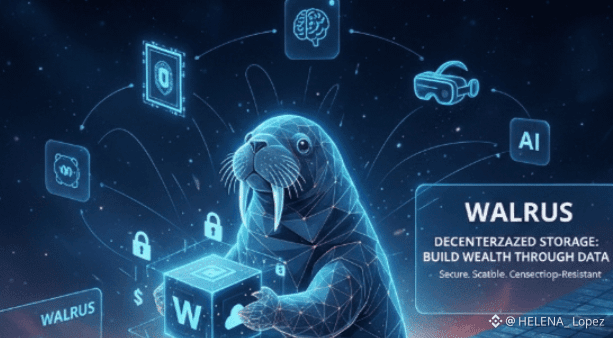
That’s the gap Walrus is trying to fix.
Walrus isn’t another blockchain chasing speed or hype. It’s built around a much quieter problem: how do you store large amounts of data in a way that’s reliable, verifiable, and doesn’t depend on one company staying online forever?
The idea is simple but powerful. Instead of pretending storage is free or hiding the cost behind complexity, Walrus makes it explicit. You pay upfront to store data for a defined period, and that payment is gradually distributed to the operators and stakers who keep that data available. The economics are visible, predictable, and designed for the long term.
That matters more than people realize.
As onchain apps evolve, they’re no longer just saving tiny bits of metadata. They’re storing models, media, game assets, AI data, and entire front-ends. The moment you scale beyond toy applications, storage stops being optional. It becomes infrastructure.
Walrus went live in March 2025, and the timing makes sense. We’re entering a phase where AI agents are starting to operate onchain, and those agents need data they can access, verify, and trust without routing everything through centralized cloud providers. Seeing projects like Talus use Walrus for agent data is one of those quiet signals that tells you something bigger is forming underneath.
What stands out most is how Walrus handles redundancy. Instead of copying entire files endlessly (which gets expensive fast), it breaks data into pieces, adds intelligent redundancy, and distributes it across the network. You don’t need every piece online at once — just enough to reconstruct the whole file. That’s how real-world systems stay resilient without becoming bloated.
This design choice changes everything. It means storage can stay affordable, scalable, and dependable at the same time. And when storage becomes predictable, builders stop treating it as an afterthought. They start building applications that assume data will still be there tomorrow.
Another underrated part of the ecosystem is Walrus Sites and wal.app. They quietly solve a huge problem: front-end dependence. In many “decentralized” apps, the smart contract is immutable, but the website isn’t. If the front-end goes down, access disappears. Hosting site assets on decentralized storage flips that model. The interface becomes as durable as the protocol itself.
That’s where $WAL fits in — not as a speculative gimmick, but as the mechanism that keeps the system honest. It powers storage, incentivizes uptime, supports staking, and aligns everyone around keeping data available over time. If the network is useful, the token has a role. If it’s not, no amount of hype can save it.
The bigger picture is simple: Web3 can’t mature without reliable data infrastructure. Fast chains and clever contracts don’t mean much if the information they rely on can vanish overnight.
Walrus feels like one of those projects that isn’t loud, but is necessary. The kind of infrastructure you only notice when it’s missing — and eventually, the kind you can’t build without.
And that’s probably the strongest signal of all.


