

 At a distance, both chains look capable.
They finalize blocks. They execute contracts. They settle value. On paper, either could support finance. That’s usually where comparisons stop throughput, TVL, tooling, developer count.
But financial infrastructure doesn’t fail on paper.
It fails when reality shows up.
Banks, funds, and regulated institutions don’t just need execution. They need explainability. They need privacy that isn’t secrecy, and transparency that isn’t exposure. They need systems that can say why something happened, not just that it did.
This is where Ethereum and Dusk quietly diverge.
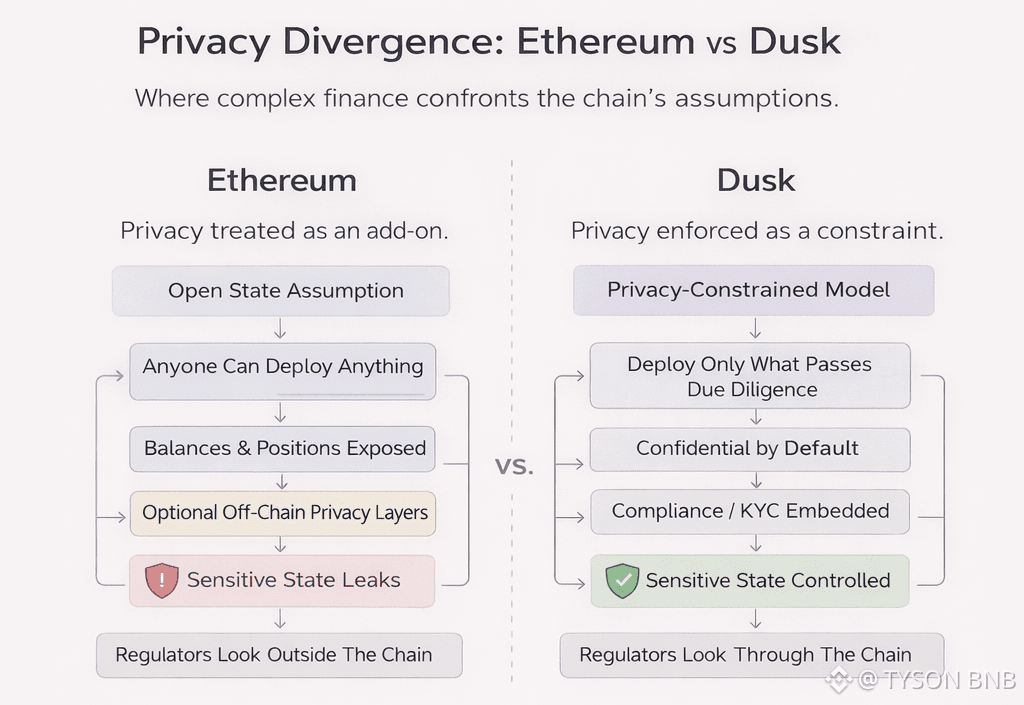
Ethereum was built to be neutral and expressive. Its strength is generality. Anyone can deploy anything, and the chain doesn’t care what it represents. That openness created the richest smart contract ecosystem in the world but it also made privacy someone else’s problem.
Financial logic on Ethereum lives in public view by default. Balances, positions, liquidation thresholds, counterparties everything is observable unless deliberately hidden off-chain or wrapped in complex cryptography layered on later.
And “later” is the key word.
Ethereum treats privacy as an add-on. Zero-knowledge systems exist, but they sit beside the core, not inside it. Compliance, identity, selective disclosure all of it is assembled through external tooling, bridges, or trusted intermediaries.
It works. Until it doesn’t.
Because financial infrastructure doesn’t want optional privacy. It wants structured privacy. Not secrecy, but rules. Who can see what, when, and under which legal conditions. Ethereum can approximate this, but only by recreating financial guardrails outside the chain itself.
Dusk starts from the opposite assumption.
On Dusk, privacy isn’t a feature it’s a constraint. Transactions are designed to be confidential by default, while still provable. Identity is not erased; it’s selectively revealed. Compliance isn’t bolted on; it’s embedded into the execution model itself.
That changes the trust surface.
In financial systems, opacity is dangerous but so is radical transparency. Front-running, balance exposure, strategy leakage these aren’t edge cases. They’re structural risks. Dusk treats these risks as first-order design problems rather than side effects to be mitigated.
Ethereum assumes open state and asks developers to defend against the consequences. Dusk assumes sensitive state and asks systems to justify disclosure.
That philosophical difference shows up under stress.
On Ethereum, regulators look outside the chain for assurance. On Dusk, they can look through the chain seeing what they’re allowed to see, without breaking confidentiality for everyone else.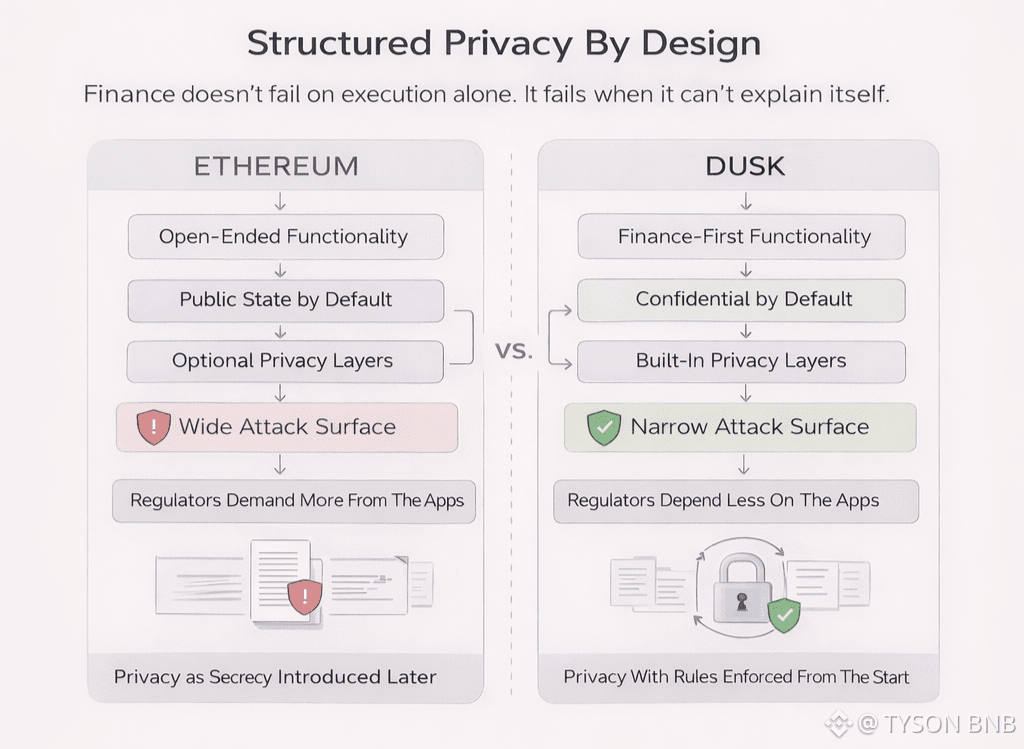
Neither approach is wrong. They’re built for different realities.
Ethereum excels at permissionless experimentation, composability, and speed of innovation. It’s a global sandbox where finance can be invented.
Dusk is quieter.
It’s built for environments where finance already exists and simply refuses to move onto infrastructure that can’t respect its constraints. Where institutions won’t accept systems that either expose everything or hide everything.
The uncomfortable truth is this:
Most financial infrastructure doesn’t fail because it can’t execute. It fails because it can’t explain itself under scrutiny.
Ethereum pushes that burden to applications. Dusk absorbs it into the protocol.
Choosing between them isn’t about which chain is “better.” It’s about whether you believe the future of on-chain finance is radical openness or structured trust.
One invites the world in. The other makes sure the doors can close without locking anyone out.

