
Hello readers, I am the uncle.
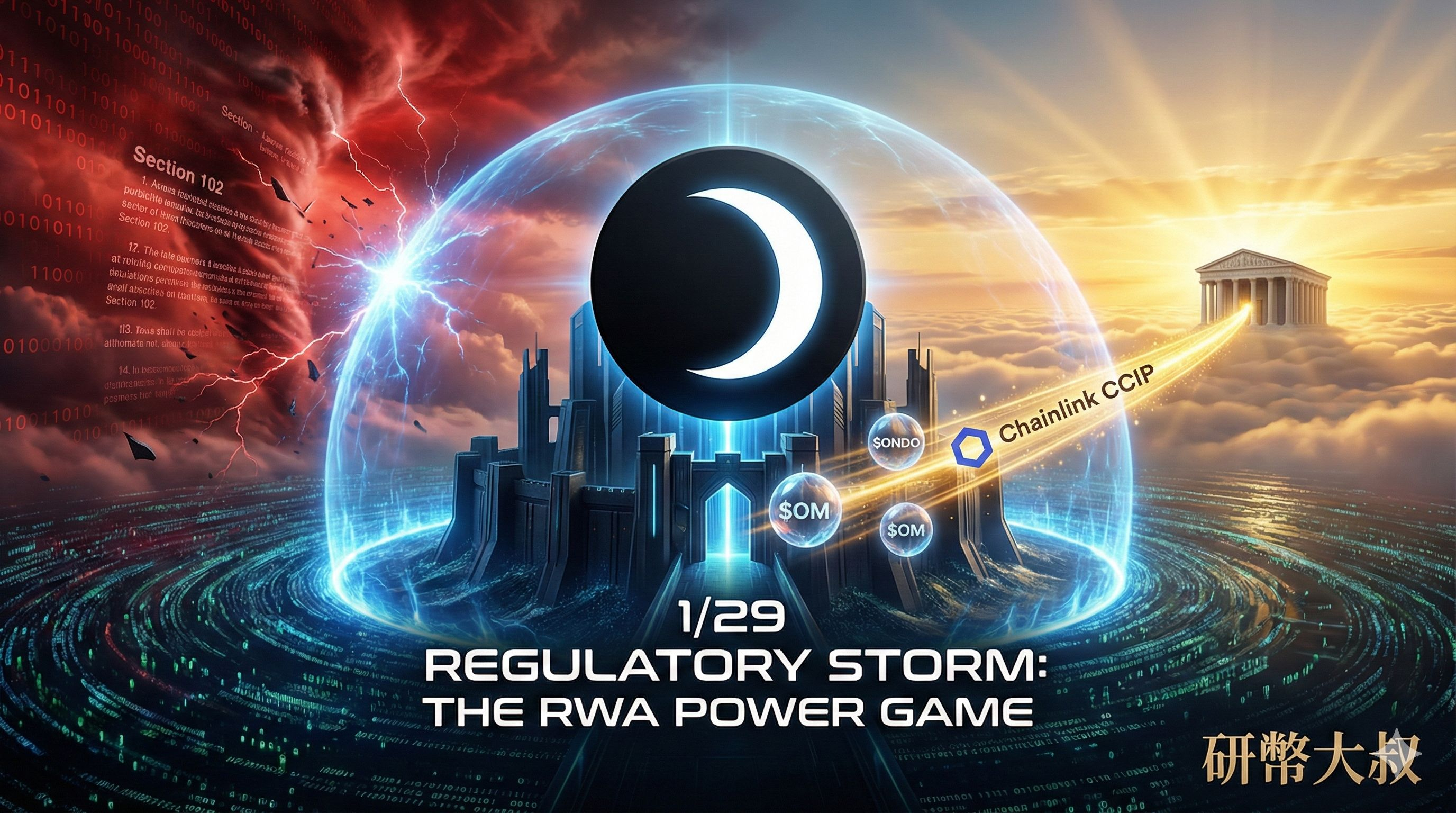
Today is January 29, 2026, and the global crypto market is holding its breath for the vote on the 102nd amendment to the U.S. (Digital Intermediary Act). The power of this bill lies in its redefinition of the interest-sharing mechanism for stablecoins. Once passed, any non-bank institution (such as Circle or PayPal) attempting to attract capital through high yields will face severe hunting under securities law.
This is not just a tightening of regulation, but a 'great migration' of capital. When the profit path of traditional stablecoins is blocked, global risk-averse funds and traditional institutional investors must seek the next compliant and income-generating 'main venue' for their assets.
But before understanding why Uncle praises @undefined , we must first recognize the four key players in this RWA migration race and their respective ecological roles.
1. The four giants of the RWA track: who is responsible for what?
In this game, these players are not all doing the same thing; they are more like different links in the financial supply chain:
* Chainlink ($LINK) —— the 'translator' of cross-chain and data
LINK does not produce assets; it is responsible for 'transportation.' Through CCIP (Cross-Chain Interoperability Protocol), it safely transports data and funds from banks and exchanges to different chains. On January 28, SWIFT announced settlements via CCIP, officially establishing its position as a 'global financial bridge.'
* Ondo Finance ($ONDO) —— the 'asset manufacturer' of the digital world
Ondo is like a digital investment bank responsible for content production. It packages real US Treasuries and money market funds into tokens. Although it recently held the Ondo Summit, showcasing its close relationship with BlackRock and Goldman Sachs, its essence is that of a 'supplier of top-tier assets.'
* Mantra ($OM) —— the 'compliance lord' of the Middle East region
It is currently the most direct L1 competitor to $DUSK. Mantra targets the Middle Eastern and Asian markets and has just completed a 1:4 split, with a very fast marketing pace. It represents regional regulatory sovereignty.
* Pendle ($PENDLE) —— the 'yield amplifier' of the interest rate market
Pendle is responsible for separating the 'principal' and 'interest' of RWA assets. It is the engineer in this game, tasked with enhancing asset liquidity and yield flexibility.
2. Dusk and the ecosystem of these players: allies or competitors?
Many mistakenly think this is a 'fight to the death' competition, but for traditional institutional funds, it resembles a set of gears:
* LINK is responsible for transport, Dusk is responsible for storage:
On January 19, Dusk officially announced a strategic cooperation with LINK. Banks bring assets in through LINK CCIP, but they need a private 'vault' that complies with EU MiCA regulations for storage and settlement. Without LINK's transport, Dusk is an island; without Dusk's privacy technology, the assets transported by LINK have no business secrets on-chain.
* Ondo builds cars, Dusk paves the road:
If Ondo's US Treasury assets are to enter the privacy-sensitive European market, the best choice is to repackage the assets through Dusk's XSC standard. This is the relationship of 'top-tier sports cars' driving on the 'privacy highway.'
3. Technological advantages: why does $DUSK win in underlying logic?
Why does Uncle believe @dusk_foundation has more momentum in the storm of Amendment 102? This is due to its three hard bones on the technical level:
* PLONK zero-knowledge proof:
This is the core engine of Dusk. Compared to general ZKPs, PLONK is more versatile and flexible. It allows institutions to complete large settlements on-chain without the counterparty seeing your cards. In the financial world, privacy is security and a moat against 'shadow trading' affecting prices.
* Citadel (Fortress Protocol) and the MiCA framework:
This ZK-KYC system resolves the contradiction of 'being compliant while ensuring privacy.' It allows established family offices to prove their legal identity to regulators without exposing personal data directly on the public chain.
* Legal-level two-way redemption:
This is the aspect that Uncle values most. Dusk combines the fiat currency status of $EURQ with the physical docking of NPEX, ensuring the path of 'digital to physical.' This means that when you hold the token, you legally own the assets and can request physical delivery at any time.
Uncle's perspective:
Don't be dazzled by tricks like 1:4 splits or high subsidies in the crypto space. This final battle of RWA is about who has the most stable foundation and the most precise regulatory connections. When LINK is responsible for paving the way and Ondo is responsible for building cars, $DUSK, with its legitimate status under the EU MiCA and the privacy armor of PLONK, builds the strongest 'compliance defense stronghold' in this track.


