

 Stablecoins don’t fail because they can’t move.
They fail because settlement happens in the wrong place, at the wrong speed, under the wrong assumptions.
On the surface, Ethereum looks like the obvious answer. It already settles billions in stablecoin volume. USDC, USDT, DAI everything clears there. Blocks finalize, balances update, the system works.
Until you ask what kind of system stablecoins actually need.
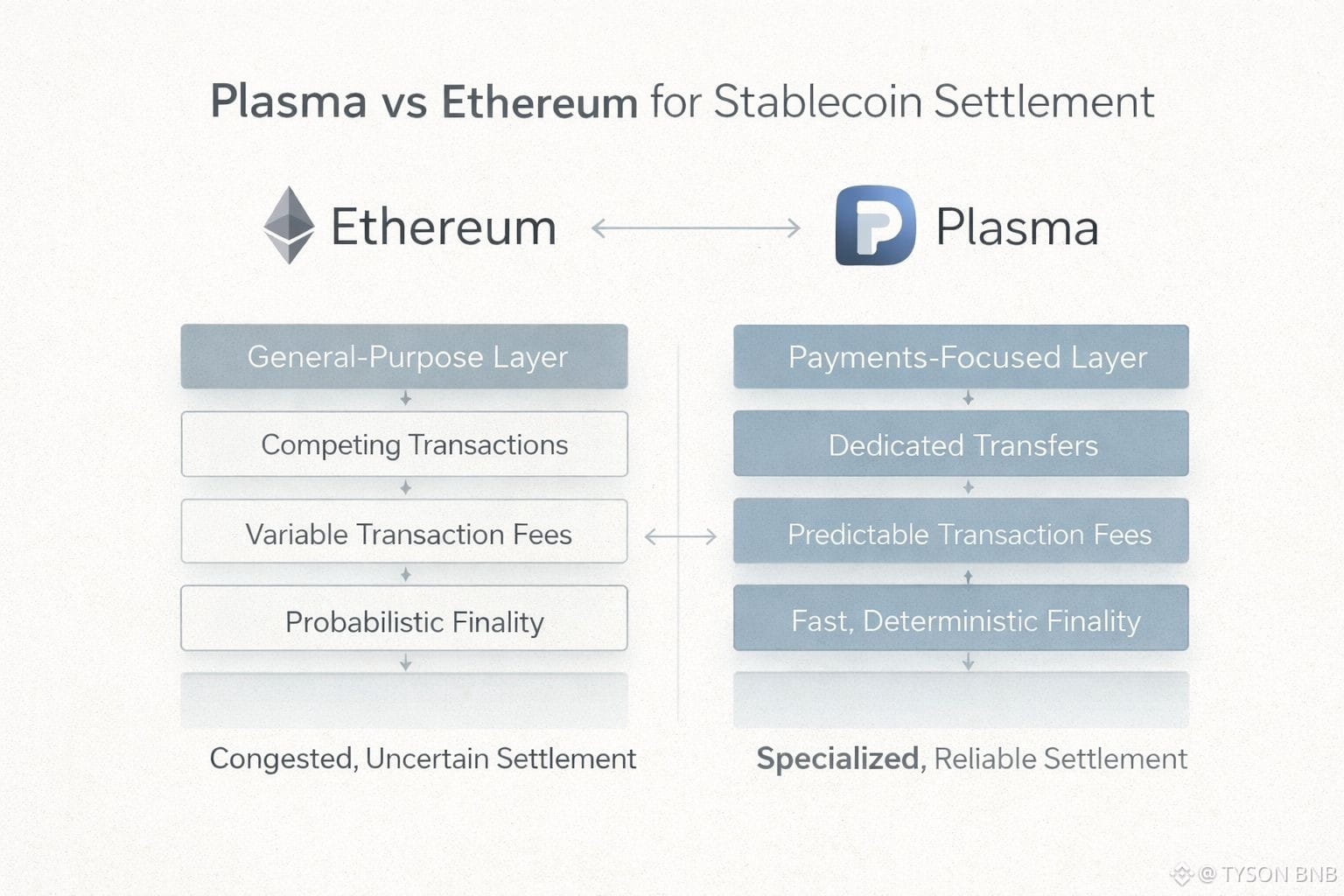
Settlement infrastructure isn’t about expressiveness. It’s about predictability. Latency ceilings. Fee determinism. Finality guarantees that don’t fluctuate with NFT mints or memecoin cycles. And this is where Ethereum and Plasma quietly diverge.
Ethereum treats stablecoins as just another application.
They share blockspace with everything else DEX trades, liquidations, arbitrage bots, experimental contracts. This gives composability, but it also creates competition. Stablecoin transfers don’t get priority because they’re important; they get priority only if they’re willing to pay.
During congestion, fees spike. During volatility, confirmation becomes uncertain. During stress, “money” behaves like any other smart contract call.
For crypto-native users, this is acceptable. For financial infrastructure, it’s a red flag.
Settlement systems are expected to behave boringly. They should be fast when nothing is happening and especially fast when everything is. Ethereum’s architecture doesn’t guarantee that. It offers neutrality, not specialization.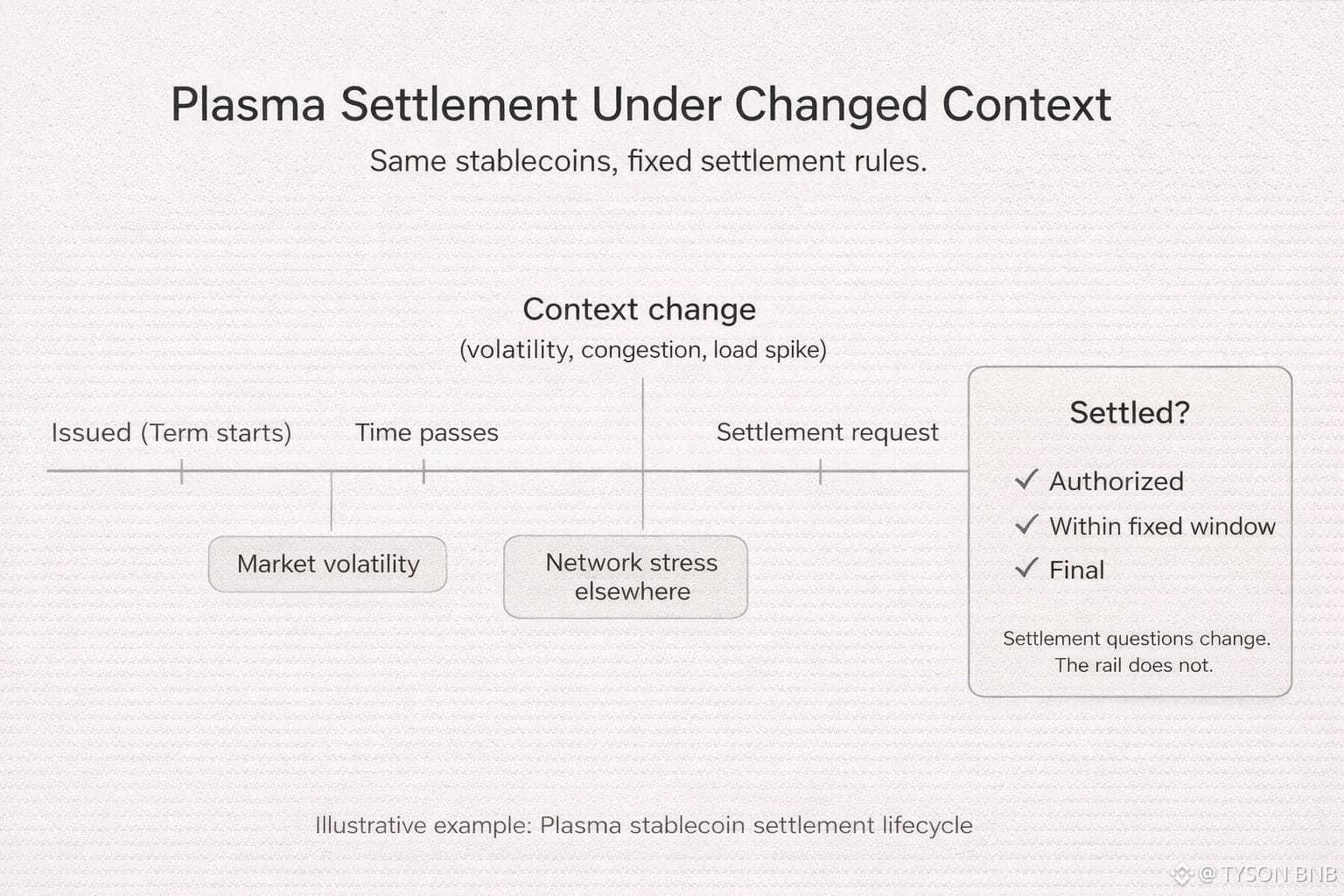
Plasma starts from the opposite assumption.
Instead of being a general-purpose execution layer, Plasma is designed around one dominant workload: stablecoin settlement at scale. Transfers aren’t competing with unrelated computation. Blockspace isn’t auctioned away to the highest bidder during chaos. The system is optimized for throughput, low variance, and consistent finality.
This changes how risk shows up.
On Ethereum, stablecoin risk is externalized. If the network is congested, applications must route around it using batching, off-chain accounting, or alternative rails. The chain doesn’t promise settlement conditions; it exposes them.
Plasma internalizes that responsibility.
Settlement isn’t treated as an application choice; it’s treated as core infrastructure. Fees are predictable. Confirmation windows are designed for payment flows, not DeFi arbitrage. The architecture assumes that transfers must continue cleanly even when markets are stressed.
Another key difference lies in finality semantics.
Ethereum finality is probabilistic and layered. Transactions are “safe enough” after a few blocks, but absolute certainty takes time. For most crypto use cases, that’s fine. For financial settlement, ambiguity is costly. Institutions don’t want “likely final.” They want done.
Plasma tightens this loop by reducing complexity around execution. Less expressive power means fewer edge cases. Fewer edge cases mean faster confidence in settlement. This isn’t a weakness it’s a trade-off made deliberately.
Ethereum maximizes what you can build. Plasma minimizes what can go wrong.
There’s also a difference in operational visibility.
On Ethereum, monitoring settlement health requires interpreting network-wide signals: gas prices, mempool pressure, MEV activity. Stablecoin operators are passengers on a shared highway.
On Plasma, the highway exists for them.
This doesn’t mean Ethereum is “bad” for stablecoins. It means it was never designed for them. It excels as a global execution layer. Plasma positions itself as a financial rail closer to payments infrastructure than application runtime.
The uncomfortable truth is this:
As stablecoins move from crypto-native usage into payroll, remittances, and institutional settlement, general-purpose chains start to show architectural strain. Not because they’re slow but because they refuse to specialize.
Ethereum asks stablecoins to adapt to its world. Plasma adapts itself around stablecoins.
Choosing between them isn’t about ideology. It’s about intent.
If stablecoins are just another smart contract, Ethereum is enough. If stablecoins are becoming monetary infrastructure, specialization stops being optional.
Settlement doesn’t need creativity. It needs reliability that doesn’t blink when everything else does.
That’s the architectural line Plasma is drawing and the one Ethereum was never built to cross.