
Recently, an AI tool called @Clawdbot has been making waves. Many people's first reaction is probably: 'Another toy for programmers.'
As a new media person, I see a deeper issue: a skill we have taken for granted is depreciating, while another undervalued skill is becoming extremely scarce.
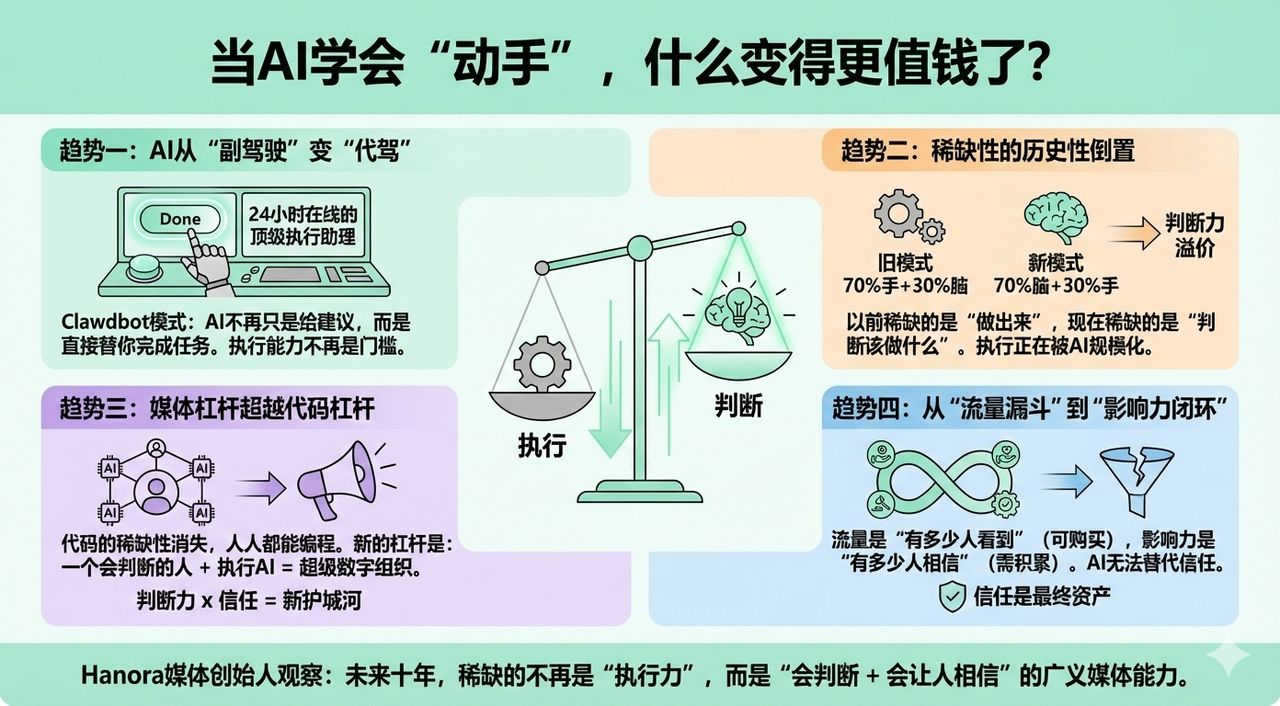
1. When AI really starts to 'take action'
Most people's impression of AI is: you ask → it answers; you want to do something → it teaches you how to do it. But Clawdbot is different: it not only guides you on how to operate → but directly completes tasks for you. For example:
Ordinary AI (Copilot mode):
Me: Help me analyze how this article performed.
AI: The views are good, but the conversion rate is low. I suggest optimizing the title.
Clawdbot (Agent mode):
Me: Categorize all articles from last week by performance, placing the high-conversion ones in the 'selected' folder.
AI: (Ten minutes later) Completed.
It can press buttons, fill out forms, send messages, modify code, organize files, run scripts... These trivial tasks that used to require 'human' effort are now fully taken over. Moreover, it is directly integrated into your daily used Telegram, Discord, Slack, like a top-tier executive assistant available 24/7.
When these types of AI tools become popular, what I see is not just an increase in efficiency.
A deeper change is: execution capability is no longer a barrier.
2. The shift of scarcity: from 'being able to do things' to 'being able to judge.'
When execution becomes no longer scarce, what becomes scarce?
In the past, to do a good job at something, the golden ratio was:
30% brain (thinking clearly about what to do)
70% hands (making it happen).
This ratio is now reversing:
70% brain (judging what to do)
30% hands (supervising whether AI is doing it right)
GitHub Copilot 2026's
Data shows that AI has now generated close to 46% of active users' code, and developers using this tool complete tasks about 55.8% faster. Meanwhile, Cursor's valuation has soared to $29 billion, dubbed the 'fastest-growing company in SaaS history.' Two things point to the same result: execution is being scaled by AI.
When everyone can execute efficiently, the focus of competition is naturally no longer 'who can do it better,' but the judgment itself—who knows better what to do, when to do it, and whether it is worth doing.
This also explains a seemingly contradictory paradox:
Why, while AI is becoming increasingly capable of 'doing work,' are AI companies in Silicon Valley starting to heavily recruit 'Storytellers'? Because in a world where 'everyone can execute,' the true leverage becomes: can you make others believe your judgment and act with you? This requires accurate judgment, clear communication, and the ability to accumulate trust—and the common carrier of these capabilities is broadly defined as 'media capability.'
When content is extremely overabundant, some distribution costs approach zero. Being seen may no longer be valuable.
What is truly valuable is:
You say "this is worth paying attention to" → someone really goes to study it.
You say "this direction has opportunities" → someone really works with you.
Your judgment → can be transformed into others' actions.
Traffic is 'how many people see it,' while influence is 'how many people believe it.'
The former can be bought with money or optimized with algorithms, while the latter can only be built through time accumulation and judgment accuracy. And this is precisely the part that AI finds most difficult to replace.
3. Code leverage vs. media leverage.
Naval once said: Code and media are the levers behind the new wealthy class.
The past decade belonged to code. The new elites of Silicon Valley and large companies relied on 'code leverage' to create wealth by writing code once → serving millions of users → scaling profit.
But it seems we are witnessing a shift. With the evolution of AI, the scarcity of code is disappearing. AI can write code and execute tasks, and everyone can engage in Vibe Coding. As technical implementation is no longer a barrier, the value of media leverage is beginning to rise sharply.
Because AI cannot generate certain things: value judgments cannot be automated, trust cannot be generated by algorithms, and influence cannot be quickly replicated.
More importantly, these two levers are starting to combine. When AI takes over execution, individual judgment can be directly translated into scaled actions.
A person who can make judgments + an AI that can execute = an independently functioning 'digital organization.'
This is not replacement but addition:
Past Present
Needs a team to get things done requires judgment + AI assistance.
Needs institutional endorsement for credibility requires continuous proof of accurate judgment.
Needs a large budget to gain exposure requires genuine influence to drive action.
Scarcity has shifted from resources to capabilities; from execution to judgment; from traffic to trust.
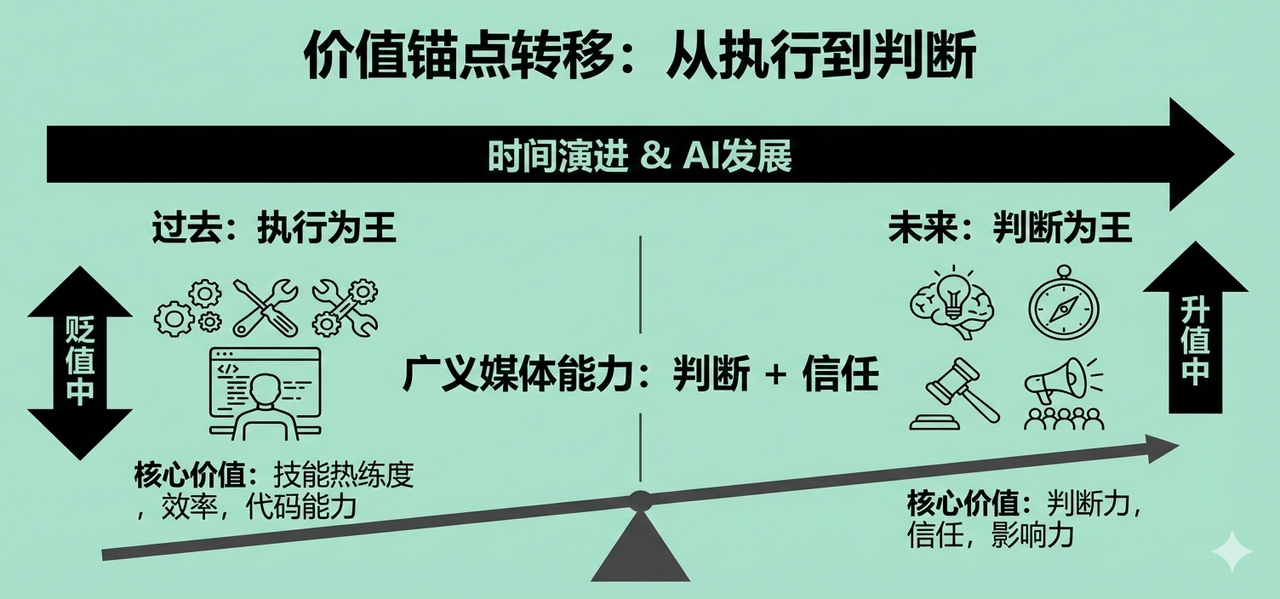
The barriers are lowering, but the winner takes all is strengthening. Goldman Sachs predicts that the creator economy will grow from $250 billion in 2024 to $480 billion in 2027. But data also shows that only 4% of creators achieve professional-level income (annual income over $100,000), while 46% of creators earn less than $1,000 annually—this is the Matthew effect of judgment and influence. AI has lowered the execution threshold, but also made the gap in judgment more apparent.
4. New ways of media: an operational reflection from a founder.
From 'output quantity' to 'judgment quality.'
AI increases content output by three times, but the impact of each piece decreases. The real competition is not about who produces more, but who can determine which three pieces are worth doing.
As McKinsey's latest research shows, current technology can theoretically automate 57% of working hours in the U.S., but this does not mean jobs will disappear—instead, humans will spend more time on skills that machines lack: judgment, relationship building, critical thinking, and empathy. For media, what is saved is not time, but attention. The future's focus is not on 'doing it faster,' but on 'judging what is worth doing.'
From 'content distribution' to 'trust accumulation.'
In the past, building a 'brand' relied on budget, exposure, and institutional endorsement. Now building 'trustworthy nodes' relies on the continuous accuracy of judgment.
This is also the reason we are doing H News prediction markets. Based on media content from prediction market data, each judgment can be quantified, verified, and recorded. When saying 'a certain trend will occur,' the market will use real money to tell the audience right or wrong. This is not a traffic game; it's a contest of judgment. When judgments can be continuously tracked, trust becomes an accumulable asset.
From 'traffic funnel' to 'influence loop.'
In the past, media content followed the 'traffic funnel': exposure → clicks → reading → conversion. Continuously generating new content to attract new traffic, and readers left after reading.
In the AI era, more attention should be paid to the 'influence loop': output judgments → accept verification → public review → optimize judgments. Every judgment is recorded, tested, and verified. If correct, trust increases; if wrong, public review. Readers are not 'traffic' that leaves after reading, but 'verifiers' who continuously observe.
What matters is not a one-time correctness or incorrectness, but the process of being continuously verified and accumulating trust.
From 'chasing hot topics' to 'providing judgments.'
In the past, media competed on 'speed'; whoever broke the news first won when hot topics emerged. Now AI is faster than everyone. The real opportunity lies in 'depth': not just superficially telling readers 'what happened,' but 'what it means' or 'what will happen next.' The former requires seeing through the surface to find the real problem, while the latter requires making verifiable predictions.
This kind of 'depth' is not about the length of the article, but about clear, bold, and verifiable judgments. What readers need is not more information, but 'judgers' who help them filter information and make judgments.
Conclusion
The emergence of Clawdbot makes the trend of AI moving from 'helping you think' to 'doing for you' irreversible.
When AI learns to take action, human value may return to the most essential thing: judging what is worth doing. And the core competitiveness of media has also shifted from 'production capability' to 'judgment capability.'
In the past decade, scarcity was 'being able to execute.'
In the next decade, scarcity will be 'being able to judge + being able to make people believe.'
As a founder, I have been thinking not about 'will AI replace us,' but about 'after trivial matters are taken over, can we create value at a higher level?'
When AI helps you organize data, categorize materials, and track trends—what do you spend the remaining time doing? Is it to continue filling it with trivial tasks, or to genuinely think: what content is worth doing? What direction is worth investing in?
The answer to the question determines its value. And this value increasingly depends on your judgment and influence, which is broadly defined as 'media capability.'
Returning to the essence, the work of media professionals has always been 'understanding the world and conveying value.' What AI takes over is merely the execution part of 'conveying,' while 'understanding' and 'judging what is worth conveying' remain core competencies, and may become more valuable.
This may be the real test of this round of the AI boom.
-
Keep Shipping🛳️