

History as a platform for foresight.. Foresight of the Iranian scene through the mirror of 'Desert Storm' (Iraq 1990–1991)
The Middle East is at a sharp strategic turning point at the beginning of 2026, as the pace of military escalation between Washington and Tehran recalls the warnings of the second Gulf War (1990-1991).
Although history does not repeat its events in a carbon-copy manner, the American 'pattern' in managing major crises shows structural similarities, making it imperative for us to study the Iraq experience to understand the dynamics of the current confrontation, especially after the erosion of deterrence equations following the strikes of June 2025.
Tehran follows a more complex pattern based on "active silence"; the lack of a direct military response to massive movements does not necessarily reflect weakness, but rather is a smart management of the "conflict ceiling".
Military mobilization: from show of force to maximum pressure
Model 1990: The mobilization of aircraft carriers and hundreds of thousands of soldiers in Operation "Desert Storm" was not just a technical preparation; it was a coded political message to convince the Iraqi leadership of the seriousness of the military option.
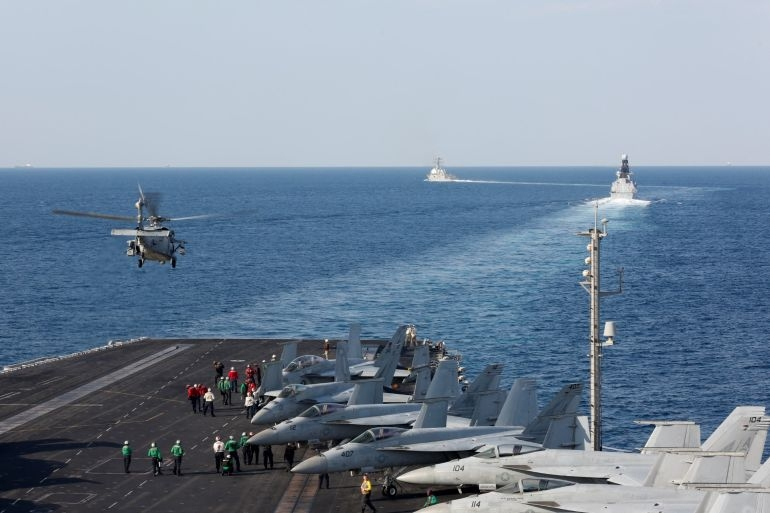
Reality 2026: The return of American fleets, led by the aircraft carriers "Abraham Lincoln" and "George Washington", reflects a revival of the same doctrine, but the difference today is "technological mobilization"; it is not limited to iron blocks, but includes cyber warfare systems and artificial intelligence, which aim to paralyze Iranian command and control capabilities before the onset of kinetic operations.
Conclusion: Mobilization is not an inevitable "harbinger of war", but rather a rough negotiation tool aimed at forcing the opponent to reconsider their calculations under the burden of "strategic ambiguity".
The strategy of "surgical strikes" and deterrence testing
The Iraqi experience: The comprehensive war was preceded by reconnaissance operations, and limited strikes to test the Iraqi air defense systems.
The Iranian scene: The strikes of June 2025, which targeted the "Fordow" and "Natanz" facilities, represent a fundamental turning point. These operations were not aimed at igniting a comprehensive war, but were "surgical strikes" to test the ceiling of the Iranian response and measure the effectiveness of bunker-busting bombs.
Analysis: Limited strikes are a "real laboratory" for the decision of war; they either lead to deterring the opponent and retreating, or reveal gaps that entice the attacking party to expand the scope of the conflict.
Strategic patience and managing the edge of the abyss
Iraq 1990: Saddam Hussein faced the mobilization with a kind of strategic inertia, betting on exhausting the opponent on land, which proved to be a failure in the face of qualitative air superiority.
Iran 2026: Tehran follows a more complex pattern based on "active silence"; the lack of a direct military response to massive movements does not necessarily reflect weakness, but rather is a smart management of the "conflict ceiling", as Iran bets on the erosion of American international consensus over time.
The time dilemma: a double-edged sword
In 1990, time worked in Washington's favor to build international legitimacy (the coalition of 34 countries). However, in 2026, the factor of time represents pressure on the global economy; the continuation of military mobilization in waterways raises insurance and oil costs, making "long waiting" an expensive option that could push Washington either for a quick settlement or a swift strike to end the state of certainty.
The similarity of current movements to the early signs of 1990 suggests that we are facing an imminent end of the Iranian regime, but the new power balances and Iran's experience in crisis management make the outcomes open to possibilities not seen in the region before.
Fundamental differences: Beyond historical comparison
Caution should be exercised in literally applying the Iraqi experience to the Iranian case for two reasons:
Nature of power: Iran's possession of "asymmetrical deterrence" (suicide drones, hypersonic missiles, and active regional cells) makes the cost of a comprehensive war not confined to its national geography.
Strategic depth: Iraq was internationally isolated and besieged, while Iran today operates within a network of (Eurasian) alliances that provide it with wider political and economic maneuvering margins.
Forward-looking indicators for the near future
Based on this historical intersection, the following paths can be observed:
Scenario of "repeated strikes": The most likely scenario is the repetition of the model of June 2025 (targeted and violent strikes) as an alternative to comprehensive war, to trim the nails of the nuclear program without slipping into a ground invasion.
Deterrence through markets: The rise in gold prices and sharp fluctuations in financial markets reflect a global recognition that the old rules of engagement have ended, and that any miscalculation could lead to a collapse in supply chains.
The "suspended" military option: The current American mobilization buys the "option of war" more than it implements it, and the goal is to reach a "deal under fire" that reshapes the influence of the region.
The most dangerous stages of the conflict are not in the moment of explosion, but in the "waiting period" we are experiencing now in January 2026.
The similarity of current movements to the early signs of 1990 suggests that we are facing an imminent end of the Iranian regime, but the new power balances and Iran's experience in crisis management make the outcomes open to possibilities not seen in the region's history before.
 #iran
#iran 