
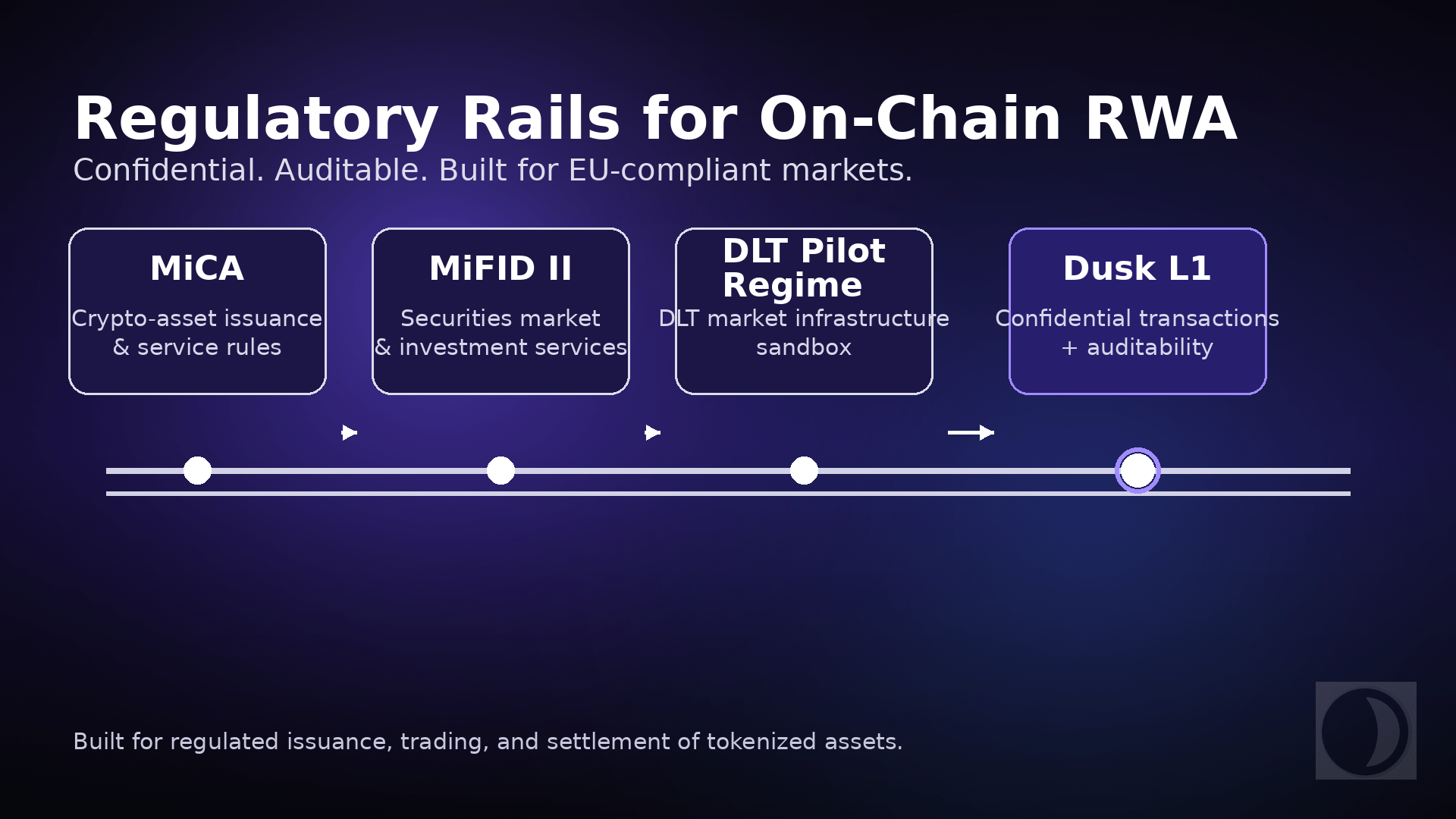
If you still consider Dusk as that kind of 'anonymous coin relative that can't go to major exchanges', Azu believes you have probably missed a narrative upgrade. The project team has stated very clearly on their official website—Dusk is a public L1 designed for regulated financial markets, aiming to allow institutional-grade assets to be natively issued, traded, and settled on the chain, while meeting the requirements of the entire regulatory framework including EU MiCA, MiFID II, and DLT Pilot Regime.
In other words, what it wants to solve is fundamentally not how to create a more concealed coin, but rather: how to move substantial real assets onto the chain without breaking the regulatory red lines, and ensure they can operate.
Many people, when they first hear about Dusk, instinctively classify it as a "privacy project": zero-knowledge, confidential transactions, privacy smart contracts... It sounds no different from a bunch of delisted privacy coins. But if you flip through the white paper and the latest architecture documentation, you'll find that it has clearly positioned itself as "regulated financial markets" from day one. It is not the kind that pretends to be a "decentralized rebellion" first, and then reconciles with regulators once the market cap grows; instead, it treats compliance as a system requirement written directly into the protocol layer from the start.
Let's first talk about where the "problem space" is. The issue with traditional public chains is very simple:
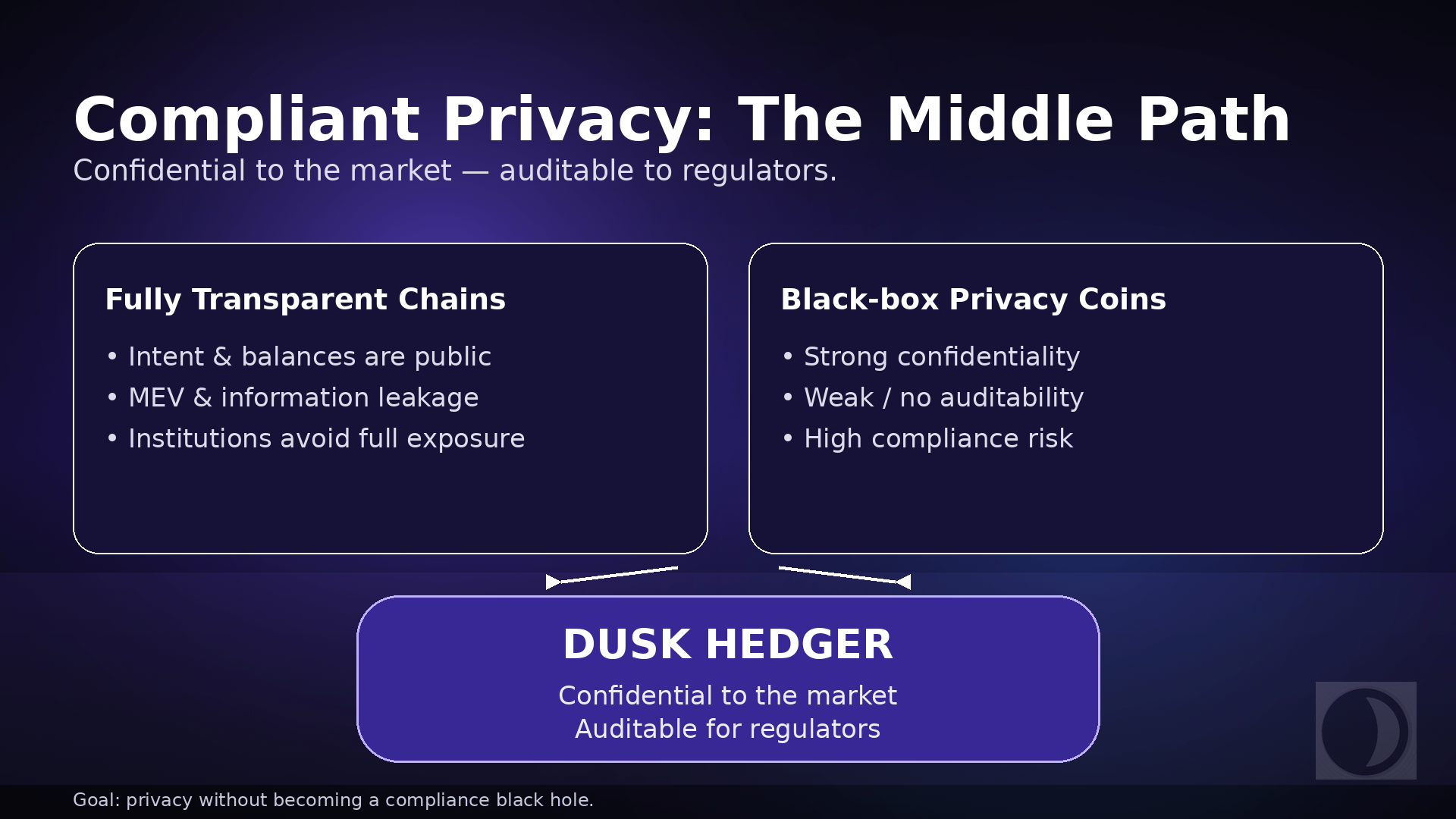
Either it is too transparent, with all addresses, balances, and orders laid bare; retail investors find it pleasing, but institutions would be alarmed—how could an institution that operates well under MiFID II and GDPR expose all its trading intentions on-chain for competitors to study? That’s unrealistic; or privacy becomes an afterthought, with a bunch of sidechains, Rollups, and mixing tools piled up at the application layer, resulting in compliance, auditing, and self-justification needs all becoming "outsourced projects," with no one willing to take the blame.
Conversely, looking at the "privacy coin" side, the problem is exactly the opposite: privacy has been achieved, but regulators have directly listed you as high-risk—many exchanges delist them, banks are unwilling to directly connect, and institutions dare not touch them. Privacy becomes a "regulatory black box"; from the retail perspective, it’s a pleasant read, but from the institutional perspective, it’s a compliance landmine.
What Dusk aims to do is actually to navigate the very narrow path between these two extremes: maintaining sufficient privacy from the market while retaining necessary auditing capabilities for regulation. In the official documentation, you can see several key designs stated very plainly.
First, using zero-knowledge technology to provide confidentiality for transactions and contracts;
Second, directly integrating the compliance logic required by regulations like MiCA, MiFID II, and DLT Pilot Regime on-chain, writing into the rules "who can hold, how to distribute, how to report";
Third, using its own consensus (Succinct Attestation PoS) to ensure the finality and efficiency of the settlement layer.
Here, let's briefly explain the regulatory environment of the EU. MiCA addresses the "general rules" for crypto asset issuance and service providers; MiFID II is essentially the old framework for securities and investment services; while the DLT Pilot Regime has specifically opened a "sandbox window," allowing a few licensed institutions to trial run securities market infrastructure on the chain in a controlled environment. For most public chains, these terms are merely background in articles or decorative on roadshow PPTs; however, in Dusk's updated white paper, these regulatory texts directly become system constraints—it must prove that it can "survive" within this framework rather than circumvent it.
Why do I say Dusk is the "dedicated underlying layer for EU compliant RWA"? You can see that from its partners. In 2024, Dusk signed a formal commercial agreement with the regulated Dutch exchange NPEX to jointly establish the first blockchain-driven securities exchange in Europe, issuing, trading, and custodizing regulated financial instruments natively on-chain. NPEX itself holds a complete set of licenses, including MTF, Broker, ECSP, so this is not a story of a "DeFi small team hanging a sign," but a deep binding between a traditional financial veteran exchange and a Layer 1.
More critically, this is not just staying at the paper stage of "exploring cooperation." According to multiple public reports and research from trading platforms, this line is already progressing towards tokenized securities and funds in the scale of €200M–300M, meaning that what Dusk is undertaking is not just a few million dollars of experimentation, but real securities stock. Combined with NPEX's own management scale exceeding €300M, you can roughly sense the level of magnitude this chain aims to move.
Many people will say, everyone dares to talk about RWA narratives in the past two years, but how many of them can actually feed you? I actually find that Dusk's style is quite "anti-Web3"—if you look at the text on its official website, it doesn’t hype the "DeFi revolution," but instead speaks directly to institutions, enterprises, and regulated markets from the very beginning. The homepage directly states "Built for institutions, users, and businesses," with a focus on "compliant privacy finance," rather than "the next generation of permissionless casinos."
Interestingly, Dusk is not a small project secretly operating outside the regulatory game in Europe and the US. Its main body is located in Amsterdam and is officially listed on the EU's digital finance platform map, clearly stating "Crypto and DeFi / Banking / Financial Management Solutions." This proactive stance in entering the market itself is a signal: the project team never intended to hide in some offshore jurisdiction relying on "gray area business" to survive, but rather bets on something longer-term—when regulated assets truly need to go on-chain, who will everyone trust more?
At this point, you might have a question: since it is so institution-oriented, what sense of participation do ordinary users, retail investors, and Web3 veterans have? To be honest, I initially had this concern until I thoroughly scanned the technical architecture documentation. Dusk's latest multi-layer white paper breaks the entire network down into several layers: the bottom layer is DuskDS, responsible for data and settlement; the middle is DuskEVM, which is EVM equivalent; and there will be a more privacy-focused DuskVM in the future; only above that is the layer directed at developers and applications.
This layered approach has two practical implications.
First, for developers, the threshold has been lowered. You can directly write smart contracts on DuskEVM using Solidity without having to learn a set of quirky languages or manually create zero-knowledge circuits. Privacy and compliance are provided at the base layer; you only need to "reference" these capabilities in your contract logic.
Second, for users, the experience feels more like a "regulated version of DeFi": you can still see assets, yields, and strategies, but in certain scenarios, the chain displays a state that has been processed for privacy protection externally, while retaining an auditing entry for qualified regulatory parties. This "layered visibility" is the real prerequisite for RWA to run—otherwise, either the transactions are completely transparent and institutions dare not enter, or it’s entirely a black box, with regulators directly hitting the pause button.
Many people ask me: "In 2026, L1 has become like this, why do we still need a new L1?" If you rephrase the question, the answer becomes very clear—we do not need a chain that is "just a bit higher in TPS and cheaper in gas"; rather, we need a chain that assumes from the very beginning that it must live within the regulatory view.
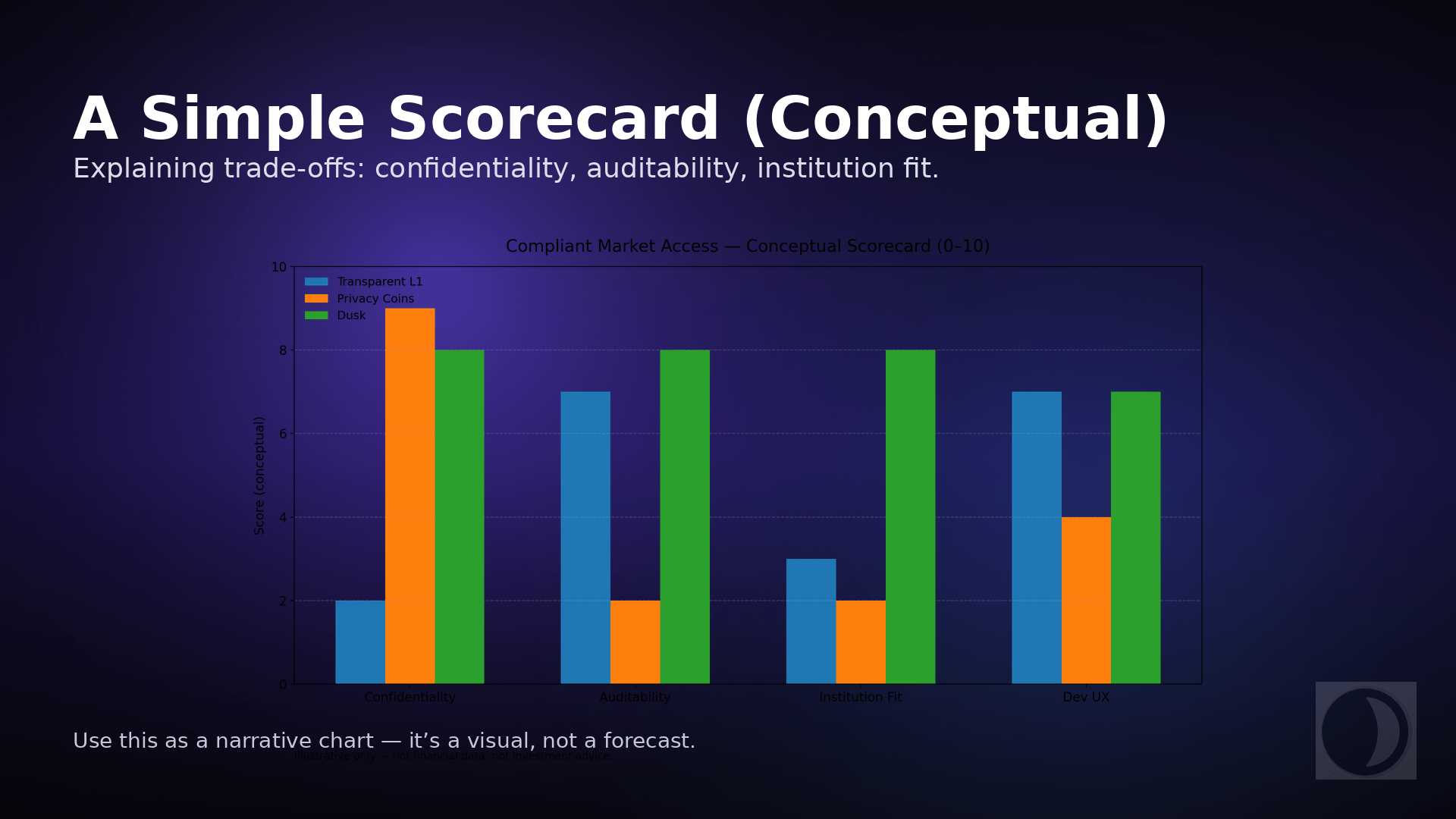
Traditional public chains are designed under the assumption of a "non-regulatory ideal world"; trying to add KYC, risk control, and auditing on top of that feels like patching; Dusk works backward from the "regulatory real world," starting from a series of EU regulations and licensing structures, and restricts itself in terms of what it can and cannot do, while incorporating privacy and zero-knowledge technologies.
Of course, no matter how beautifully it is put, it cannot escape a soul-searching question: will anyone actually use this system? From the currently disclosed information, the most promising lines to run are roughly as follows:
One is the "on-chain securities market" bound to NPEX, gradually moving from small and medium-sized enterprise equity to fund shares on Dusk's settlement layer;
One is a compliant stablecoin in cooperation with payment institutions like Quantoz (such as electronic currency tokens like EURQ), allowing regulated funds to settle efficiently on-chain rather than circling around off-chain;
Next, it's about building a "compliant version of DeFi" around these underlying assets—market-making, leverage, structured products, yield certificates, all need to find a balance between privacy and auditing.
For ordinary users, I think the most realistic point is: it is very difficult to understand the value of Dusk through a bunch of violently high-yield pools anymore. The value capture of this chain is more like, "how many regulated assets are willing to gamble their infrastructure on this for the next decade." It is a typical "slow-burn underlying facility"—there may not be a shortage of good short-term stories, but what truly determines its upper limit is looking back three to five years later, how many real assets and institutions have actually settled on-chain.
Writing to this point, my personal conclusion is actually very clear: if you see someone in your social circle still referring to @Dusk as "another privacy coin," you can totally share this article, letting them update their understanding. What Dusk is doing is not simply hiding transactions but attempting to solve the seemingly unsolvable equation of "auditable privacy + legitimate RWA" within the EU regulatory framework.
As for the price, volatility, and market of $DUSK , that's another topic. Here, I just want to emphasize one statement: I am willing to spend time repeatedly studying and writing #Dusk , not because it has risen significantly in the short term, but because it has chosen a direction that most projects dare not choose or cannot move forward—facing regulation head-on, encoding rules into the chain itself through engineering and cryptography. This matter, even if the final result is unknown, is worth keeping a close eye on.