


The Dusk settlement state is already final.
That's not the debate. Funds moved. Eligibility resolved at execution. Nothing is pending on-chain. If you were only looking at Dusk finality... the book is closed and the cutoff already passed.
The room doesn't move.
A release controller still needs one sentence before they can ship. Not philosophy. Not reassurance. A classification that survives audit pressure... safe to release under the Dusk's disclosure scope we committed to. That sentence isn't written yet.
Not because the chain is unclear.
Because the reason it cleared lives inside Dusk's transaction settlement model Moonlight's credential-scoped view, behind an entitlement boundary nobody approved for circulation. The proof exists. The permission to repeat it does not.
On Dusk, the privacy layer-1 built for regulated finance, evidence and authority don't arrive together. You can know that something was allowed long before anyone agrees on who gets to say why. That gap didn't matter yesterday. It didn't have a clock.
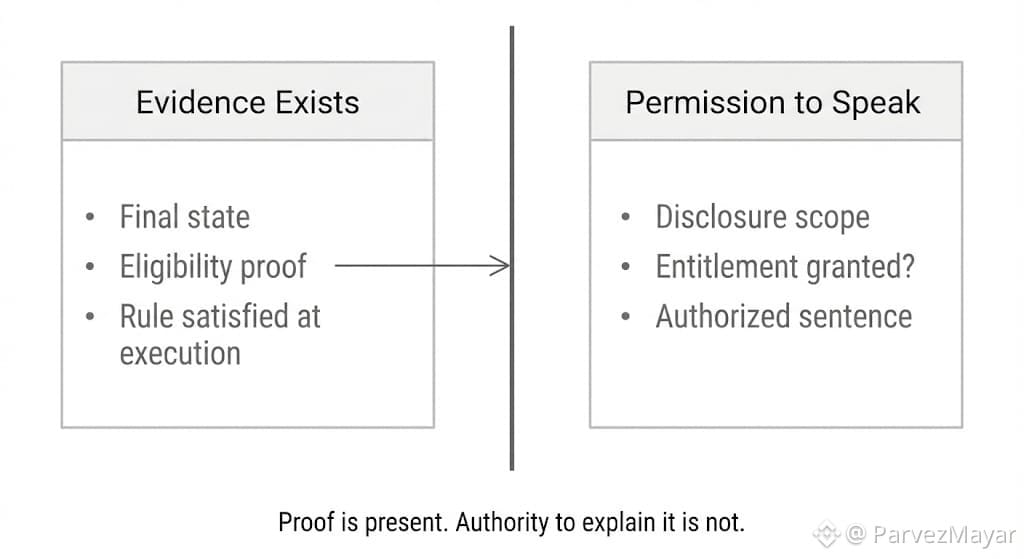
Now it does.
No one wants to widen scope with a cutoff ticking. Expanding disclosure here doesn't just close this release. It becomes precedent. The next dispute will point at it and ask why this time was special. Someone has to own that signature.
No one does.
So the release waits.
From the outside it looks like hesitation after success. From the inside it feels like restraint. Shipping without classification turns a finished state into exposure. Holding is expensive, but shipping words you aren't entitled to use is worse.
Nothing is broken.
That's the trap.
There's no incident to escalate. No rollback to justify urgency. Just a finalized Dusk state sitting there, correct and irreversible, while the organization realizes it never decided who was allowed to explain it out loud.
Ten minutes to cutoff stretches when the chain has already moved.
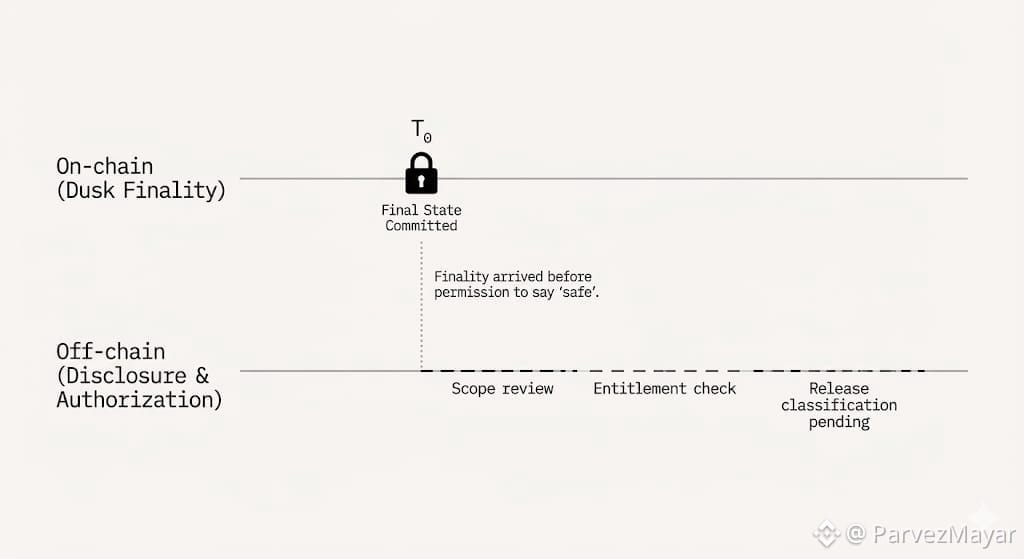
This is where behavior changes without anyone writing it down. Teams stop learning by documentation and start learning by avoidance. The next cycle shifts. Transfers that require post-execution classification quietly stop running near close. Release paths that depend on discretionary disclosure get pulled earlier, when pausing does not rewrite authority. Amounts shrink. Windows widen. The workflow bends upstream.
Not because Dusk slowed.
Because nobody wants to stand in front of an irreversible state without permission to speak about it.
Over time, that becomes muscle memory. Decisions migrate earlier. Gates appear before execution instead of after. The system stays correct, but the organization grows more conservative about when it allows correctness to arrive.
Dusk didn't force this.
@Dusk allowed it.
Finality stayed fast. Dusk's Confidentiality held. What changed was everything wrapped around them. Release control learned the real bottleneck isn't cryptography. It is language. And who is entitled to use it.
The chain won't wait for you to decide who can say "safe'.
So eventually, you decide sooner.
And the system gets quieter... not because less happens, but because fewer people are willing to be caught needing words after irreversibility already arrived.