
1. Sudden market change: The signal significance of Bitcoin falling below $86,000
At the beginning of this analysis, the Bitcoin price had already fallen below $86,000. Initially, there was still some uncertainty about whether it would further dip to $80,000, so I deliberately kept the question when creating related content. However, the market experienced a significant flash crash within just a few minutes, directly confirming the previous judgment direction. This rapid decline has basically covered and realized the core conclusion of this analysis.
From the market performance, this is not an ordinary correction, but an accelerated decline where both sentiment and structure are changing simultaneously.
2. Daily structure confirms a bearish trend: The trend has changed.
From a technical structure perspective, a very strong bearish candle was formed yesterday, completely engulfing the rebound space of the previous three days. This is very critical. We have repeatedly emphasized that to judge whether the daily level has turned bearish, the core lies in two conditions: first, failing to create a higher high, and second, the appearance of a lower low.
Currently, both of these conditions have been fully met, and the price has broken below the important structural high point on the left side, which technically confirms that the Bitcoin daily level trend has officially turned bearish.
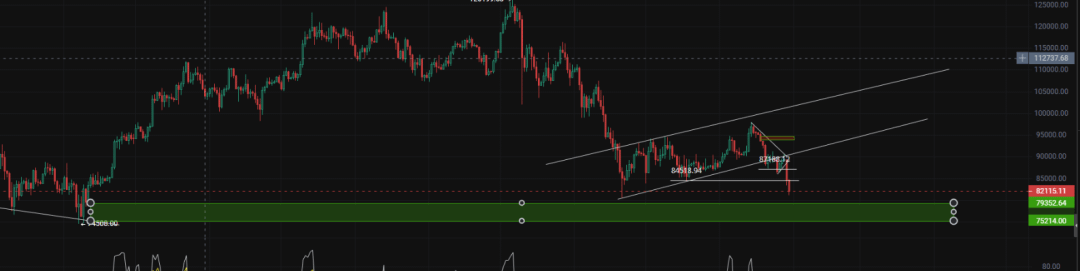
If we look at the moving average system, the current MA shows a standard bearish arrangement, which further strengthens the judgment of a trend reversal to bearish. It can be said that at this stage, bearish sentiment has become the mainstream consensus in the market.
3. The risk of the 'vacuum zone' after losing $86,000.
The loss of the $86,000 line has very strong structural significance. The reason is that there is no dense transaction area below this price level, but rather a clear 'price vacuum zone'. The area that previously consolidated for a long time and accumulated a lot of trading volume is actually at a lower level.
Historical data shows that during this round of consolidation, over 2 million Bitcoins have changed hands in this area, and now this entire area has been completely breached. This means that once the price enters the vacuum zone, the downward speed will often accelerate significantly until it encounters new effective support.
4. $80,000: The current most critical dividing line between bulls and bears.
In the current structure, the area around $80,000 has become an extremely critical position. If this line cannot be defended, then from a structural perspective, the next possible target will directly point to the $74,000 - $75,000 range.
However, I personally believe that there is still potential for a phase of support around $80,000, mainly based on the following reasons: First, this is an important previous low; second, from a smaller structural level, there is a clear demand for gap filling in this area.
5. Order book and order data: Real buying pressure is emerging.
From the perspective of the order book, it can be clearly seen that there have been considerable and large buy orders around the $80,000 mark. Especially on major exchanges, large buy orders are concentrated around $80,000, indicating that there is indeed some defense here.
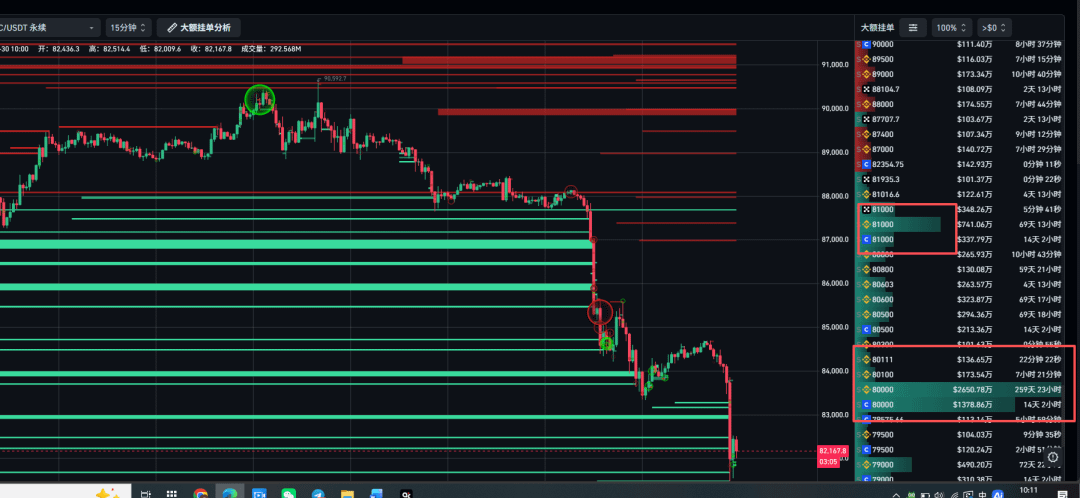
Combining large transaction data, whether from previous limit orders or new institutional buy orders, a phase of support has formed at this position. This is also one of the important reasons I believe $80,000 will not be easily breached.
6. The ideal market state: Panic is released but the price does not break.
An ideal scenario would be: the price oscillates around $80,000 repeatedly, market sentiment remains bearish, and retail investors continue to panic sell, fearing the price will drop to $60,000 or even $65,000. But at the same time, key indicators like CVD continue to decline, while the price is unable to effectively break below $80,000, or briefly dips below before quickly recovering.
If this state of 'low volume and stable price' occurs, it is actually a very healthy signal, indicating effective support is happening below.
7. The support significance of institutional cost lines and chip structure.
From a data perspective, the average institutional holding cost is currently concentrated around $79,000. This means that the $79,000 - $80,000 range is not only a technical and order support area but also a dense area of institutional costs.
Whether it is spot orders, historical support levels, or institutional holding prices, this area has multiple resonant supports. Therefore, even if market sentiment is extremely pessimistic, there is still strong speculative value near this line.
8. Macro risks have been fully priced in by the market.
The macro risks faced by the current market are actually already in a 'known state'. Factors such as a potential partial government shutdown in the U.S. and escalating geopolitical situations have already been anticipated by the market.
It is worth noting that even in this environment, gold has not risen in a one-way manner; rather, it has first fallen with risk assets and then quickly rebounded, indicating that safe-haven funds are not pouring in mindlessly but are looking for more suitable entry areas.
In this context, Bitcoin's role has become very clear - it is being sold off as a typical risk asset.
9. The logic of judging funding rates and rebound windows.
Currently, we have observed that the funding rate in the futures market has started to turn negative and there is a trend of continuous expansion. If the funding rate remains in negative territory for consecutive days while the price cannot continue to decline, then this position is likely to be the low point for a phase rebound.
From a structural perspective, although the theoretical target can point to $75,000, or even lower at $65,000, completing such a drop 'in one go' is not easy. The more likely path is to first rebound to around $86,000 - $87,000, and then build a new downward structure.
10. Summary of operational thoughts: Do not short, wait for structural confirmation.
Overall, the current downward risk has been fully released, and the market has fallen to 'the position it should fall to'. What is more important next is patience, not emotional trading.
At this stage, it is not recommended to continue shorting, but rather to wait for potential rebound opportunities from the perspective of trend and structure. The realization of downward risk has been completed, and what will truly determine the direction of the market is whether the $80,000 line can be effectively defended.