Recently, while watching the Agent track, I noticed a rather awkward phenomenon:
All AI projects are showcasing 'how many Bots I have', but none dare to show 'how long my Bot has lived'.
Because they simply don’t last long.
On the current stateless public blockchain, every interaction with AI is a brand new beginning. It has no memory, no history, and even no accumulated credibility.
It's like hiring a nanny, but this nanny wakes up every morning with amnesia, and you have to teach her how to open the door all over again every day.
With this kind of efficiency, how can we possibly bear the complexity of the economy in 2026?
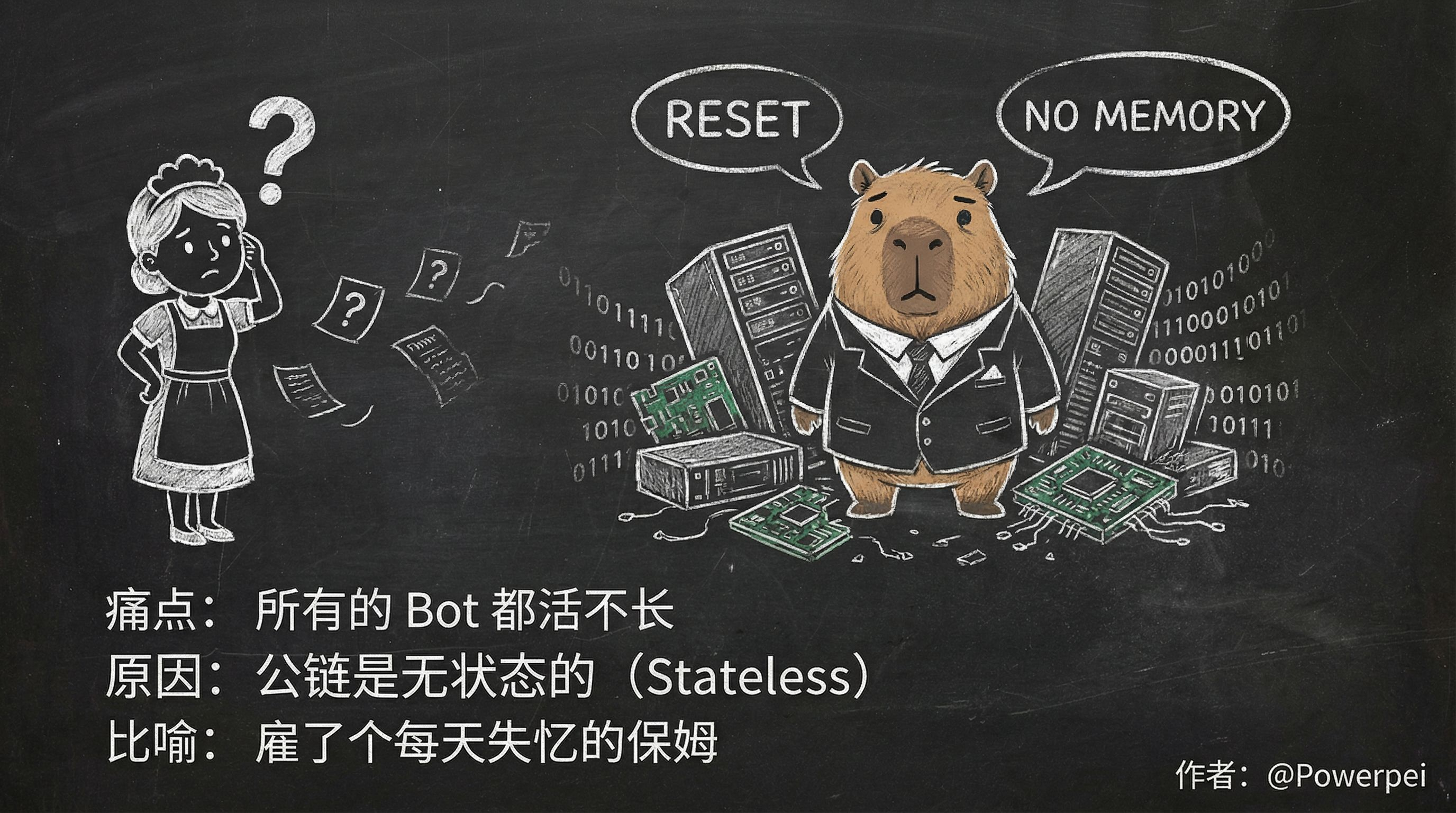
After reading COO Ash's article, I realized they are addressing the labor shortage issue.
1. Why will Solana and Sui become ineffective in the Agent era?
This statement can offend people, but it's the truth.
The core logic of existing high-performance public chains is to serve human hand speed.
Human operations are low-frequency and discrete. We click Swap once, and it’s likely we won't click again for several hours.
So public chains just need to be fast enough.
But the AI Agent is a continuous decision-maker. It needs to remember whether the last arbitrage was a loss or a gain and needs to adjust today’s leverage based on last week’s volatility.
If the chain itself does not support persistent memory, AI can only store data on centralized servers.
What do you call that Web3? Isn't it just a Web2 crawler with a wallet?
2. Vanar's problem-solving approach: give AI an ID card.
Vanar's current approach is to issue long-term ID cards to these 'temporary workers'.
Through the protocol layer's Intelligence Continuity, AI can remember its historical decisions and accumulate its on-chain reputation.
This means that AI can finally evolve from a 'pay-per-use' tool to a full-time housekeeper that is 'results-oriented'.
Imagine an AI that can independently manage your RWA assets and automatically adjust positions based on macro data; it needs not only computing power but also verifiable credentials.
3. A dialectical reflection on cryptocurrency prices and FUD.
To be honest, the current
The price of VANRY (around 0.007) indeed looks bad, and there is a lot of criticism in the community (regarding unlocking and inflation).
Many people think this is about cutting leeks.
But I actually think this is a healthy clearing.
The construction cycle of infrastructure is inherently long. Look at Ethereum's early inflation rate and the panic during Solana's downtime.
All infrastructure looks like a Ponzi before it lands.
When those hot money that only want to speculate on the 'AI concept' withdraw, what remains is the capital that truly cares about the survival rights of AI.
My conclusion:
This is a bet on the reconstruction of productivity.
If in 2026, what we need is an AI that can help us make money long-term, rather than just a toy that chats with us,
then the memory-enabled chain provided by Vanar is the only choice.
For patient capital, the current low-level fluctuations may be the last opportunity to enter at a non-consensus price.#vanar $VANRY