

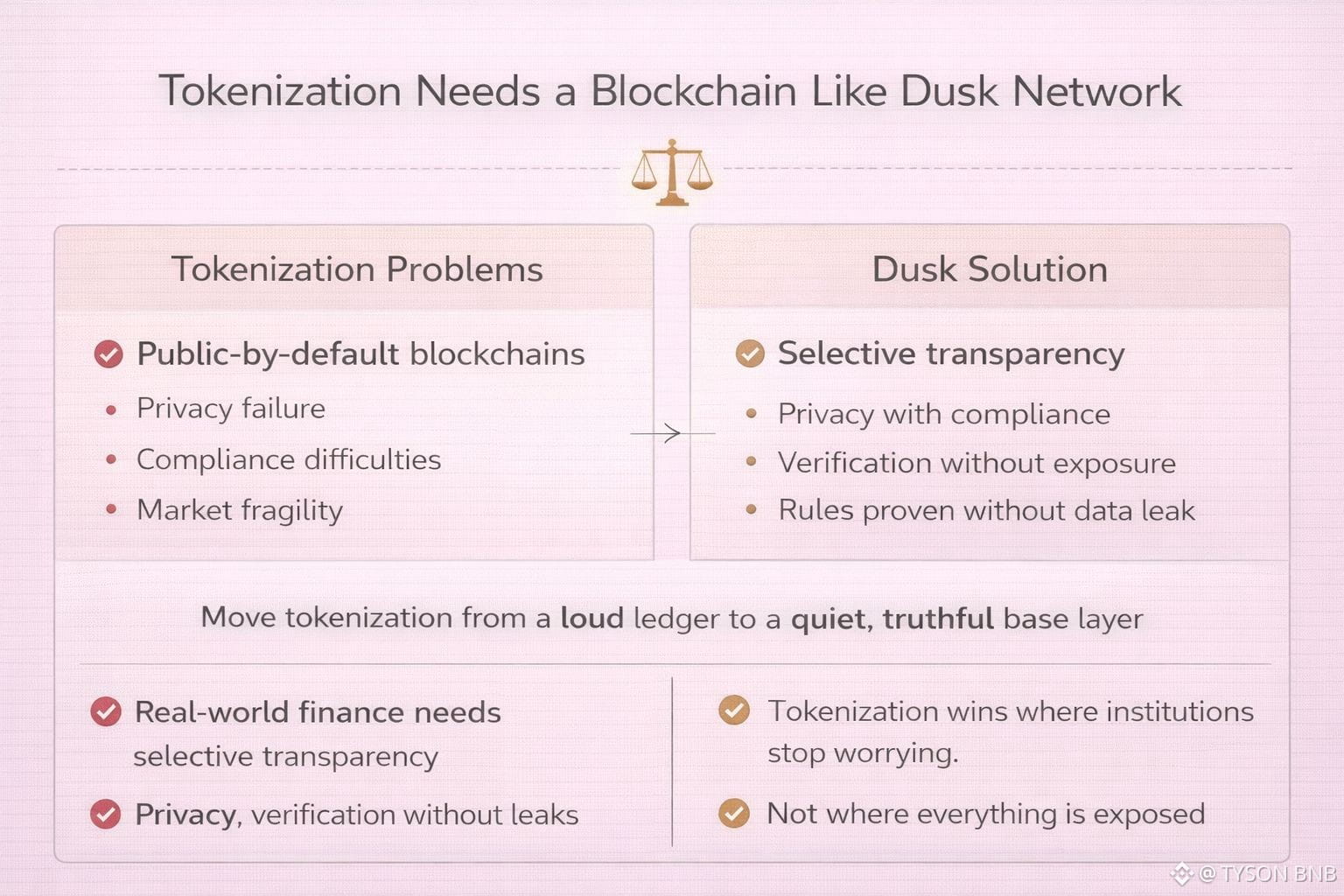
 Tokenization didn’t fail because the idea was wrong.
It failed because the infrastructure underneath it was too loud.
Early on, everyone focused on the asset. Real estate, equities, bonds, invoices if it existed, it could be tokenized. Ownership could be fractional. Settlement could be instant. Liquidity could be global. The logic was sound.
What wasn’t sound was where all of this was being placed.
Most blockchains treat tokenization as a visibility problem. Put the asset on-chain. Make ownership transparent. Let the market do the rest. That approach works for crypto-native assets, where exposure is a feature and openness is part of the social contract.
It breaks the moment real-world finance enters the picture.
Tokenized assets don’t just represent value. They represent relationships—between issuers and holders, between institutions and regulators, between counterparties who are legally bound to not expose everything to everyone.
Public-by-default chains force an uncomfortable compromise. Either sensitive financial data is exposed, or it’s hidden off-chain and loosely stitched back in. In both cases, the chain becomes a ledger of fragments, not a source of truth.
Tokenization doesn’t need more transparency. It needs selective transparency.
This is where Dusk starts from a different premise.
On Dusk, privacy isn’t about hiding wrongdoing. It’s about preserving market structure. Ownership, transfer conditions, compliance checks these are all handled in a way that allows verification without disclosure. The chain can prove that rules were followed without publishing the rules’ internal state to the world.
That distinction matters more than it sounds.
In traditional finance, privacy is not optional. It’s foundational. Positions aren’t public. Cap tables aren’t broadcast. Trade sizes aren’t exposed in real time. Yet compliance still exists. Audits still happen. Regulators still see what they’re allowed to see.
Dusk mirrors that reality on-chain.
Instead of asking institutions to abandon their operating assumptions, it brings those assumptions into the protocol itself. Identity is not erased; it’s controlled. Compliance is not simulated; it’s enforced cryptographically. Disclosure becomes contextual, not absolute.
This changes how tokenization scales.
On general-purpose chains, tokenization pilots often stall after proofs of concept. Not because the tech doesn’t work, but because no one can answer basic questions under scrutiny. Who can see what? When does data leak? How do you prove compliance without exposing counterparties?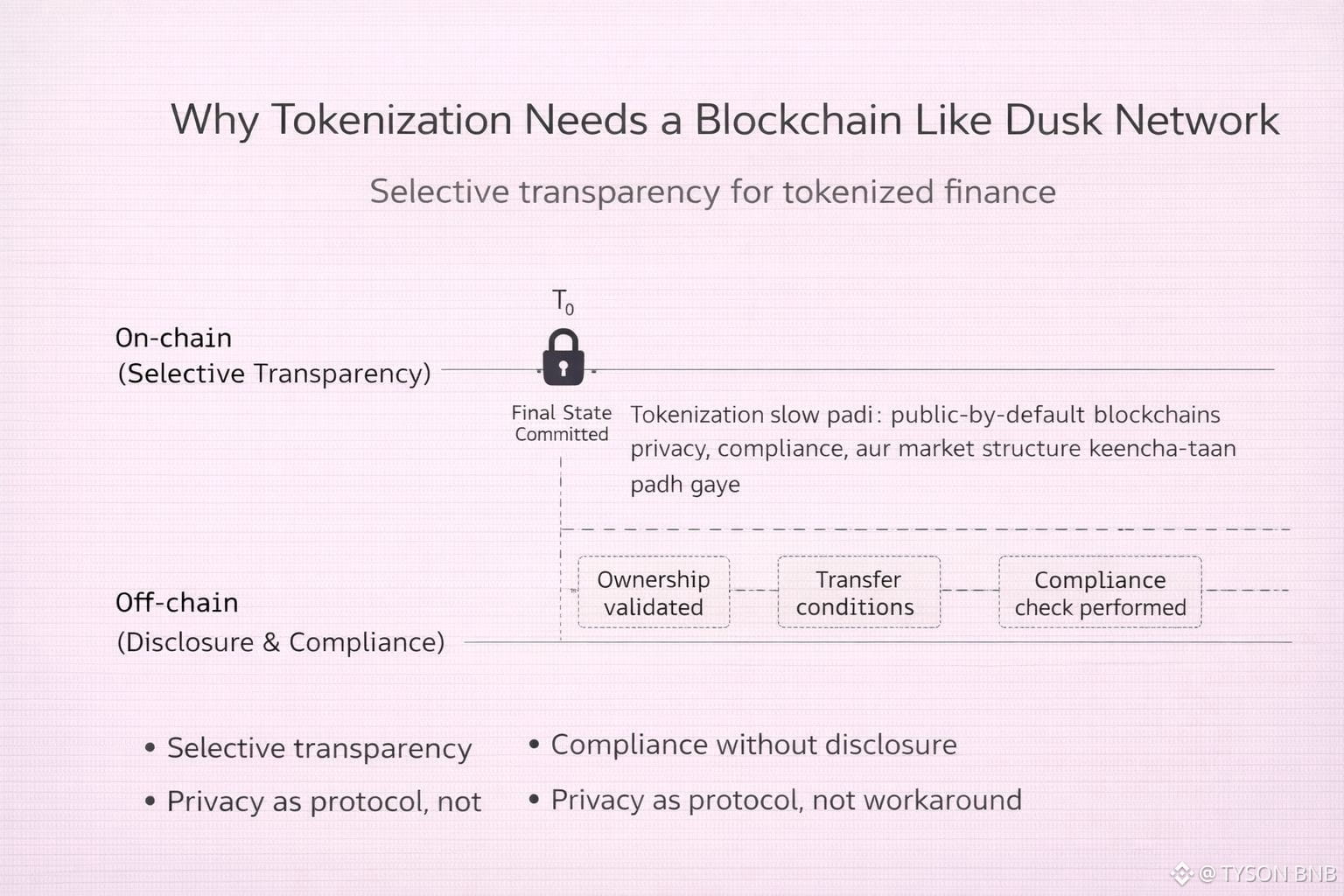
Dusk doesn’t eliminate those questions. It answers them by design.
Another quiet advantage is durability.
Tokenized assets aren’t meant to live for weeks or months. They represent long-term obligations—equity that lasts years, debt that matures over decades. Infrastructure that treats privacy and compliance as afterthoughts accumulates risk over time. Every workaround becomes another point of fragility.
Dusk compresses that complexity back into the base layer.
The result isn’t flashier tokenization. It’s calmer tokenization.
Systems that don’t need to explain themselves every time a new stakeholder enters the room. Assets that can move without announcing themselves to the entire market. Compliance that doesn’t require trusted intermediaries to sit between the chain and reality.
The uncomfortable truth is this:
Tokenization won’t be won by the chain with the most assets issued. It will be won by the chain that institutions stop worrying about.
Dusk isn’t trying to tokenize everything. It’s trying to tokenize things that already matter and do so without forcing them to become something they’re not.
Tokenization doesn’t need a louder ledger. It needs a quieter one that still tells the truth.
That’s why it needs a blockchain like Dusk.
