

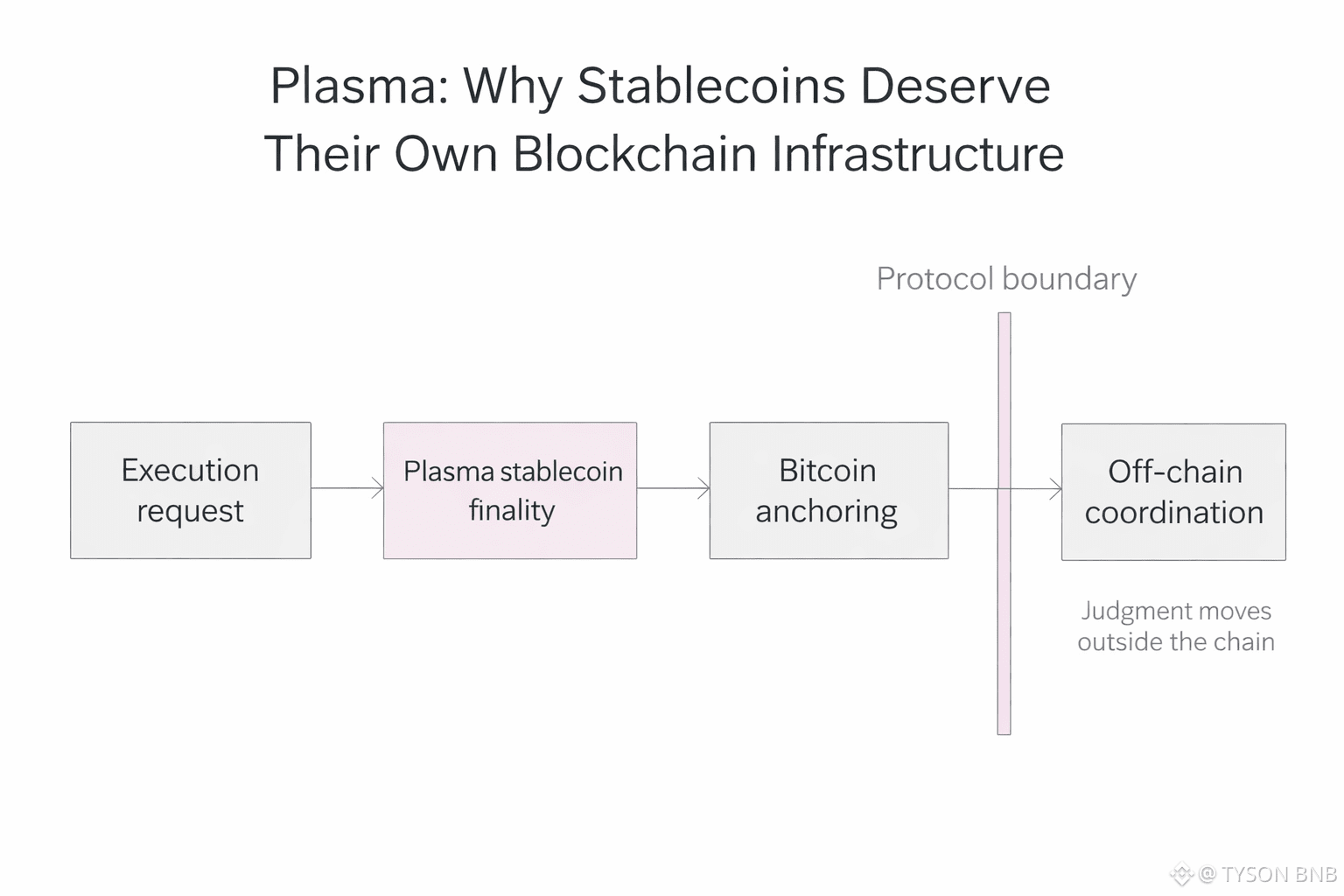
 Stablecoins are treated like guests in most blockchains.
Welcome, tolerated, useful but never truly at home.
They move trillions in value, settle payrolls, power remittances, and quietly replace banking rails in parts of the world. Yet almost everywhere they live on-chain, they’re forced to share space with speculation, experimentation, and congestion that has nothing to do with money itself.
That mismatch is starting to show.
Blockchains were originally built to execute ideas. Stablecoins are built to execute certainty. Those two goals overlap less than people like to admit. When stablecoins run on general-purpose chains, they inherit assumptions that don’t belong to financial settlement: variable fees, unpredictable latency, shared blockspace, and execution environments optimized for creativity rather than reliability.
For a while, this works.
Transfers clear. Balances update. From the outside, everything looks functional. But underneath, stablecoins are paying an invisible tax adapting themselves to infrastructure that was never designed around their core responsibility: being boring, dependable money.
This is where Plasma draws a line.
Plasma starts from a premise most chains avoid saying out loud: stablecoins are not just another application. They are infrastructure. And infrastructure behaves differently when stress arrives.
On general-purpose chains, stablecoin settlement competes. During volatility, transfers wait behind arbitrage bots. Fees spike at the exact moment users need certainty. Confirmation windows stretch when markets are moving fastest. Nothing is broken but nothing is guaranteed either.
For finance, that ambiguity is expensive.
Plasma removes the competition entirely.
By designing a chain specifically for stablecoin settlement, it eliminates the need for stablecoins to fight for blockspace. Transfers don’t negotiate priority. Fees don’t swing wildly based on unrelated demand. Finality isn’t a side effect of congestion dynamics it’s the primary objective.
This isn’t about speed for its own sake.
It’s about predictability.
Payments infrastructure doesn’t need to be clever. It needs to behave the same way at noon as it does during a market panic. Plasma’s architecture reflects that reality. By narrowing the execution surface, it reduces edge cases. By limiting scope, it increases confidence. Less flexibility means fewer ways for settlement to surprise you.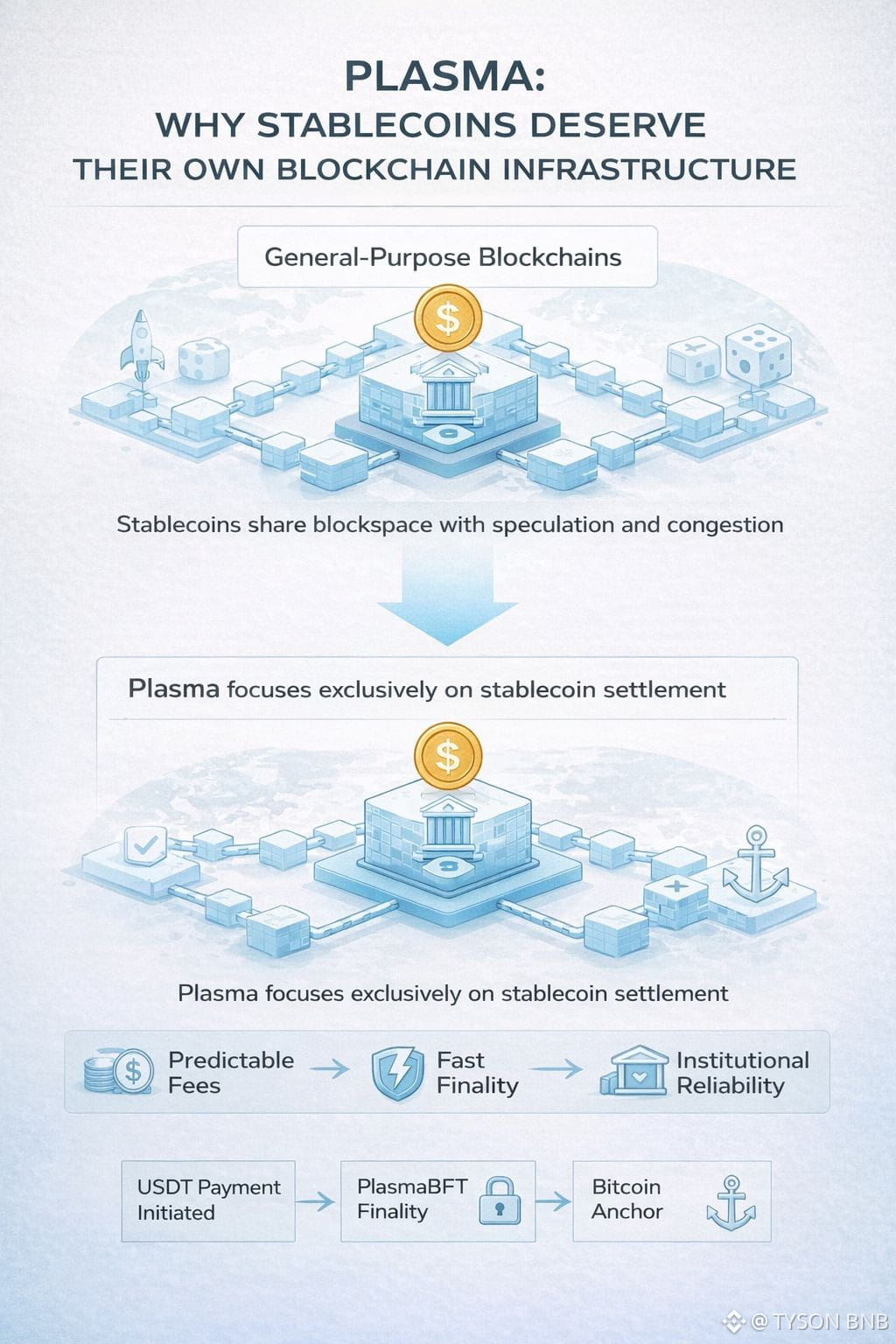
That trade-off is intentional.
General-purpose chains maximize what can happen. Plasma minimizes what shouldn’t.
There’s also a deeper operational shift here.
Stablecoin operators on shared chains are passengers. They monitor gas markets, mempool behavior, MEV activity, and network upgrades all of which can change settlement conditions overnight. Risk management becomes an exercise in adapting to external forces.
Plasma internalizes those forces.
When the chain exists for stablecoins alone, the operational model simplifies. Settlement assumptions don’t change because someone launched a new token or NFT mint. The system’s behavior remains legible to the institutions and users depending on it.
This matters as stablecoins move beyond crypto-native use.
Payroll, merchant payments, treasury management, and cross-border settlement don’t tolerate “usually works.” They require rails that behave consistently under load, during volatility, and across time zones. Infrastructure that treats stablecoins as first-class citizens instead of tolerated guests.
Plasma isn’t arguing that general-purpose chains are obsolete.
It’s arguing that money deserves specialization.
The internet didn’t run on one protocol for everything. Payments didn’t scale on creative platforms. Financial rails emerged because reliability demanded it. Stablecoins are now reaching that same moment.
The uncomfortable truth is this:
As long as stablecoins live on chains built for everything else, they will inherit risks they didn’t choose. Congestion they didn’t cause. Volatility they didn’t create. Assumptions that don’t match their role.
Plasma exists because that compromise is no longer acceptable.
Stablecoins don’t need more features. They need fewer surprises.
They don’t need louder ecosystems. They need quieter guarantees.
That’s why they deserve their own blockchain infrastructure and why Plasma is being built around that belief.