
$PAXG Gold has gone crazy to the point of not resembling gold: the real peak is never the price, but the human heart. It surged 500 dollars in 72 hours, increased by 230 dollars in a single day, and saw a market value evaporate and then recover 1.5 trillion dollars in 20 minutes.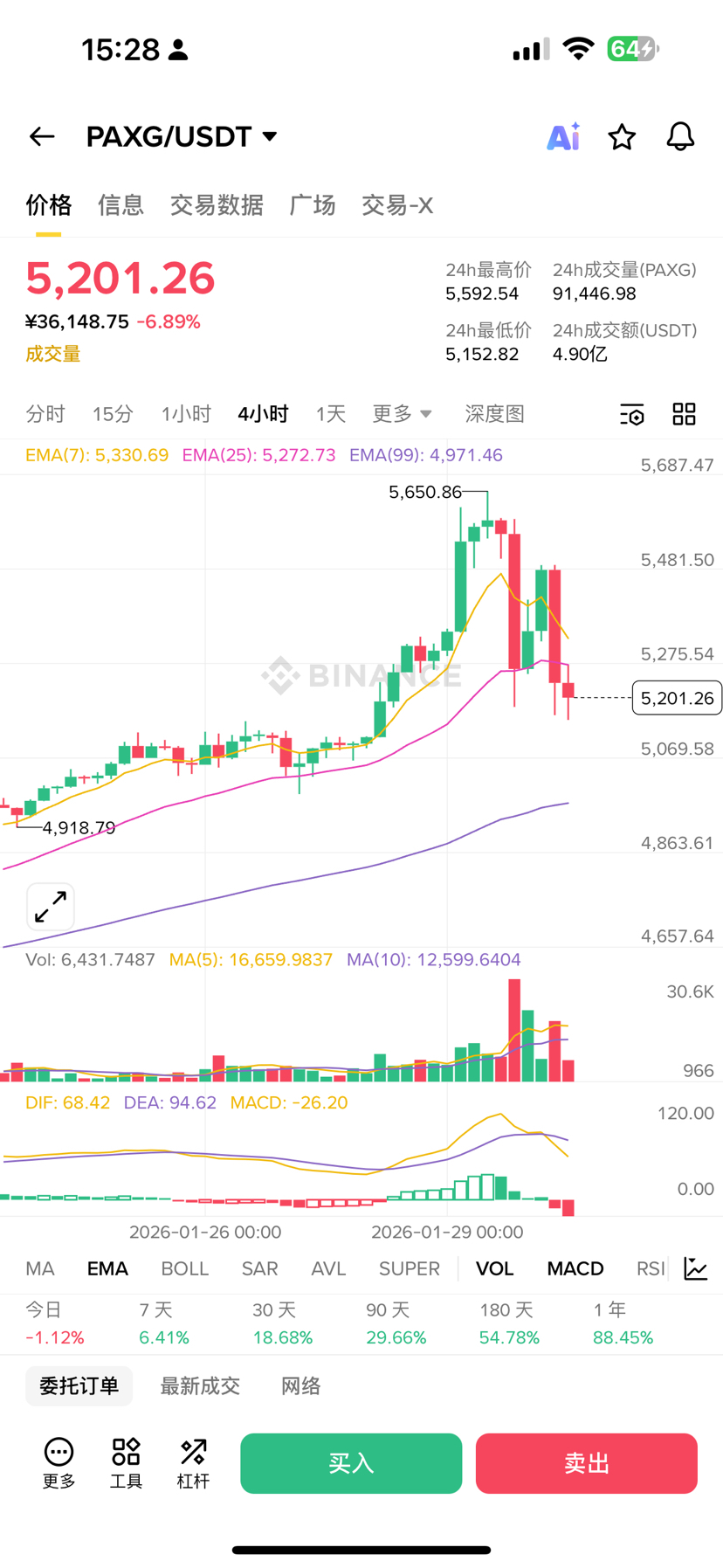
This year's gold market is no longer like traditional financial assets, but more like a highly leveraged cryptocurrency.
Safe assets are fluctuating as 'risk assets'.
Gold surged over 1000 dollars within the month, with prices once approaching 5600 dollars/ounce, setting records for the largest single-day, largest monthly, and fastest rate of increase in history.
Market sentiment is almost unanimous: shock, fear, unease, mixed with a bit of excitement.
Some say: "Gold is trading like crypto now."
Some say: 'Safe haven now looks like meme coins.'
Some still ask: 'Does someone already know what we don't?'
This is not an ordinary bullish sentiment; this is a collective projection of systemic anxiety.
First, history has already given us two bloody lessons.
Before discussing 'is this time different', one must first face history.
The first time: 1979–1980
Gold skyrocketed from $200 to $850, and silver surged from $6 to $50.
The background is the oil crisis, severe inflation, and deeply negative real interest rates.
The consensus at that time was: The fiat currency system is out of control, and precious metals are the only anchor.
And the result?
Two months after peaking, gold was halved, and silver lost two-thirds.
Then, there was a 20-year freeze.
The second time: 2010–2011
After the financial crisis, the Federal Reserve initiated QE, and the European debt crisis erupted.
Gold rose from $1000 to $1921, and silver surged again to $50.
The market believes: 'Unlimited easing will definitely destroy the dollar.'
The result is: Gold retreated by 45%, silver fell by 70%, and it was years of bearish sideways trading.
These two market events have different backgrounds, but the outcomes are highly consistent.
The crazier it rises, the more brutal the subsequent adjustments will be.
History almost repeatedly emphasizes one thing:
When precious metals change from 'hedging tools' to 'faith assets', the top is already on the way.
Second, is this time really different?
Must admit: This time there really is a new structural force.
1️⃣ Real buying power at the central bank level
De-dollarization is no longer a slogan, but a balance sheet behavior.
Central banks in emerging markets such as China continue to increase their gold holdings, and it is a long-term allocation that is not price-sensitive.
This determines a fact: The long-term bottom of gold has been significantly raised.
2️⃣ The 'credibility erosion' of the dollar system.
Weaponization of sanctions, uncontrolled fiscal deficits, and policy swings.
The dollar index weakening is not just a single economic cycle issue, but a trust discount.
Gold is no longer just an anti-inflation tool, but a hedge against sovereign credit and institutional risks.
3️⃣ Geopolitics has become a 'normal variable'.
Trade wars, tariff threats, strained alliances, and prolonged regional conflicts.
Uncertainty is no longer temporary but structural.
These factors were not entirely present in 1980 and 2011.
Three, but the problem is not in logic, but in 'speed'.
Even if the fundamentals hold, this round of market activity still appears extremely abnormal.
First, the time scale is completely distorted.
Historically, gold usually needs 5–10 years to rise by $1000.
And now, the same increase has been completed in 28 days.
This is not slow variables pricing; this is positions being out of control.
Second, the nature of volatility has changed.
20 minutes +120 dollars, then -100 dollars.
This is not central bank behavior; this is a cascading reaction of leveraged funds + CTAs + algorithmic stop-losses.
Once the direction reverses, the market won't 'correct gently', but will crash sharply.
Third, market sentiment has shifted from 'bullish' to 'panic'.
You will find that the market is no longer discussing: 'Can gold still rise?'
But rather: 'Is the system already broken?'
Panic buying is almost always the last phase of any bubble.
Four, the real top is never the price, but the signal.
So the question arises: What signal appears that means this round of market activity has truly peaked?
① The marginal changes in central bank buying (most crucial)
It's not the central banks selling, but:
The buying speed has significantly slowed.
Or start 'verbally reassuring market stability.'
Once the central banks exit the marginal buyer role, the market is left with only emotional funds.
② The narrative undergoes a qualitative change: from hedging → faith
When you start to frequently hear these words:
"Gold is not an asset, it is currency."
"The fiat currency system is about to end."
"This time we can never go back."
This is not bullish; this is a sign of a logical top.
③ Volatility structure reversal
The characteristics of the top phase are often:
The rise is getting slower.
Pullbacks are getting faster.
A single-day bearish candle erases several days of gains.
The real top makes bulls feel very secure.
④ The counterintuitive divergence of the dollar and real interest rates
If there is: a dollar rebound, real interest rates rising, and gold does not fall but rises, that is often the last segment of a rally.
⑤ Silver runs ahead to the top
Silver is an emotional amplifier.
Once silver peaks before gold, or volatility surges but prices do not keep up, it usually means that speculative funds have begun to withdraw.
Five, what is the most likely outcome of this round of market activity?
A judgment that pleases no one:
It's unlikely that another 20-year freeze will occur.
But a 30% pullback in gold and a 50% pullback in silver is completely reasonable.
And it is very likely that:
It came very quickly.
The magnitude is severe.
Happening at the 'most optimistic' moment
History never kills in despair; it only strikes when you believe 'this time is different.'
Finally: Gold hasn't gone crazy; the world is sick.
Gold is not telling a story; it is just using price to tell you: The uncertainties of this world are being repriced.
But the market's way of solving problems is often more brutal than the problems themselves.
In the long term, gold is still a reasonable insurance for this era.
In the short term, it is no longer the 'buying zone', but the risk management zone.
The last sentence is for all those who are watching the market:
The more intense the rise, the greater the future adjustment will be.
This is not an opinion; this is a physical law of the market.
In 72 hours, it surged by $500, with a single-day increase of $230, and $1.5 trillion in market value evaporated and then recovered.
The gold market at the end of January 2026 no longer resembles traditional financial assets, but more like a highly leveraged cryptocurrency.
Safe assets are fluctuating as 'risk assets'.
Gold surged over $1000 in a month, with prices once approaching $5600/ounce, breaking records for the largest single-day, largest monthly, and fastest speed increases in history.
Market sentiment is almost unanimous: shock, fear, unease, mixed with a bit of excitement.
Some say: 'Gold is trading like crypto now.'
Some say: 'Safe haven now looks like meme coins.'
Some people still ask: 'Does someone already know what we don't?'
This is not an ordinary bullish sentiment; this is a collective projection of systemic anxiety.
First, history has already given us two bloody lessons.
Before discussing 'is this time different', one must first face history.
The first time: 1979–1980
Gold skyrocketed from $200 to $850, and silver surged from $6 to $50.
The background is the oil crisis, severe inflation, and deeply negative real interest rates.
The consensus at that time was: The fiat currency system is out of control, and precious metals are the only anchor.
And the result?
Two months after peaking, gold was halved, and silver lost two-thirds.
Then, there was a 20-year freeze.
The second time: 2010–2011
After the financial crisis, the Federal Reserve initiated QE, and the European debt crisis erupted.
Gold rose from $1000 to $1921, and silver surged again to $50.
The market believes: 'Unlimited easing will definitely destroy the dollar.'
The result is: Gold retreated by 45%, silver fell by 70%, and it was years of bearish sideways trading.
These two market events have different backgrounds, but the outcomes are highly consistent.
The crazier it rises, the more brutal the subsequent adjustments will be.
History almost repeatedly emphasizes one thing:
When precious metals change from 'hedging tools' to 'faith assets', the top is already on the way.
Second, is this time really different?
Must admit: This time there really is a new structural force.
1️⃣ Real buying power at the central bank level
De-dollarization is no longer a slogan, but a balance sheet behavior.
Central banks in emerging markets such as China continue to increase their gold holdings, and it is a long-term allocation that is not price-sensitive.
This determines a fact: The long-term bottom of gold has been significantly raised.
2️⃣ The 'credibility erosion' of the dollar system.
Weaponization of sanctions, uncontrolled fiscal deficits, and policy swings.
The dollar index weakening is not just a single economic cycle issue, but a trust discount.
Gold is no longer just an anti-inflation tool, but a hedge against sovereign credit and institutional risks.
3️⃣ Geopolitics has become a 'normal variable'.
Trade wars, tariff threats, strained alliances, and prolonged regional conflicts.
Uncertainty is no longer temporary but structural.
These factors were not entirely present in 1980 and 2011.
Three, but the problem is not in logic, but in 'speed'.
Even if the fundamentals hold, this round of market activity still appears extremely abnormal.
First, the time scale is completely distorted.
Historically, gold usually needs 5–10 years to rise by $1000.
And now, the same increase has been completed in 28 days.
This is not slow variables pricing; this is positions being out of control.
Second, the nature of volatility has changed.
20 minutes +120 dollars, then -100 dollars.
This is not central bank behavior; this is a cascading reaction of leveraged funds + CTAs + algorithmic stop-losses.
Once the direction reverses, the market won't 'correct gently', but will crash sharply.
Third, market sentiment has shifted from 'bullish' to 'panic'.
You will find that the market is no longer discussing: 'Can gold still rise?'
But rather: 'Is the system already broken?'
Panic buying is almost always the last phase of any bubble.
Four, the real top is never the price, but the signal.
So the question arises: What signal appears that means this round of market activity has truly peaked?
① The marginal changes in central bank buying (most crucial)
It's not the central banks selling, but:
The buying speed has significantly slowed.
Or start 'verbally reassuring market stability'
Once the central banks exit the marginal buyer role, the market is left with only emotional funds.
② The narrative undergoes a qualitative change: from hedging → faith
When you start to frequently hear these words:
"Gold is not an asset, it is currency."
"The fiat currency system is about to end"
"This time we can never go back"
This is not bullish; this is a sign of a logical top.
③ Volatility structure reversal
The characteristics of the top phase are often:
The rise is getting slower.
Pullbacks are getting faster.
A single-day bearish candle erases several days of gains.
The real top makes bulls feel very secure.
④ The counterintuitive divergence of the dollar and real interest rates
If there is: a dollar rebound, real interest rates rising, and gold does not fall but rises, that is often the last segment of a rally.
⑤ Silver runs ahead to the top
Silver is an emotional amplifier.
Once silver peaks before gold, or volatility surges but prices do not keep up, it usually means that speculative funds have begun to withdraw.
Five, what is the most likely outcome of this round of market activity?
A judgment that pleases no one:
It's unlikely that another 20-year freeze will occur.
But a 30% pullback in gold and a 50% pullback in silver is completely reasonable.
And it is very likely that:
It came very quickly.
The magnitude is severe.
Happening at the 'most optimistic' moment
History never kills in despair; it only strikes when you believe 'this time is different.'
Finally: Gold hasn't gone crazy; the world is sick.
Gold is not telling a story; it is just using price to tell you: The uncertainties of this world are being repriced.
But the market's way of solving problems is often more brutal than the problems themselves.
In the long term, gold is still a reasonable insurance for this era.
In the short term, it is no longer the 'buying zone', but the risk management zone.
The last sentence is for all friends who are watching the market.
The more intense the rise, the greater the future adjustment will be.
This is not an opinion; this is a physical law of the market$BTC $XAU