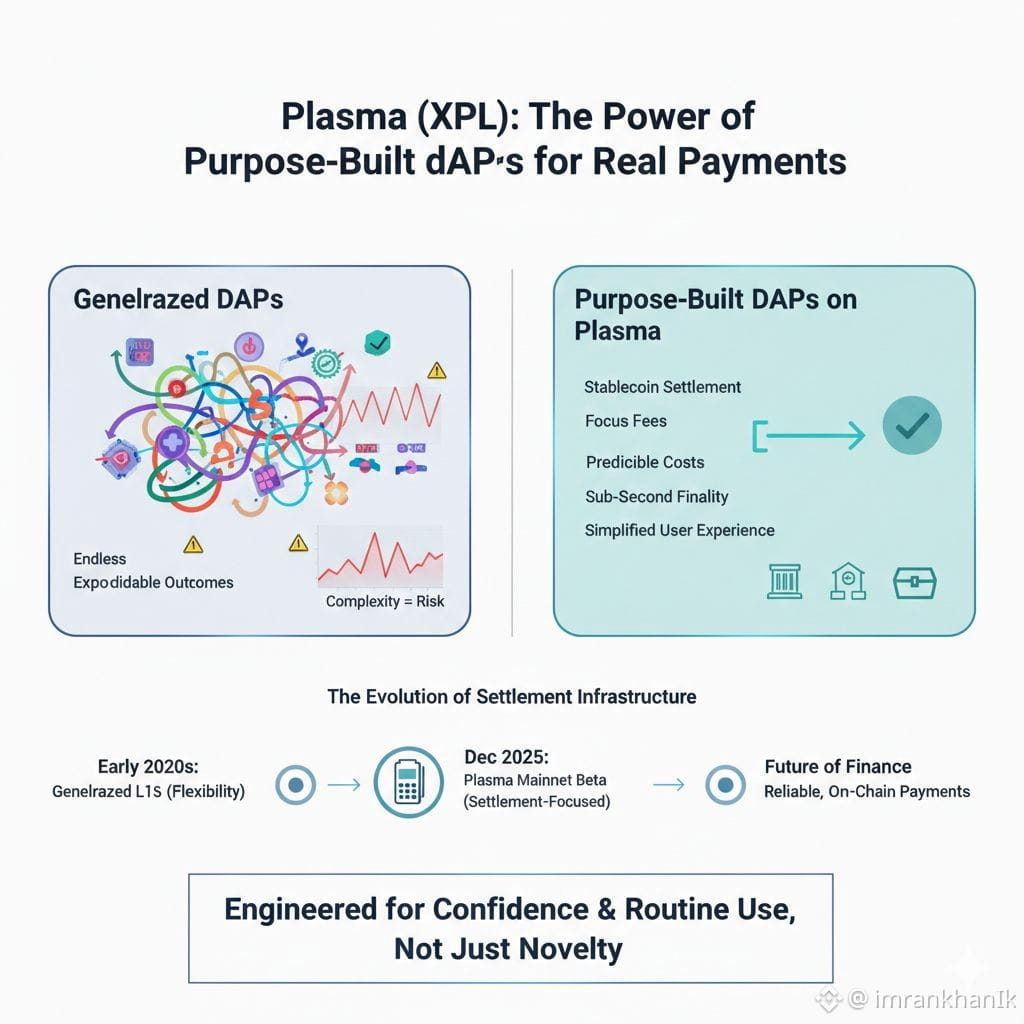
Apps, as narrow or limited. They are usually compared to generalized apps that try to do everything at once, and by that measure, they can seem restrictive. But that comparison starts to fall apart once blockchain systems move out of the experimental phase and into real payment use. When money actually needs to move reliably, the strengths of purpose-built design become much easier to appreciate, especially on infrastructure like Plasma (XPL).
Generalized applications are designed for flexibility. They support many assets, complex interactions, and constant feature expansion. That makes sense in early ecosystems where discovery and experimentation matter most. Payments work differently. They depend on consistency, predictable costs, and clear outcomes. In that setting, flexibility can quietly turn into risk. Every extra feature adds complexity, and complexity shows up as delays, congestion, or unexpected behavior when volume increases.
Plasma takes a different starting point. It is built as a settlement-focused Layer 1, with stablecoin movement as its core use case rather than a side feature. Purpose-built payment dApps on Plasma reflect that mindset. Instead of asking what could be added, they focus on what must work every single time. Asset support is usually centered on stablecoins. Transaction flows are designed to be short, repeatable, and easy to reason about. Features like gasless stablecoin transfers are not about novelty. They remove friction that gets in the way of everyday use. These constraints are intentional, and they reduce the chance of things going wrong at scale.
This matters most when payments stop being occasional events and become routine. On generalized networks, fees can swing unpredictably and confirmation times can slow down under load. Transaction ordering may change when the network is busy. For enterprises and institutions, these are not minor details. They affect accounting, treasury management, and user trust, Plasma is designed to reduce those variables With sub-second finality through PlasmaBFT and a stablecoin-first execution model, it aims to make settlement behavior more predictable. As of December 2025, Plasma operates with deterministic settlement tailored specifically to payment flows, which is something generalized environments often struggle to guarantee.
Compliance is another area where purpose-built design shows its value. Payment systems rarely exist outside regulatory expectations, even when built on decentralized rails. On Plasma, payment dApps can bake compliance-aware choices directly into how they operate. Predictable transaction behavior, clearer metadata handling, and audit-friendly settlement flows are easier to support when the base layer is optimized for payments. These details are not exciting, but they matter deeply to organizations that need to answer to regulators, partners and customers,
Sustainability also looks different in payment-focused systems. Many generalized apps rely on constant growth, speculative activity, or incentive-driven behavior to stay active payment dApps tend to grow more quietly. Their usage comes from payroll, merchant settlements, internal transfers, and recurring payments. Plasma’s stablecoin-centric design fits this pattern. Over time, steady usage supports healthier economics for both the application and the network, without relying on hype cycles.
The way partnerships form reflects this difference too. Payment dApps on Plasma are more likely to work with financial service providers, payment processors, or enterprise platforms. Those relationships shape design decisions early on. Reliability expectations, integration requirements, and operational constraints influence how products are built. This can slow experimentation, but it increases the chances that the system fits into real-world workflows.
For long-term users, the benefits are subtle but important. Payments settle when expected. Fees stay understandable. Failures are rare and usually explainable. These qualities do not attract attention, but they build confidence over time. Trust becomes the real advantage, and it is something generalized apps often struggle to achieve without major redesign.
None of this makes generalized applications irrelevant. They remain essential for innovation and exploration. Many ideas that later become core infrastructure start in flexible environments. The issue arises when those designs are pushed into areas that demand discipline. Payments are one of those areas.
Plasma and the purpose-built dApps built on it make their tradeoffs clear. They give up breadth to gain reliability, and novelty to gain clarity. For enterprises and institutions, that alignment matters. Over time, adoption tends to follow systems that behave consistently under pressure. In payments, that consistency is often what allows infrastructure to last rather than just experiment.