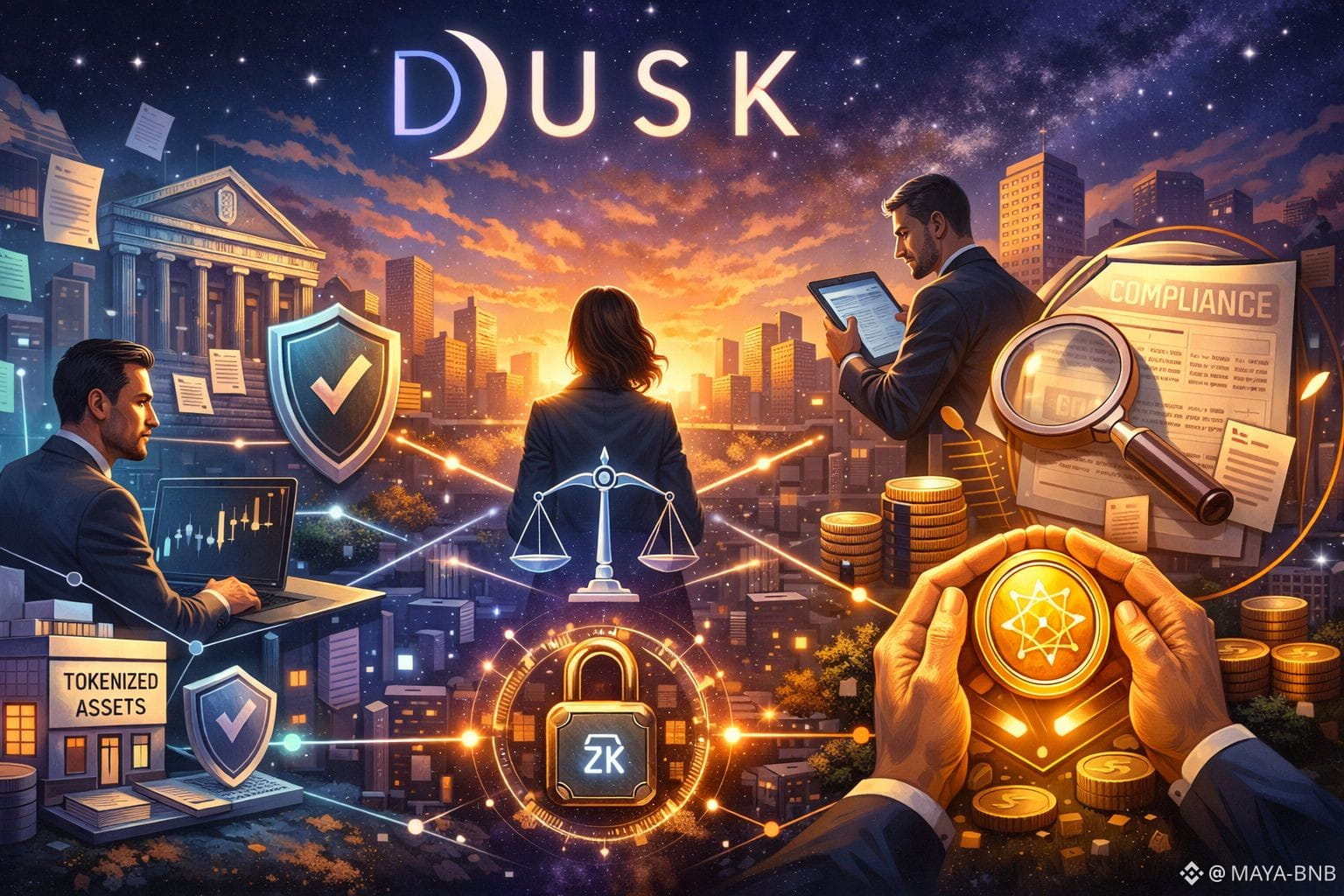
Founded in 2018, Dusk Network didn’t start with the usual crypto mindset of “break everything and worry later.” Instead, it started with a very human question: how can blockchain actually work for real people, real businesses, and real financial systems? The team behind Dusk understood early on that finance is deeply personal. It involves livelihoods, trust, privacy, and responsibility—and any technology touching money needs to respect that.
In traditional finance, privacy isn’t a luxury, it’s a requirement. People don’t want their salaries, investments, or business transactions visible to the entire world. Yet many blockchains made full transparency the default, unintentionally pushing institutions and everyday users away. Dusk chose a different path by designing privacy directly into the protocol. Using advanced cryptography like zero-knowledge proofs, Dusk allows transactions and smart contracts to stay private while still being provable and secure. You don’t have to expose everything just to prove that something is valid.
What truly sets Dusk apart is how it treats regulation—not as an enemy, but as a reality of modern finance. Instead of forcing users to choose between compliance and decentralization, Dusk makes room for both. Its system supports selective disclosure, which means sensitive information stays hidden unless it needs to be shown to the right party, such as a regulator or auditor. This creates a healthier balance where rules can be followed without turning blockchains into surveillance tools.
Dusk’s modular architecture reflects this practical, long-term thinking. By separating key parts of the network, the protocol can grow and adapt over time without major disruptions. This matters because financial systems don’t stand still. Laws evolve, markets change, and technology improves. Dusk is built to move with that reality rather than fight against it.
The network is especially well suited for compliant DeFi. While much of DeFi today operates in uncertain legal territory, Dusk enables developers to build decentralized financial applications that respect identity requirements, regional laws, and compliance standards. This opens the door for banks, funds, and institutional investors who want the efficiency of blockchain without stepping outside legal boundaries.
Another major focus of Dusk is the tokenization of real-world assets. Things like shares, bonds, and funds can be brought on-chain in a way that feels familiar to traditional finance but benefits from automation and transparency where it matters. Ownership transfers, settlements, and corporate actions can happen faster and with fewer intermediaries, all while keeping sensitive information private. For investors and issuers alike, this means less friction and more trust.
Under the hood, Dusk is designed for stability and reliability. Financial infrastructure needs to be predictable; there’s little room for downtime or uncertainty when real value is involved. Dusk’s consensus and network design prioritize finality and security, making it suitable for serious financial use rather than short-term experimentation.
More than just a blockchain, Dusk represents a shift in how the industry thinks about decentralization. It shows that you don’t have to choose between privacy and accountability, or innovation and regulation. You can have systems that are open yet respectful, decentralized yet responsible.
As blockchain continues to mature, the future won’t belong only to the loudest or fastest networks, but to those that understand people. By building with privacy, compliance, and real-world needs at its core, Dusk offers a more grounded and human vision of what Web3 finance can become—one that feels less like an experiment and more like infrastructure you can actually trust.