
Most people think blockchains “move tokens.”
That idea is incomplete.
In reality, blockchains manage state transitions and how those transitions are designed determines whether a network feels reliable, chaotic, or fragile. Vanar Chain stands out because it treats every transaction as a controlled, predictable state change, not a speculative event competing for attention.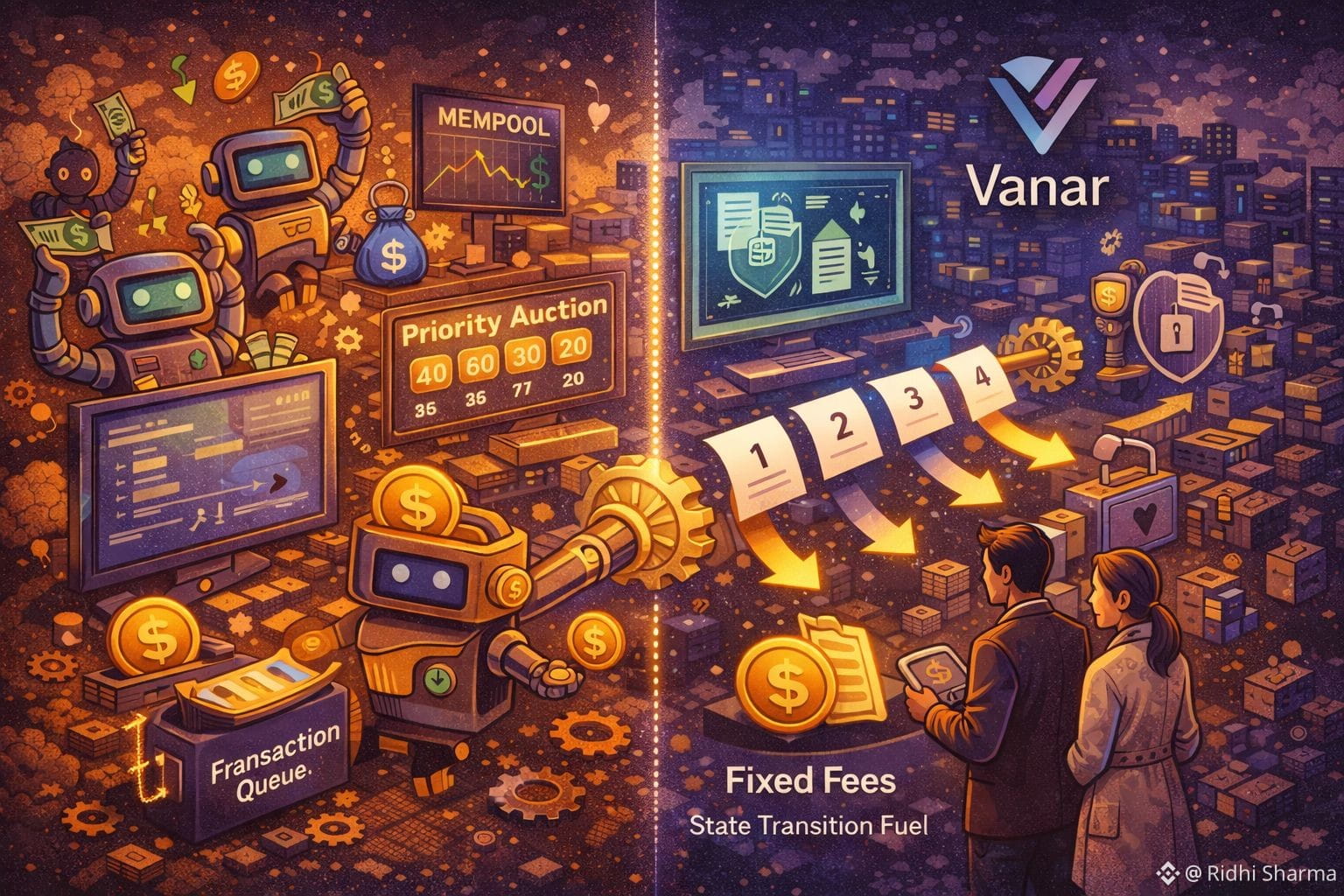
This design choice has deep implications for correctness, scalability, and long-term reliability.
Transactions Begin With Intent, Not Competition
On many blockchains, a transaction enters a mempool and immediately competes with others. Priority is determined by who pays more, not by order or fairness. This turns transaction processing into an auction.
Vanar rejects that model.
On Vanar Chain, transactions enter a first-in, first-out execution pipeline. Once submitted, a transaction’s position is determined by time not bidding power. This shifts the system from a competitive market to a deterministic queue.
The result is subtle but powerful:
Users know when their transaction will be processed
Applications can reason about execution order
State changes follow a clear timeline
This is closer to how traditional financial systems handle settlement.
Execution Is Predictable by Design
After entering the queue, transactions are executed within a controlled block environment defined by:
Stable block timing
Fixed execution costs
Known gas limits
Because fees are fixed and blocks are produced regularly, execution does not fluctuate based on external pressure. A transaction that works today will behave the same way tomorrow.
This predictability is critical for applications that depend on:
Sequential actions
Time-based logic
Multi-step workflows
Vanar makes execution behavior repeatable, not probabilistic.
State Changes Are Bounded, Not Explosive
One of the hidden risks in blockchain systems is unbounded state growth and unpredictable computation. Vanar addresses this by combining fixed fees with transaction size awareness.
Larger, more complex transactions are priced differently than simple ones. This ensures that no single action can unexpectedly dominate block resources.
From a state-management perspective, this means:
Blocks remain balanced
Execution stays within expected limits
Validators can process state changes reliably
State evolves steadily, not violently.
Finality That Aligns With Human Expectations
Finality is not just a technical concept it’s a user-facing promise.
#vanar ’s ~3-second block time ensures that state transitions reach finality quickly and consistently. There are no long confirmation chains or probabilistic waiting periods.
Once a transaction is included and confirmed, the resulting state is treated as settled.
This is especially important for:
Interactive applications
Financial logic
Systems that react immediately to outcomes
Vanar minimizes the gap between action and certainty.
$VANRY as the State Transition Fuel
VANRY’s primary role in this lifecycle is functional: it fuels state transitions.
Because fees are predictable and emissions are long-term, VANRY does not distort execution behavior. Users don’t rush transactions. Validators don’t reorder execution for profit. The token supports the system without interfering with it.
This keeps the transaction lifecycle clean and disciplined.
Why This Design Scales Better Over Time
As networks grow, complexity compounds. Systems that rely on competition and volatility struggle to maintain consistency.
Vanar’s approach scales differently:
More users means longer queues, not higher chaos
More activity means steady throughput, not fee explosions
More applications means structured state growth
This is how infrastructure survives scale by staying boring and predictable.
A Chain That Treats State Seriously
#Vanar Chain feels like it was designed by people who understand that correctness beats excitement.
By treating transactions as orderly state transitions rather than competitive events, Vanar builds a foundation where applications can rely on outcomes not probabilities.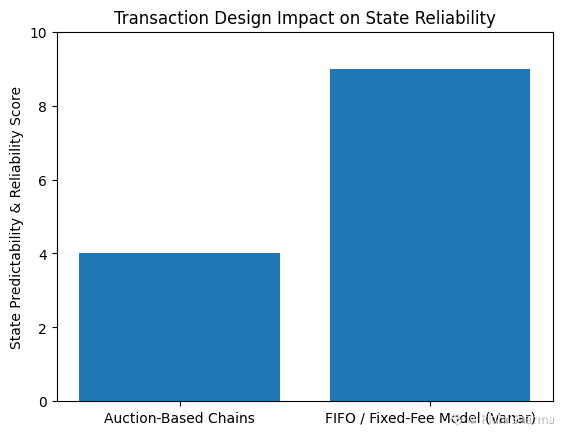
That’s a quiet design choice.
But it’s one that separates infrastructure from experiments.
