
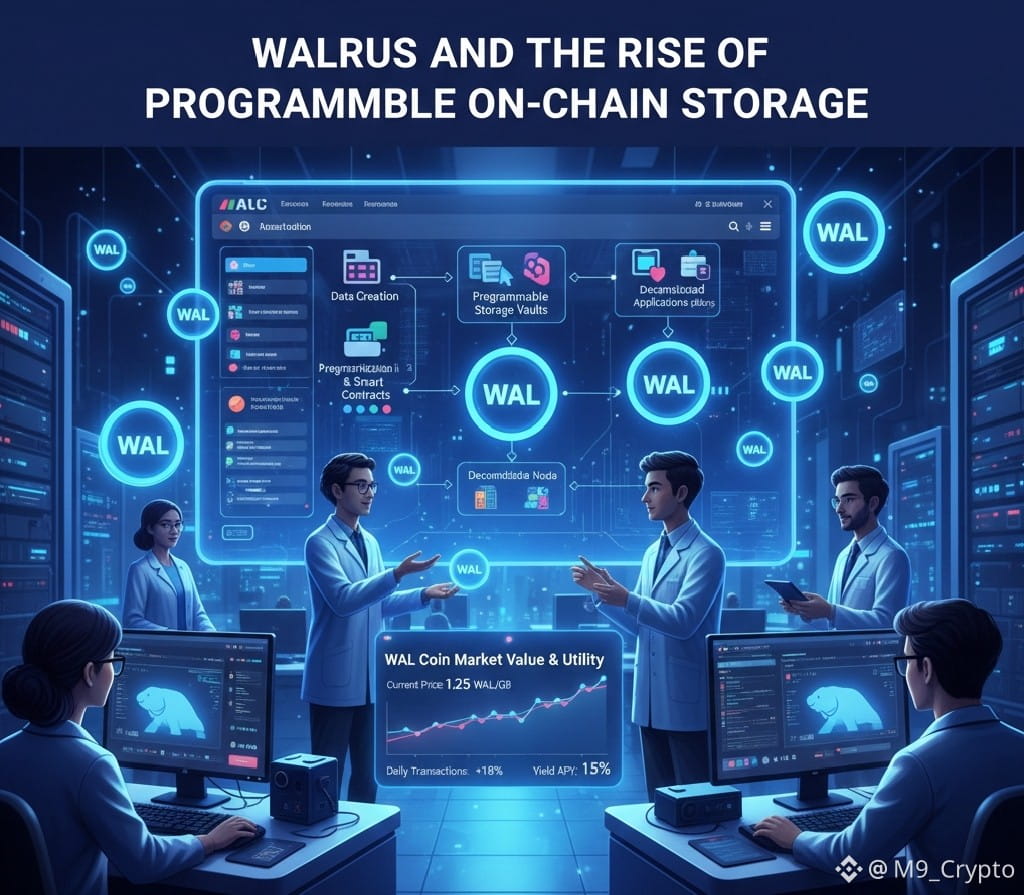
For a long time, blockchains have been described mainly as financial systems. Payments, tokens, DeFi, and speculation dominate the conversation. But at a deeper level, blockchains are coordination machines. They define ownership, responsibility, permissions, and rules without relying on centralized authorities.
What has always been missing from this vision is not logic or value—but data.
Modern applications depend on massive amounts of information: images, videos, gaming assets, AI training data, logs, records, and historical archives. Storing this kind of data directly on traditional blockchains is impractical due to high costs, limited throughput, and slow performance. As a workaround, Web3 applications typically store data off-chain and only keep references or hashes on-chain.
While this approach works technically, it weakens the promise of decentralization. If the actual data can disappear, be censored, or become too expensive to access, then the application is only partially on-chain. This gap between on-chain logic and off-chain data is where Walrus enters the picture.
The Core Vision: Treating Data Like an On-Chain Asset
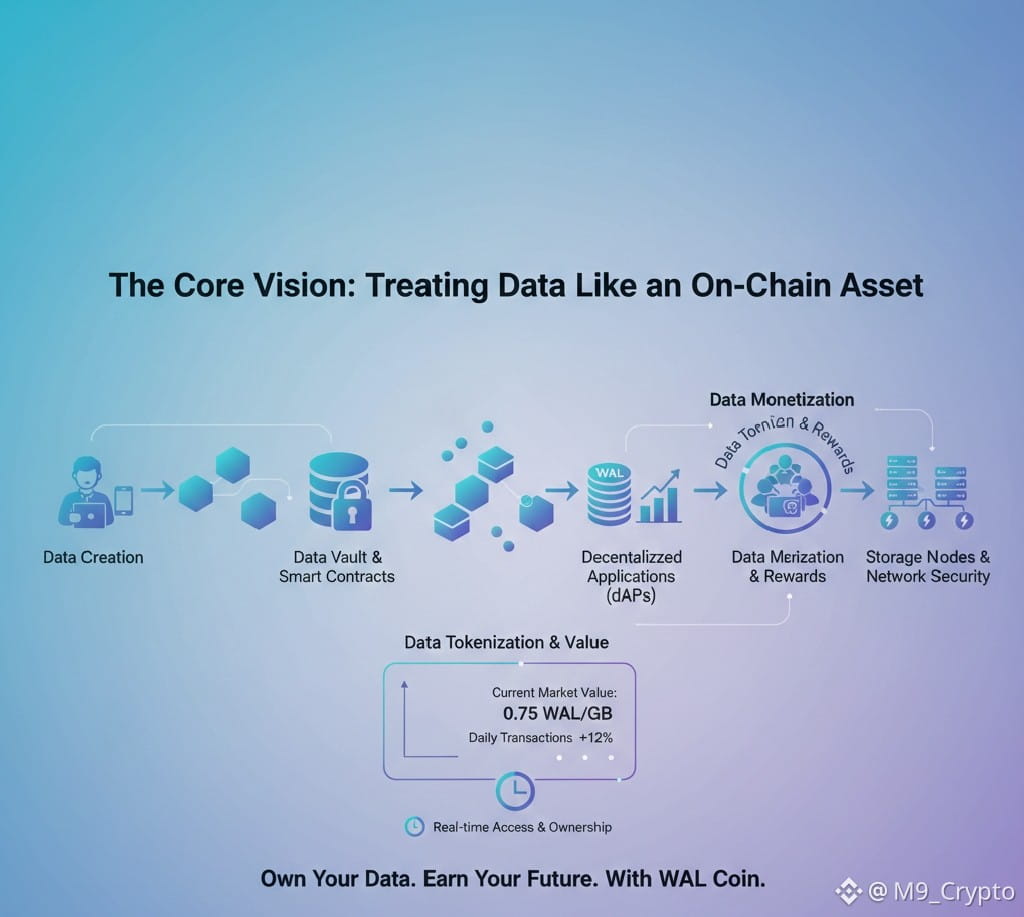
Walrus is built around a simple but powerful idea: data should behave like a native blockchain resource, just like tokens or NFTs. Instead of being an external dependency, storage becomes programmable, verifiable, and economically sustainable within the Web3 ecosystem.
Walrus is a decentralized protocol designed for storing large, unstructured data—often referred to as blobs. These blobs can include media files, AI datasets, archives, and other heavy content that traditional blockchains struggle to handle. Rather than operating as a loose network of storage nodes, Walrus uses Sui as its coordination and control layer, giving storage a clearly defined lifecycle governed by on-chain rules.
Mysten Labs introduced Walrus as a secure blob storage solution, initially releasing it as a developer preview for Sui builders, with plans to expand access more broadly. The long-term ambition is not just storage—but programmable storage, where data can be rented, shared, restricted, monetized, and referenced by smart contracts.
Why Decentralized Storage Has Been So Hard
Decentralized storage is not a new idea. However, many previous systems have struggled to achieve usability at scale. Replicating entire files across many nodes is expensive. Recovery processes can be slow. Proof mechanisms are often complex and computationally heavy.
One persistent issue in erasure-coded systems is repair cost. When a node goes offline, replacing it can require large data transfers across the network, which undermines efficiency gains and increases operational overhead.
Walrus aims to keep the advantages of decentralized storage—no single owner, high reliability, and open participation—while significantly reducing the friction that has historically made these systems difficult to deploy in real-world applications.
The Technical Backbone: Red Stuff Encoding
At the heart of Walrus lies a specialized erasure-coding technique known as Red Stuff Encoding. This method uses a two-dimensional structure that allows data to be split, distributed, and recovered efficiently across many nodes.
Instead of storing full copies of a file, Walrus divides data into fragments, adds carefully designed redundancy, and spreads those fragments throughout the network. Even if multiple nodes fail or go offline, the original file can still be reconstructed from the remaining pieces.
What makes Red Stuff particularly valuable is its efficiency. According to the Walrus design, the encoding and recovery processes rely on fast, linearly decodable operations, allowing the system to scale to hundreds of nodes without excessive overhead. Compared to older, math-heavy erasure-coding approaches, this design prioritizes speed, flexibility, and real-world reliability.
The result is a storage system that can handle frequent node churn—nodes joining and leaving—without triggering massive data reshuffling or performance degradation.
Sui as the Control Plane
Rather than creating a standalone blockchain solely for storage, Walrus uses Sui as its control plane. This design choice allows Walrus to leverage existing on-chain infrastructure for coordination, payments, and verification.
Through Sui, the network can manage who stored what, for how long, under which conditions, and at what cost. Storage agreements, incentives, and rules become transparent and enforceable on-chain. This makes storage not just decentralized, but auditable and programmable.
By avoiding a fully custom chain, Walrus also reduces complexity for developers who are already building within the Sui ecosystem.
Proof of Availability: Making Storage Trustless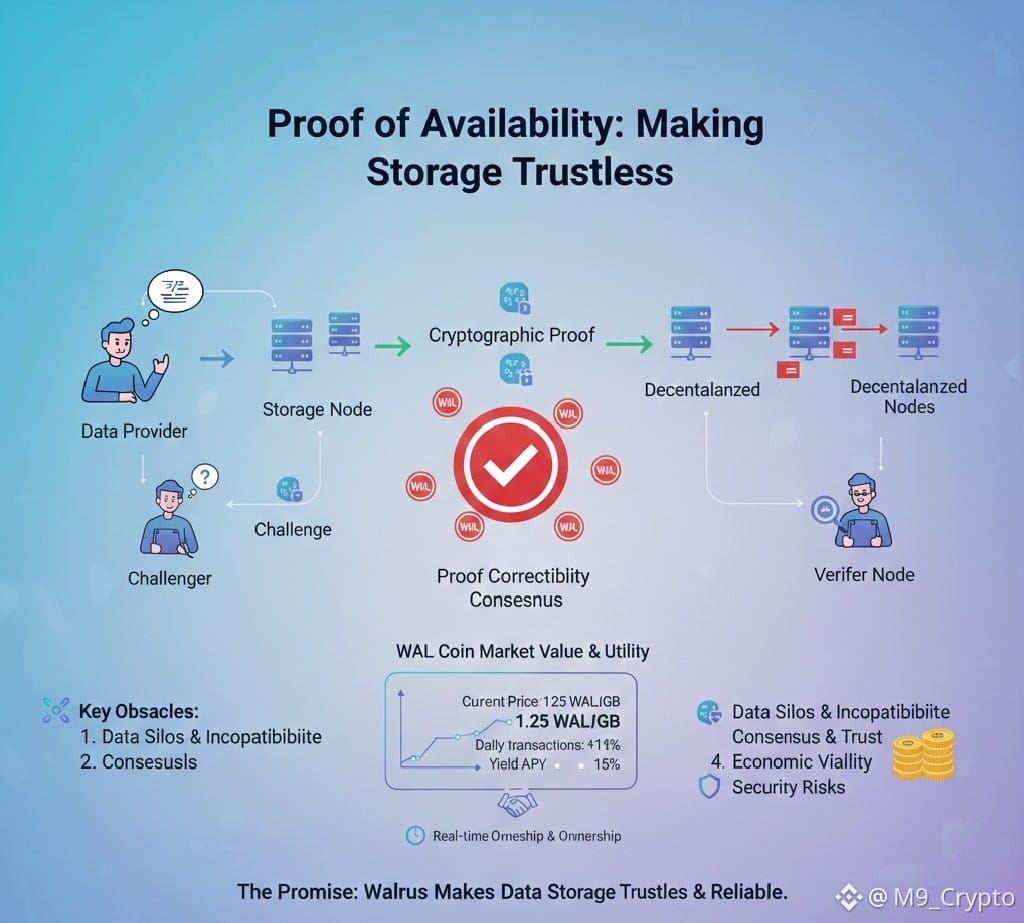
A storage system is only useful if users can trust that their data will remain available. Walrus introduces Proof of Availability (PoA) to address this concern.
PoA acts as an on-chain certificate issued through Sui, confirming that data has been accepted by the network and is under active custody. Applications can reference this proof as evidence that storage obligations are being met.
This is a significant shift from traditional cloud storage models, where availability is governed by private contracts. In Walrus, storage becomes a public service, backed by cryptographic proofs and economic incentives rather than trust in a single provider.
Economics of WAL: Predictable and Human-Friendly
One of the biggest challenges in Web3 infrastructure is unstable pricing. Storage costs in the real world are relatively predictable, but token-based systems often fluctuate wildly.
Walrus attempts to solve this by designing WAL—the network’s payment token—around stable, fiat-aligned pricing. Storage fees are calculated to remain consistent over time, making it easier for users and businesses to budget their costs.
Payments are distributed to storage nodes and stakers, ensuring that those who maintain the network are fairly compensated while keeping the service practical for everyday use.
Staking, Security, and Long-Term Growth
Walrus operates under a proof-of-stake model, where WAL holders can stake tokens to support network security and earn rewards. The reward structure is designed to favor long-term sustainability rather than short-term hype.
Early rewards are higher to bootstrap the network, then gradually adjust as adoption grows. This reflects a realistic understanding of storage networks: success comes from slow, steady usage, not sudden speculation.
The goal is for Walrus to mature into reliable infrastructure—boring, dependable, and widely used.
Unlocking the Data Economy
If Walrus succeeds, data stops being just an operational cost and becomes a programmable resource. Applications can store data, define access rules, and automatically monetize usage without intermediaries.
This opens the door to new data-driven business models, particularly in areas like AI. Autonomous agents require persistent memory, datasets, and logs. When these agents operate on-chain, they need storage that is verifiable, programmable, and predictable in cost—exactly the niche Walrus aims to fill.
Risks, Reality, and What Success Looks Like
The real test for Walrus is not price action, but developer adoption. Success means builders choosing Walrus by default because it is reliable, easy to integrate, and cost-effective.
Challenges remain. The network must prove it can scale under stress, maintain incentives for node operators, and deliver consistent performance over time. While the technical and economic designs address these risks, real-world usage will ultimately determine the outcome.
Final Thoughts: Why Walrus Matters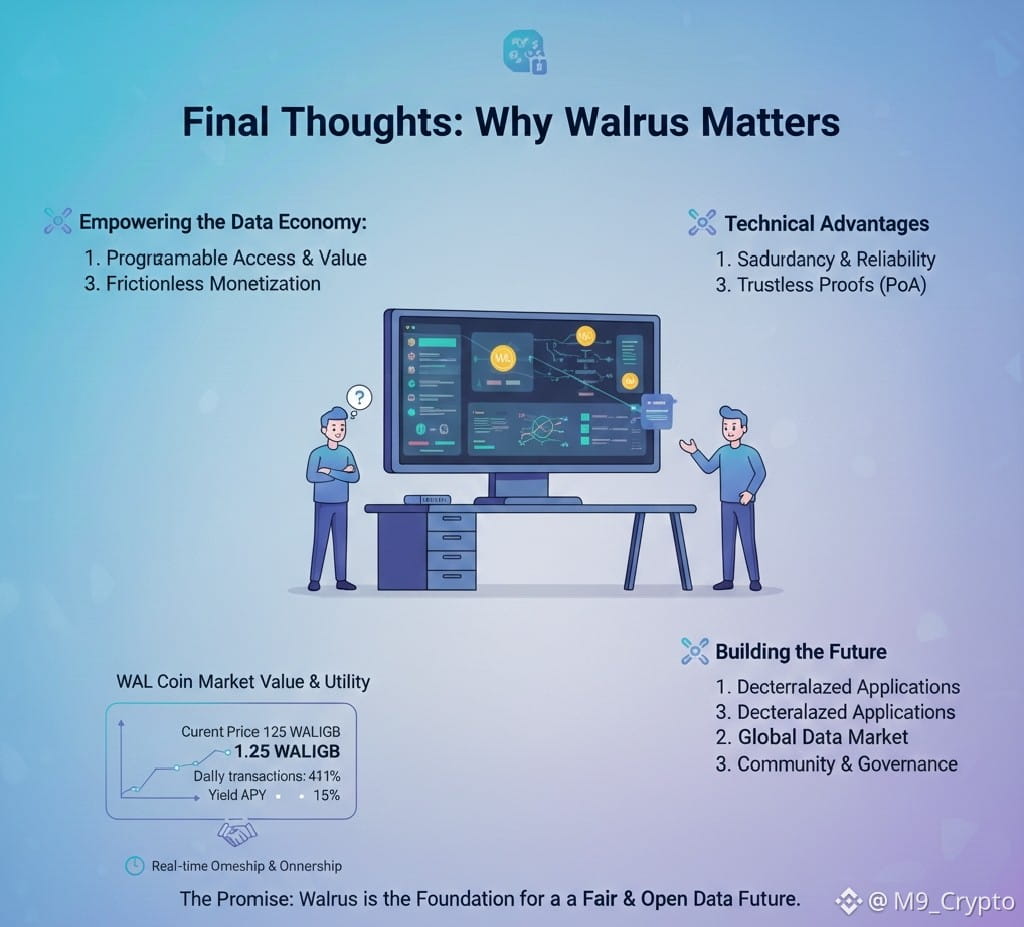
The future of Web3 will be limited less by smart contracts and more by data. Media platforms, AI systems, games, and enterprise workflows all depend on large-scale storage. Without a decentralized alternative, these applications remain tied to Web2 infrastructure.
Walrus proposes a world where storage is as programmable as value—where data becomes a first-class citizen on-chain. If that vision holds, decentralized storage will no longer be an afterthought, but a foundation for the next generation of blockchain applications.