
Vanar makes the most sense when blockchains are viewed not as tools for human interaction, but as foundational infrastructure for machines. The next phase of blockchain adoption will not be driven by people manually clicking buttons. Instead, it will be powered by automated systems such as AI agents, payment routers, compliance engines, and background software that moves value continuously and autonomously.
For machines, reliability matters far more than excitement. This is where Vanar positions itself differently from most existing blockchains. Many current networks still function like open auctions, where transaction fees fluctuate constantly and execution priority is determined by who bids the highest at that moment. While this approach may work for speculation, it fails in automated environments. An AI agent cannot operate safely if transaction costs swing unpredictably from fractions of a cent to several dollars.
Such uncertainty makes it impossible to scale activities like streaming payments, settling invoices, or rebalancing portfolios automatically. Vanar addresses this issue by introducing a fixed-fee model, where transaction costs are linked to stable fiat values rather than volatile token prices. This allows automated systems to rely on consistent cost structures.
The idea alone is not enough—execution is what matters. Vanar implements protocol-level fee recalibration using multiple price feeds. The mechanism is straightforward: as token prices change, fees are adjusted internally so users experience stable and predictable costs. This principle is standard in traditional business systems, where reliable cost modeling is essential. By making transaction costs estimable, Vanar shifts blockchain usage away from speculation and toward dependable infrastructure.
However, low fees by themselves create another challenge: spam and abuse. Vanar counters this risk with a tiered gas system. Simple, everyday transactions remain extremely cheap, while larger or more resource-heavy operations move into higher fee brackets. This creates an economic defense mechanism—normal users are not penalized, but large-scale attacks become expensive and impractical.
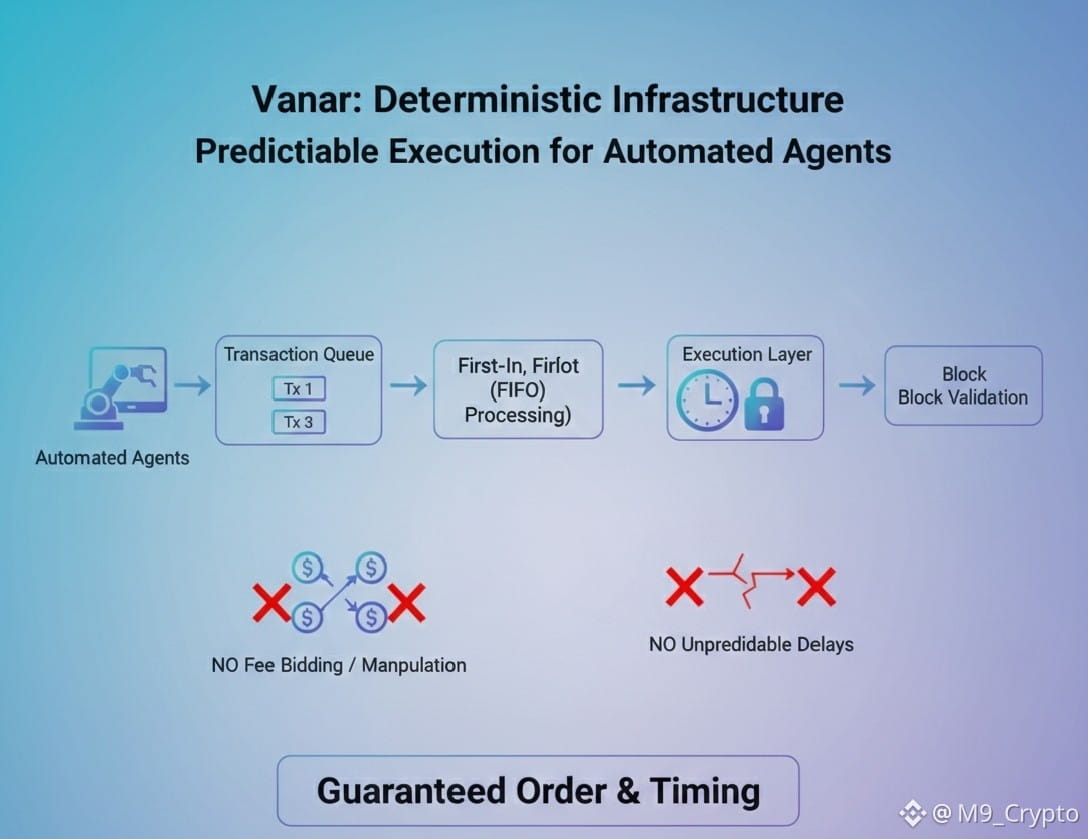
Transaction ordering is another often-overlooked aspect that becomes critical in automation. Instead of prioritizing transactions based on fee bidding, Vanar processes them on a first-in, first-out basis. This removes ambiguity and eliminates manipulation. For automated agents, predictability in execution timing is essential. When a transaction is submitted, the system must guarantee it will be processed without delays caused by bidding wars. This design choice reinforces Vanar’s role as deterministic infrastructure rather than a competitive marketplace.
Governance and security follow the same pragmatic philosophy. Vanar begins with a Proof-of-Authority model and gradually transitions toward Proof-of-Reputation. In the early stages, this allows the network to operate efficiently with accountable validators and fast decision-making. Over time, new validators are onboarded based on performance, behavior, and reputation. While this approach sacrifices early decentralization purity, it prioritizes stability and trust—an acceptable trade-off for enterprise and institutional use cases.
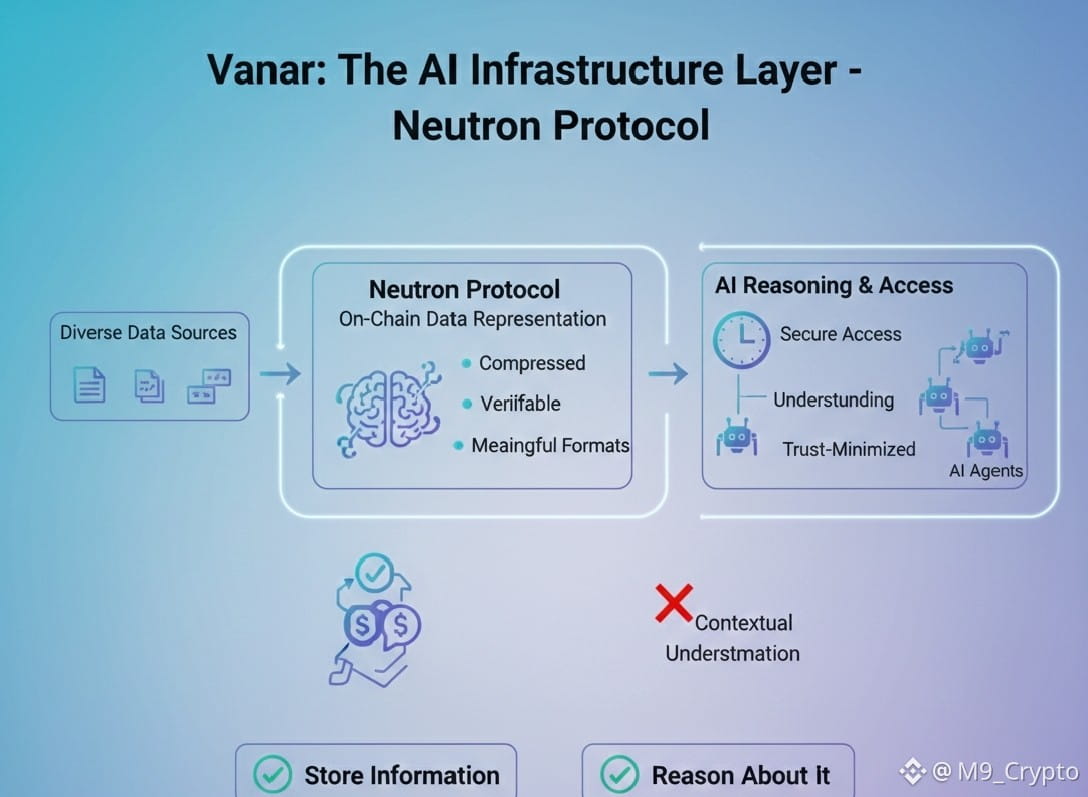
Vanar’s approach to AI is also notably grounded. Rather than embedding AI features directly into applications, it treats intelligence as an infrastructure layer. Through Neutron, data can be represented on-chain in compressed, verifiable, and meaningful formats. This allows software not just to store information, but to reason about it. AI agents can securely access documents, media, and transaction context in an efficient and trust-minimized way.
This context layer is critical because financial transactions are never just value transfers. They involve invoices, contracts, receipts, identity checks, and regulatory requirements. Most blockchains ignore this dimension entirely. Vanar argues that by verifying and compressing this contextual data, AI agents can understand it and act accordingly—enabling automated, compliant financial workflows rather than simple token movements.
As AI agents become more prevalent, the role of blockchains will fundamentally change. Instead of users manually managing wallets, intelligent agents will negotiate, execute, and audit transactions in real time. For this to work, the underlying rails must be consistent: predictable fees, deterministic ordering, and verifiable information. Vanar’s design choices align closely with these requirements, positioning it as backend infrastructure for autonomous systems rather than a consumer-facing blockchain.
This machine-first perspective also explains Vanar’s focus on real-world payment integration. Partnerships aimed at stablecoin adoption and traditional payment rails signal a long-term vision: becoming a blockchain layer that existing financial systems can safely integrate with. In this context, distribution and real-world usage matter more than ideology. A technically elegant chain without merchants, processors, or institutions remains isolated.
The same philosophy extends to tokenomics. New token issuance is primarily directed toward validators and ongoing development rather than insiders. There are no large team allocations, suggesting a focus on long-term security and ecosystem growth instead of short-term extraction. Block rewards decline over time, encouraging early participation while maintaining sustainability.
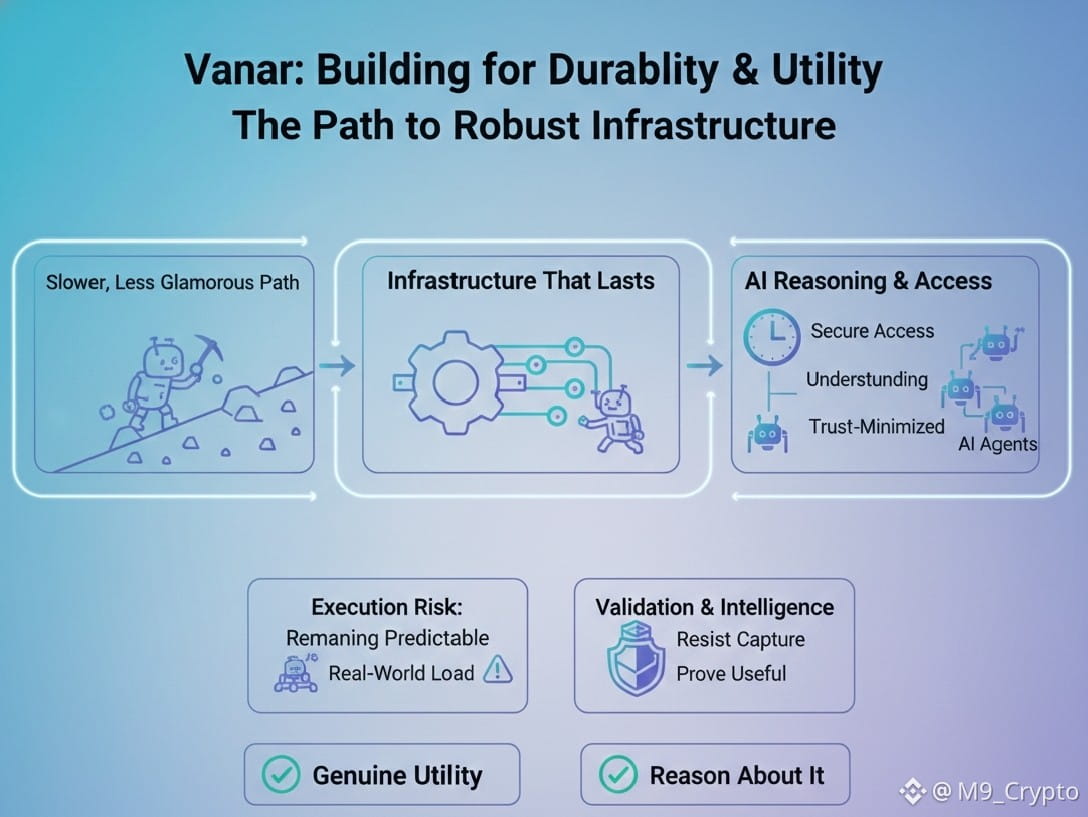
Ultimately, Vanar is not chasing hype cycles—it is building for durability. This is a slower and less glamorous path, but history shows that infrastructure tends to last longer than attention-driven products. The systems that run quietly in the background often become the most critical.
The main risk lies in execution. Predictable systems must remain predictable under real-world load. Reputation-based validation must resist capture, and intelligent data structures must prove useful beyond demonstrations. If Vanar succeeds in these areas, it could become one of the rare blockchains chosen not for excitement, but for genuine utility.
In a future where value moves automatically, AI agents dominate, and compliance is mandatory, the most important blockchains may be the least visible. Vanar is building toward that future—and that may be its strongest signal of intent.
