
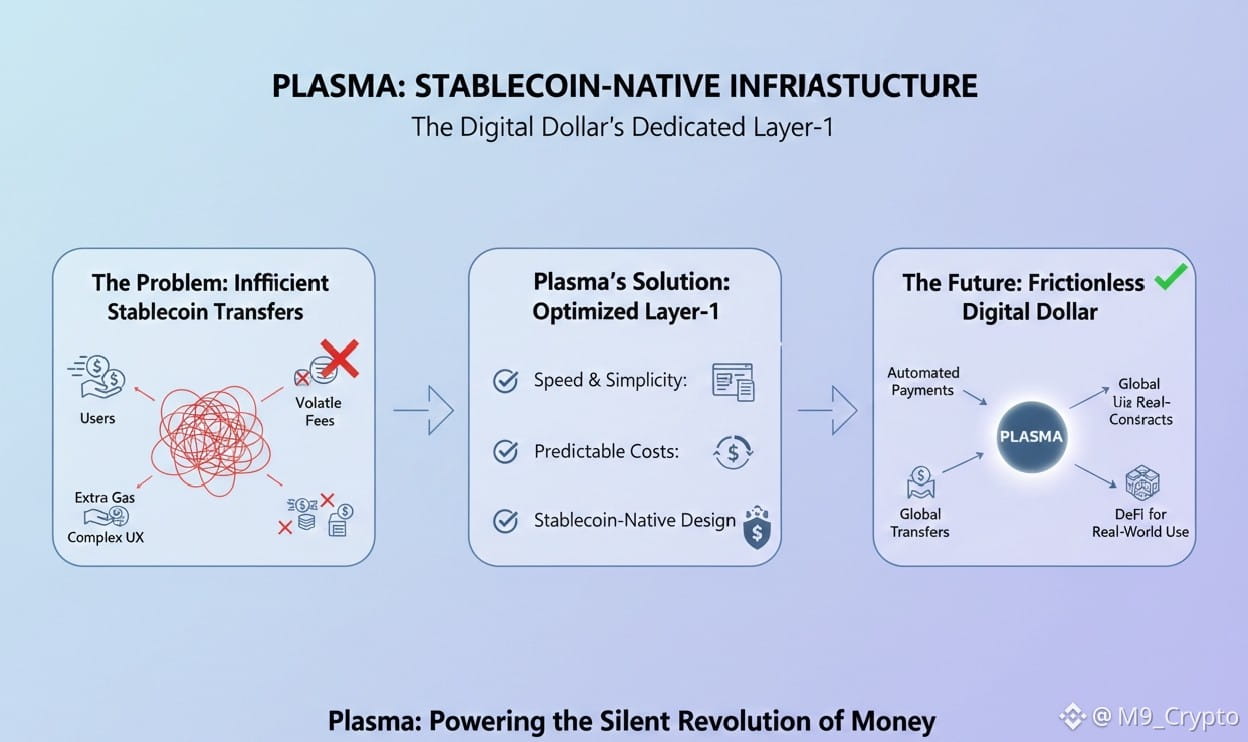
Most blockchains try to do everything at once. Payments, DeFi, NFTs, gaming, identity, and even abstract ideas like becoming a “world computer.” Plasma takes a different path. Instead of expanding horizontally, it narrows its focus around a single observation that most networks overlook: stablecoins have already become the digital dollar, but the infrastructure beneath them is still inefficient.
USDT and similar stablecoins are already used globally. People save in them, send them across borders, and settle obligations with them. Yet the experience remains awkward. Users must hold extra gas tokens, fees fluctuate during congestion, and simple transfers feel like interacting with developer tooling rather than money. Plasma exists to remove this friction at the base layer.
Plasma is a Layer-1 blockchain designed specifically for stablecoin payments at scale. It is fully EVM-compatible, allowing developers to use familiar tools, but the design priorities are centered around high-volume, low-friction transfers. The goal is not to compete for attention—it is to quietly power the movement of digital dollars.
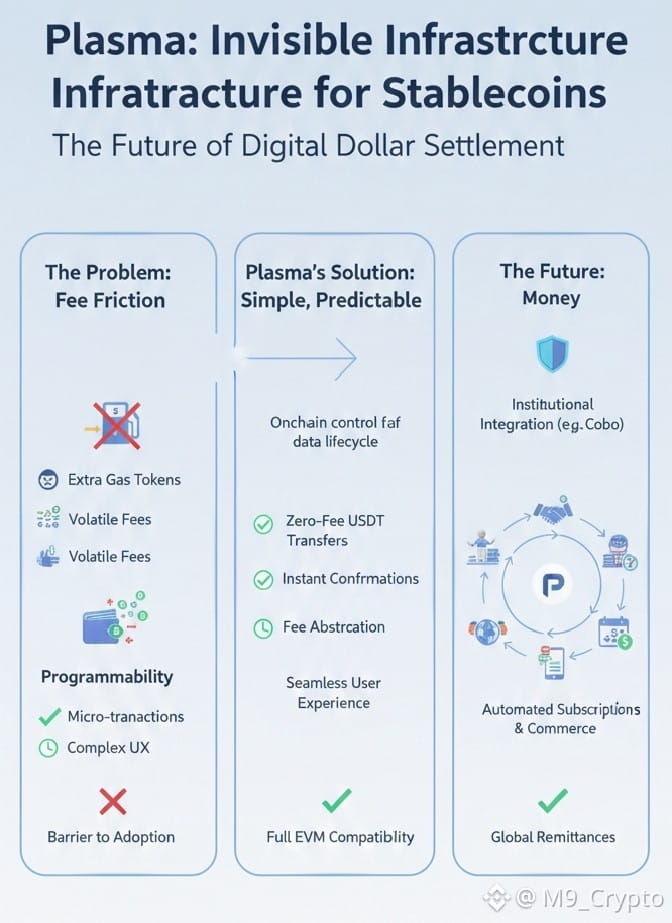
The core thesis behind Plasma is simple: people using stablecoins are not seeking speculation. They are not excited about gas tokens or yield mechanics. What they want is speed, predictable costs, and simplicity. Stablecoins already provide price stability and global reach, but most chains treat them as secondary assets rather than first-class money.
Plasma flips this model. If stablecoins are becoming the internet’s default currency, then the chain underneath them must be built around their needs. This is why Plasma is designed as stablecoin-native infrastructure, not a general-purpose chain that happens to support stablecoins.
Zero-fee USDT transfers are not a marketing trick. They are a consequence of the architecture. Plasma removes the requirement for users to hold volatile tokens “just in case” a fee is needed. This eliminates cognitive friction and makes stablecoins feel like money rather than applications layered on top of complex systems.
Fee friction is one of the largest barriers to stablecoin adoption, especially for small or frequent payments. Plasma’s design allows wallets to abstract away gas entirely, enabling micro-transactions, subscriptions, and everyday commerce. Over time, this encourages stablecoins to be used as utilities rather than speculative instruments.
Payments alone, however, are not enough. A modern payment network must also be programmable. Plasma embraces full EVM compatibility so that stablecoin transfers can interact with smart contracts seamlessly. This bridges the gap between simple payments and programmable money without forcing developers to adopt new tooling or languages.
The future stablecoin economy will not revolve around basic transfers. It will include payroll systems that automatically allocate funds, merchant tools with instant settlement, subscription models with refund logic, and global marketplaces using escrow rules. Plasma is built to support this complexity while keeping the user experience simple.
Security is where Plasma anchors its long-term credibility. Rather than inventing a new narrative, Plasma aligns itself with Bitcoin’s reputation for neutrality and permanence. Through a trust-reduced Bitcoin bridge, BTC can be used in smart contracts while benefiting from Bitcoin’s security assumptions. Speed alone is easy to advertise; trust is much harder to earn.
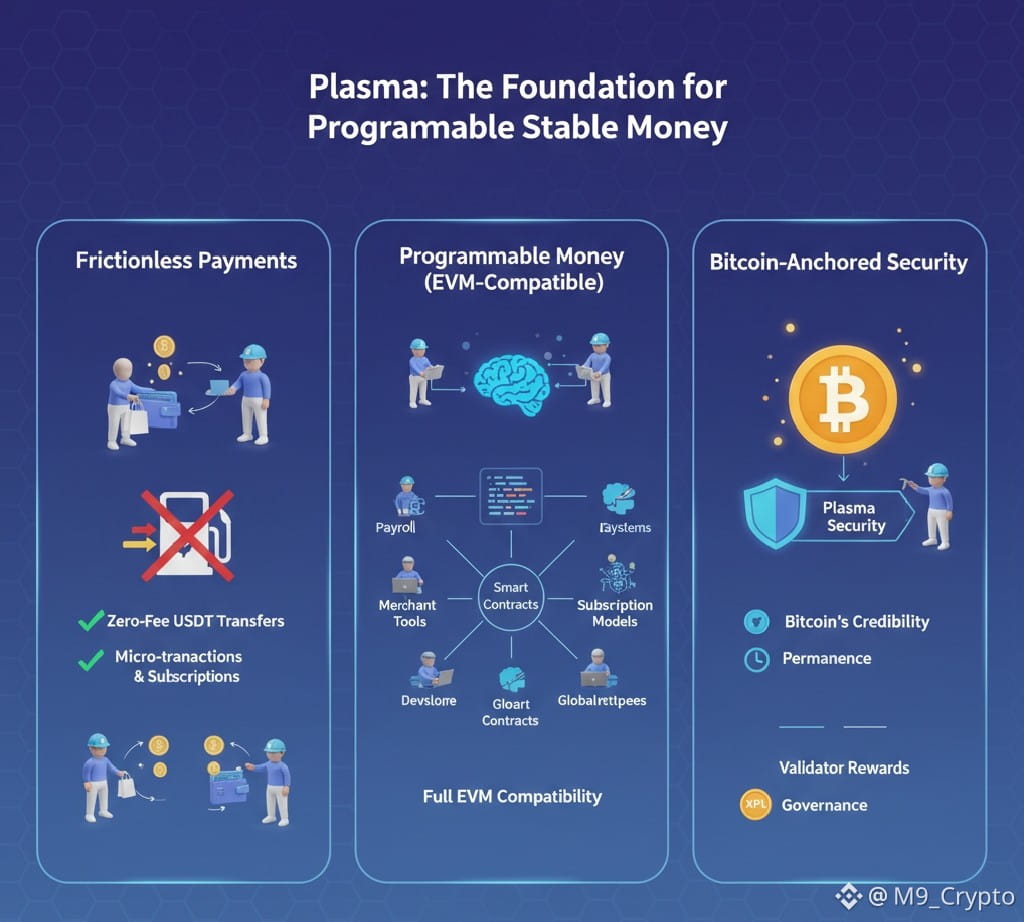
The objective is clear: combine Bitcoin’s credibility with a modern payment chain that feels fast, intuitive, and developer-friendly. If stablecoins are to be treated as real money, they must settle on infrastructure that carries a strong security and settlement narrative.
XPL, Plasma’s native token, plays a supporting—not dominant—role. In a stablecoin-first system, users prefer to remain in stable assets, but the network still requires incentives, validator rewards, and governance. XPL coordinates these economic functions without forcing volatility onto everyday users.
This structure makes zero-fee stablecoin transfers sustainable. Plasma does not claim the network is free; it ensures that costs are absorbed at the infrastructure level rather than pushed onto someone sending $20 to a family member. Validator economics, architecture, and non-core monetization support the system.
Real adoption is measured by integration, not slogans. Institutional partners care less about narratives and more about reliability. The integration announced by Cobo, a major digital-asset custodian, highlights Plasma’s positioning as a stablecoin settlement layer, referencing USDT0 and lifetime zero-fee transfers.
Infrastructure adoption usually begins with custodians and payment workflows before becoming visible to end users. Plasma appears to be following that path deliberately.
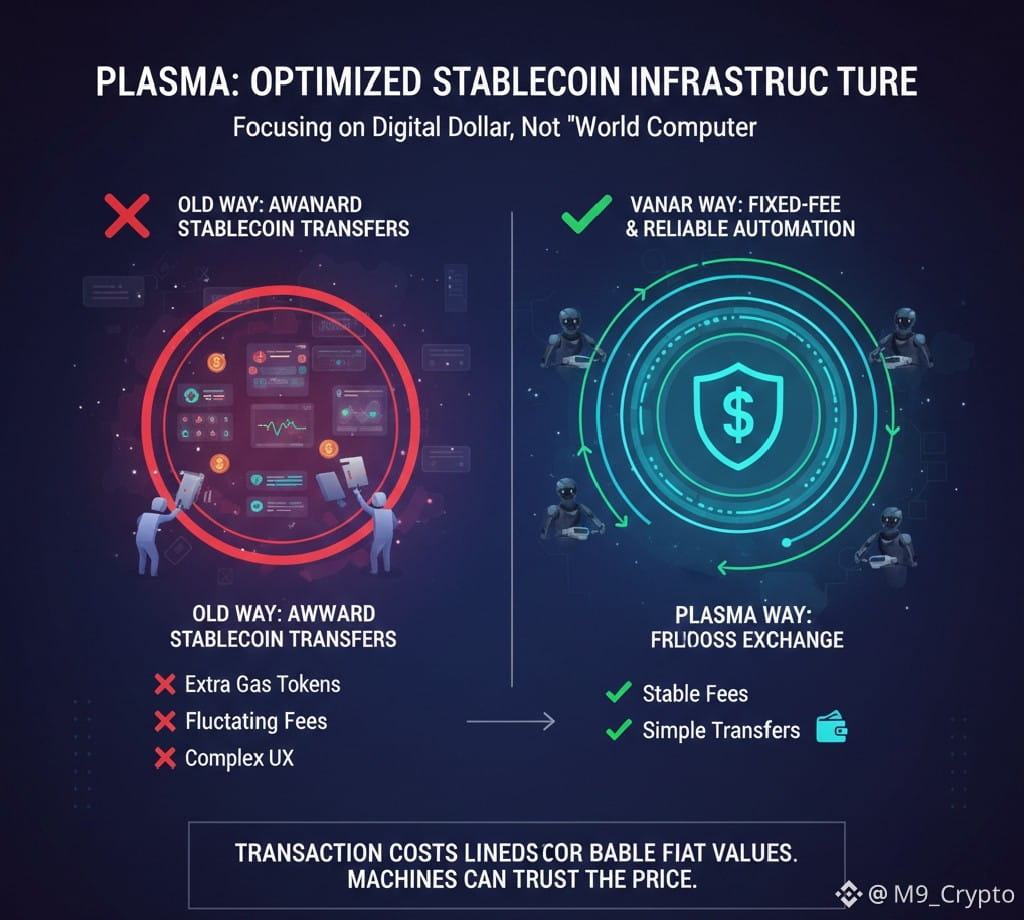
The long-term question is whether Plasma can make stablecoins invisible. The ideal experience is simple: open a wallet, send digital dollars, done. No explanations, no gas tokens, no complexity.
Plasma’s educational focus reflects this goal—emphasizing speed, simplicity, and usability rather than speculation. Instant confirmations, stablecoin-first contracts, and fee abstraction define the experience.
There are risks. A stablecoin-centric strategy depends on issuer policies and regulation. Plasma plans to support multiple stablecoins over time, but USDT remains central. Sustainability of zero-fee transfers must also be proven under real network conditions. Competition from existing chains and L2s is real, and Plasma’s bet is that specialization will outperform generalization as markets mature.
These risks raise the bar but do not invalidate the thesis. Payment rails are infrastructure, not memes. They must earn trust through execution.
Plasma stands out because of focus, not novelty. In a space driven by attention, clarity of purpose is rare. If Plasma succeeds, it will not look like a typical crypto success—it will look like boring, dependable money quietly moving across the internet.

