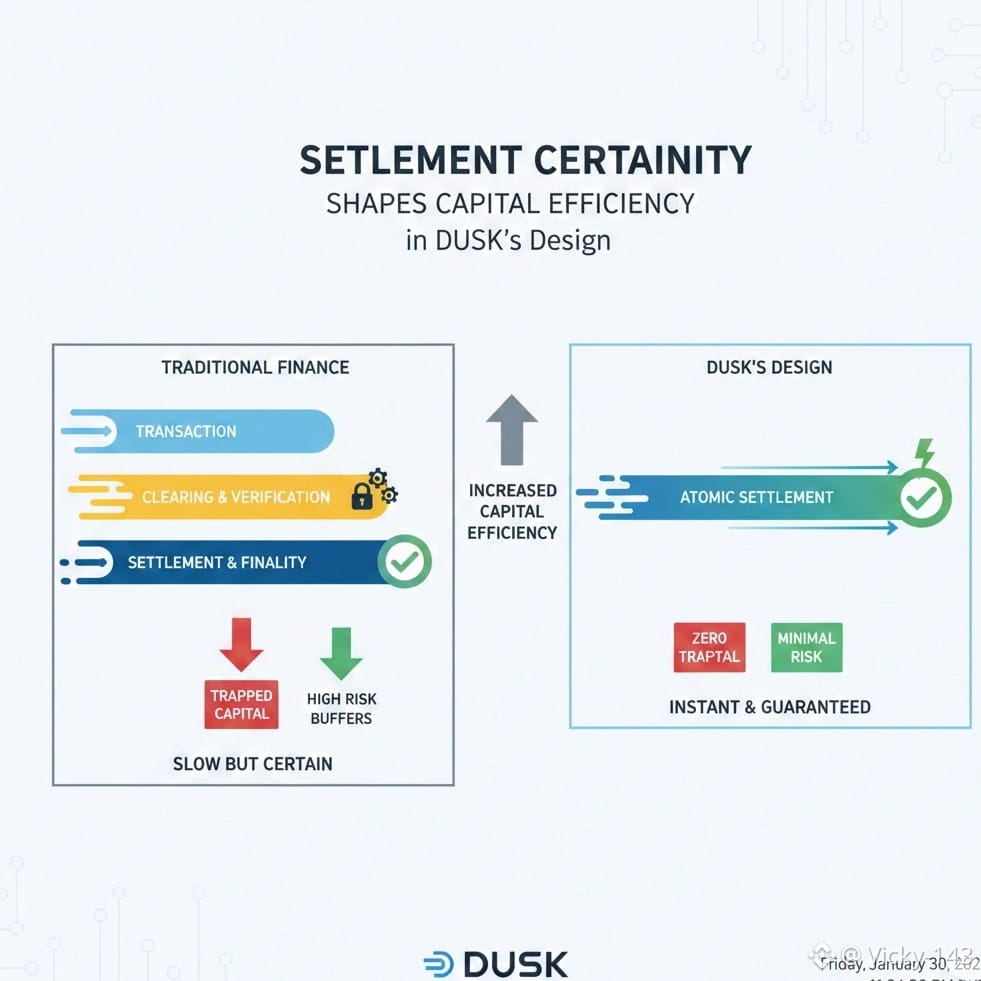
In the financial markets capital does not simply move from one party to another. It passes through layers of verification clearing and settlement before it becomes usable again. The moment settlement is complete defines when risk ends and resources can be redeployed. When this moment is unclear or delayed capital remains trapped in uncertainty. Over time this inefficiency accumulates across the entire system.
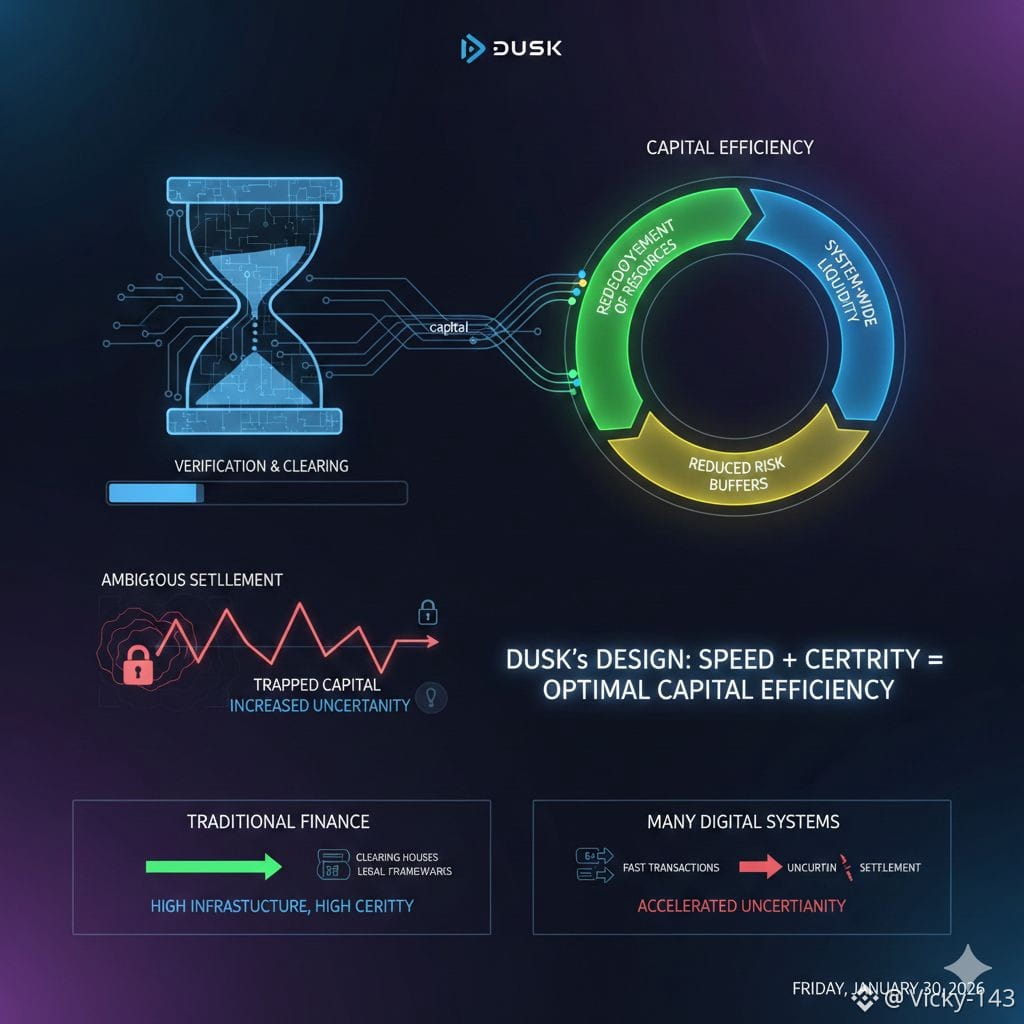
Traditional finance invests enormous infrastructure into achieving settlement certainty. Clearing houses legal frameworks and reconciliation processes exist primarily to ensure that obligations are fulfilled definitively. Without this certainty markets would require far larger risk buffers and manual oversight. Capital efficiency would collapse under the weight of unresolved exposure.
Many digital systems misunderstand this principle. They focus on transaction speed while leaving settlement behavior ambiguous. A transaction may appear confirmed quickly but still carry risk of reversal dispute or delay. In regulated finance speed without certainty does not reduce friction. It merely accelerates uncertainty.
Capital efficiency depends on knowing exactly when assets are settled. Institutions cannot reuse funds until obligations are legally and operationally complete. If settlement is probabilistic or reversible risk managers must assume worst case scenarios. This increases collateral requirements and reduces available liquidity.
Uncertain settlement also increases operational cost. Institutions must monitor pending transactions reconcile records and manage exposure manually. These processes consume resources that could otherwise be deployed productively. Over time the cost of managing uncertainty often exceeds the benefit of faster execution.
Clear finality transforms financial workflows. When settlement is deterministic institutions can immediately reuse capital. Liquidity circulates faster without increasing risk. Automation becomes reliable because outcomes are enforced rather than assumed. This efficiency compounds across markets.
Legal clarity is another critical aspect of settlement certainty. In regulated finance disputes are resolved based on definitive records. Systems must provide a clear boundary where obligations end. If settlement can be challenged later accountability becomes blurred. Deterministic finality creates a legal anchor that courts regulators and institutions can rely on.
Unclear settlement also affects market confidence. Participants hesitate when outcomes are uncertain. Liquidity thins and spreads widen. Even technically advanced systems struggle to gain adoption if settlement behavior remains ambiguous. Confidence grows when completion is absolute.
DUSK is designed with settlement certainty as a foundational requirement. Its architecture treats finality not as a performance feature but as a structural property. Transactions reach a clear and irreversible conclusion that aligns with legal and operational expectations.
Deterministic settlement within DUSK ensures that once a transaction is finalized it cannot be altered or questioned. This removes lingering exposure and allows immediate reuse of capital. Institutions can operate workflows continuously without waiting for additional confirmation layers.
This design directly improves capital efficiency. Funds do not remain idle due to pending risk. Liquidity flows more smoothly across participants. Risk buffers can be reduced because exposure is resolved definitively. Over time this efficiency becomes a competitive advantage.
Settlement certainty also simplifies integration with existing financial systems. Custody platforms accounting systems and compliance frameworks rely on settled data. When settlement behavior is predictable integration becomes straightforward. Records remain stable and interpretable.
Information handling complements this process. Controlled disclosure ensures that settlement outcomes can be verified without exposing sensitive transaction details publicly. Oversight exists without distorting market behavior. Confidentiality preserves fairness while finality ensures accountability.
Auditability strengthens settlement certainty further. Cryptographic proof confirms that transactions reached final state according to protocol rules. Regulators and auditors can verify outcomes objectively. This reduces disputes and removes reliance on manual reconciliation.
Governance stability is essential to maintaining settlement guarantees over time. Infrastructure built for regulated finance must ensure that rule changes do not undermine finality of past transactions. DUSK treats governance as a controlled process to preserve historical correctness.
During periods of market stress settlement certainty becomes even more valuable. When volatility increases institutions seek environments where exposure is resolved quickly and definitively. Systems with ambiguous settlement behavior often experience congestion and loss of confidence. Deterministic systems remain stable.
Capital markets reward platforms that remove uncertainty. Participants prefer environments where completion is guaranteed rather than probable. Over time liquidity concentrates where settlement behavior is most reliable.
Public blockchain environments that prioritize openness often struggle to deliver this level of certainty. Reorganizations delayed confirmations and coordination assumptions introduce risk. Institutions compensate by slowing activity and increasing buffers.
DUSK eliminates these issues by enforcing settlement at the protocol level. Finality is built into consensus and execution rather than layered on top. This structural choice aligns infrastructure behavior with financial reality.
As digital finance matures the importance of capital efficiency will only increase. Markets will not tolerate systems that trap liquidity in uncertainty. Infrastructure must allow rapid yet definitive resolution of obligations.
Settlement certainty also supports more complex financial instruments. Derivatives structured products and regulated securities require precise settlement boundaries. Without deterministic finality these instruments cannot operate safely on chain.
By centering settlement certainty in its design DUSK creates a foundation for scalable financial activity. Automation becomes dependable. Risk becomes manageable. Capital moves efficiently.
This approach reflects how traditional markets have evolved over decades. Systems that remove settlement uncertainty gradually replace those that rely on assumption. Digital infrastructure must follow the same trajectory.
The future of regulated on chain finance will belong to platforms that deliver clear and irreversible outcomes. Speed will matter only when certainty is guaranteed.
DUSK’s architecture embodies this principle by treating settlement finality as core infrastructure. This enables capital efficiency without increasing risk and supports long term institutional adoption.
In financial systems certainty is what unlocks scale. DUSK’s focus on deterministic settlement positions it as infrastructure built not just for movement of assets but for sustainable financial activity.
If you’d like, say Article 6 and I’ll continue with the next deep analytical piece in the same high quality long form style.