
The crash in the cryptocurrency market has always been a mirror that reveals the truth; either funds panic and withdraw from exchanges, clutching their wallets, or they flock to truly valuable safe havens. This time, however, the market has given an unusual answer: in 48 hours, $6.6 billion poured into Plasma at a pace that even surpassed the peak moments of Ethereum Layer 2.
Many attribute this achievement to Aave—after all, this massive capital is mostly concentrated in the Aave V3 protocol on Plasma. But those with clear eyes know this is just the surface. As a leading DeFi lending protocol, Aave is deployed across dozens of chains such as Ethereum, Tron, and Arbitrum. So why did it specifically explode on Plasma? The answer is simple: Plasma is not just an ordinary public chain; it is the only dedicated container for stablecoins in the crypto market, precisely hitting the pain points of the industry like a liquidity black hole. Its success also teaches a lesson to the competitive public chain space: vertical focus is far more effective than all-encompassing competition.
To understand Plasma's capital-raising logic, one must first grasp the core position of stablecoins in the DeFi ecosystem. Stablecoins are the lifeblood of DeFi, serving as a bridge between the crypto world and traditional finance. The global market cap of stablecoins exceeds $260 billion, supporting all operations of DeFi including lending, trading, and arbitrage. However, stablecoin circulation has long been troubled by two major pain points: first, transaction friction; on most public chains, even transferring USDT incurs Gas fees priced in native tokens, leading to high costs for frequent transactions; second, low transfer efficiency; general-purpose public chains have slow settlement speeds, often causing network congestion during high-frequency stablecoin lending activities.
Plasma's first smart move was embedding 'serving stablecoins' into its underlying architecture, achieving extreme foundational adaptability. It doesn't rely on flashy new technologies but instead uses the most mature solutions to tackle the most pressing issues: it enables zero Gas transfers for stablecoins through account abstraction technology, allowing users to send USDT or USDC without paying any fees; it also achieves instant settlement, meaning even high-frequency lending operations can be settled in real-time. This kind of experience directly addresses the core demand of the stablecoin lending market—high frequency and low friction.
It's important to note that top-tier protocols like Aave are notoriously picky about infrastructure. What they need isn't just a simple 'chain', but a 'port' that allows for efficient capital flow without extra costs. Plasma has perfectly built this port, with zero Gas fees and instant settlement at its core, aligning seamlessly with Aave's business logic, maximizing stablecoin lending efficiency while minimizing costs. This isn't luck; it's a solid victory of product-market fit (PMF). Just like a supercar can only unleash its full potential on a dedicated racetrack, Aave's breakout on Plasma fundamentally stems from a premium protocol finding the most suitable infrastructure for itself.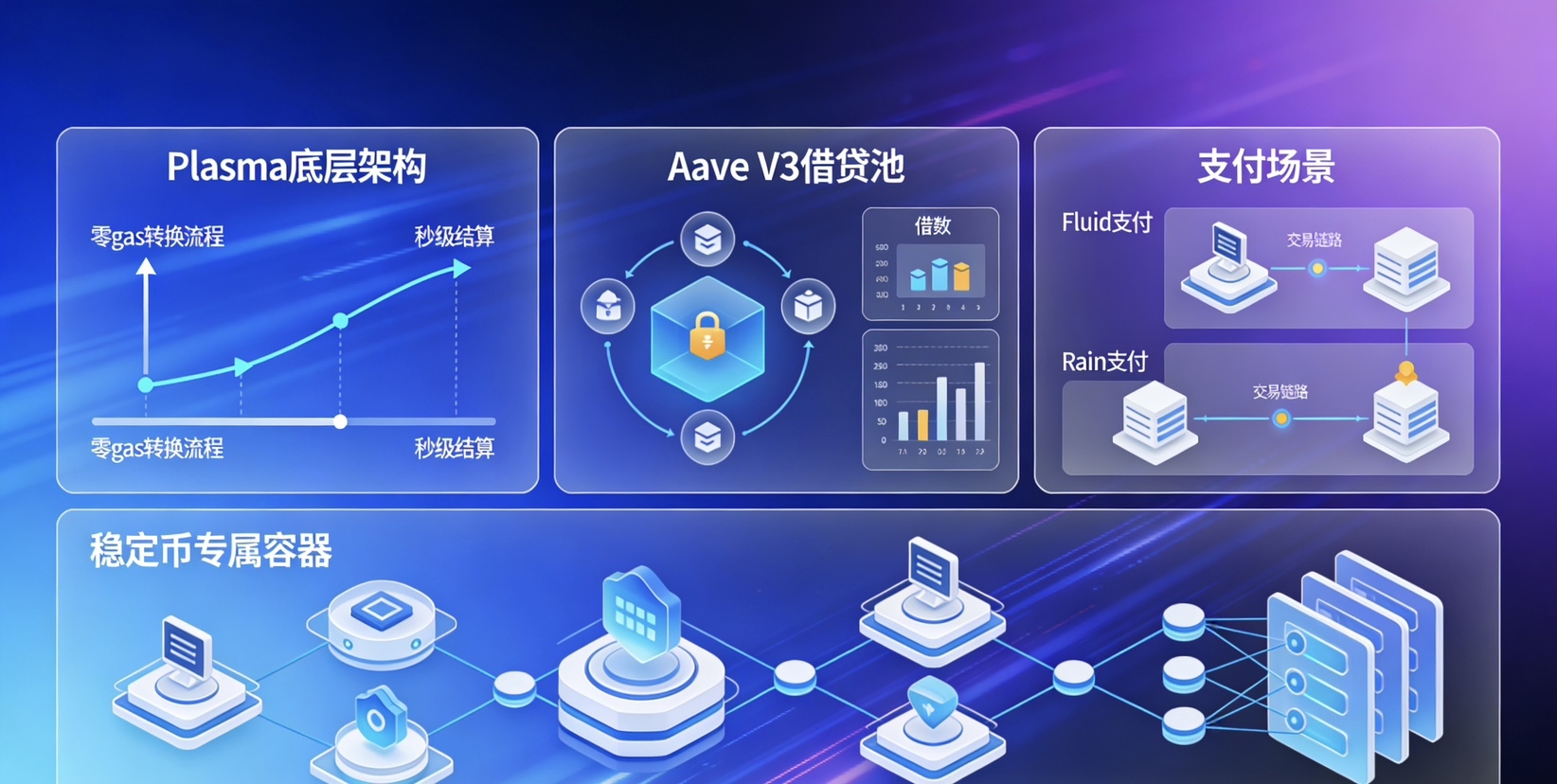
Plasma's second key decision was to implement a trust-based 'lossless migration', which is also the core of its cold start success. As a new chain, the biggest need isn't technology but user trust. Many new chains launch with a frenzy of various low-quality protocols, attracting funds with high yields, but ultimately fizzling out due to a weak foundation of user trust. Plasma, on the other hand, took a different approach, integrating the most robust Aave V3 without flashy innovations.
This move was very strategic. Aave, having been tested in the market for years, is one of the most trusted lending protocols globally, and Plasma directly leverages Aave's brand equity, making users willing to enter the Plasma ecosystem because they trust Aave. Once users come in, they are further impressed by Plasma's zero Gas and instant settlement experience, completing the shift from 'trusting Aave' to 'recognizing Plasma'. More importantly, Plasma has partnered with Binance Earn to directly reach 280 million exchange users, lowering the entry barrier to the minimum and allowing ordinary users to easily engage with the ecosystem, which also provides a massive user base for its capital influx.
It is these two points that have turned Plasma into a liquidity black hole for stablecoins: the underlying architecture allows stablecoin transfers to be 'zero-cost and high-speed', and the trust transfer encourages users to 'dare to enter and want to stay'. The combination of both means that even in a declining market, capital is still willing to flow into this safer, more efficient harbor. After all, compared to just holding on an exchange, engaging in low-risk lending on Aave within Plasma allows for both risk mitigation and profit generation—why not?
Of course, Plasma is not perfect; 80% of its TVL is concentrated in Aave V3, which does create a bit of an imbalance. But for a new chain, this is a typical 'happy problem'. Many public chains struggle to build ecosystems and incentives after launch, ultimately failing to attract significant funds, while Plasma started with $6.6 billion in its war chest, a starting point that most public chains can only dream of.
This massive capital is Plasma's strength, but also its test. Whether it can grow from a 'high-quality infrastructure for lending' to a true stablecoin ecosystem hinges on whether it can effectively retain this capital. Plasma's strategy is also very clear: it's not about letting capital stay idle in lending protocols but guiding stablecoins into actual use through payment scenarios like Fluid and Rain. For instance, Rain's USDC corporate card allows Web3 teams to use stablecoins for daily expenses with automated on-chain settlements; Fluid's cross-border payment solutions leverage zero Gas and instant settlement to address the slow and costly issues of traditional cross-border remittances; and Plasma One's digital banking services even integrate with Visa physical cards, extending stablecoin use cases from on-chain to millions of offline payment terminals.
These payment scenarios are Plasma's ultimate trump card. The value of stablecoins never just sits idle in lending pools; it's realized in actual payments and transactions. If Plasma can execute these scenarios, channeling $6.6 billion in stablecoins from lending pools to cross-border payments, enterprise spending, and retail consumption, it can create an ecosystem loop of 'stablecoin deposit - lending/payment - capital accumulation'. At that point, it will no longer just be an 'Aave-exclusive chain', but a real stablecoin ecosystem hub, poised to challenge Ethereum's DeFi dominance.
Plasma's $6.6 billion capital raise in 48 hours is not only a textbook case of a cold start but also points to a new direction for the increasingly competitive public chain space. Currently, every public chain aspires to be an 'all-in-one chain', trying to do DeFi, NFTs, GameFi, and DePIN, but ends up failing to excel in any track, resulting in a chaotic basic transfer and settlement experience. Plasma's success proves that in the competition for infrastructure, vertical focus is far more effective than being a generalist.
Plasma doesn't pursue being able to 'do everything'; instead, it focuses on 'perfectly executing stablecoin operations'. From zero Gas transfers in the underlying architecture to ecological layouts in payment scenarios, all actions revolve around stablecoins. This precise positioning has allowed it to stand out among a multitude of public chains and has positioned it to catch the wave of stablecoins approaching a trillion-dollar market cap. The future stablecoin market will certainly reach hundreds of billions or even trillions, and this market needs a dedicated, efficient infrastructure, and Plasma is right at the forefront of this opportunity.
Of course, Plasma's future also faces challenges: it must contend with competition from established stablecoin ecosystems like Ethereum and Tron, address the issue of excessive TVL concentration, ensure that XPL tokens genuinely capture ecosystem value, and navigate global regulatory uncertainties. However, it cannot be denied that it has already demonstrated the value of vertical focus with its $6.6 billion achievement.
The development of the crypto market has never relied on a pile of concepts, but rather on addressing real demands. Plasma's story tells us that instead of being a mediocre generalist in a red ocean, it's better to be an extreme vertical expert in a blue ocean. In this era where everyone wants to create an 'ecosystem', achieving excellence in one area is already a win. For Plasma, $6.6 billion is just the starting point; it aims to become the terminal for stablecoins.
