
In the current blockchain community, almost everyone is competing in one direction: who can make transactions faster, who can make asset circulation more free, and who can allow users to operate as they wish. But very few people have considered one question: if a transaction itself is non-compliant, and the person performing the operation has no authority, then what does it matter how fast or free it is?
My original intention to study Dusk was to discover that it is an 'outlier' in this circle — it effortlessly makes assets freer, but instead focuses on one thing: ensuring that all asset circulation is based on the premise of being 'correct'. Here, 'correct' means compliance, having authority, and following rules, which happens to be the most core issue in real finance, and is also the lesson that most public chains inherently lack.
Many believe that blockchain should be unrestrained, but once you step out of DeFi and NFT scenarios driven by emotions and examine real-world financial assets like equity, fund shares, and promissory notes, you will understand: these assets are never transferable just because someone has them. The core principle is never liquidity, but rather 'do you have the qualifications to act' and 'is this action compliant'. What Dusk does is to bring these underlying rules of real finance onto the blockchain.
Privacy is not an optional feature but a fundamental prerequisite.
In today's public chains, discussions about privacy are all 'after-the-fact tickets'. Either install a zero-knowledge proof plugin or create a coin-mixing protocol at the application layer; privacy is an optional feature that can be enabled or disabled at will.
But Dusk’s logic is completely reversed: it sets rules at the lowest level of the protocol layer, where transactions are by default private, and transparency is the exception. Currently, over 90% of transactions in the Dusk network operate under privacy, but this is not to allow users to evade audits or conceal malfeasance; rather, it is a form of 'selective disclosure'.
In simple terms, Dusk does not care about 'whether others can see your transactions'. It only cares about 'who is qualified to see, under what conditions they can see, and which parts they can see'. For example, in a fund share transfer, ordinary users see nothing, regulatory agencies can view all information, and partner institutions can only see agreed-upon content. This is not a technical play for geeks but rather a systematic approach that tightly integrates privacy and compliance, centered on the principle that 'those who should see can see, while those who shouldn't can't'.
Don’t just focus on zero-knowledge proofs; the state machine model is the core.
Many people studying Dusk focus on technical points like zero-knowledge proofs and confidential contracts, overlooking the core design that truly determines its direction: state machine models. This is also the aspect of Dusk that is most easily underestimated.
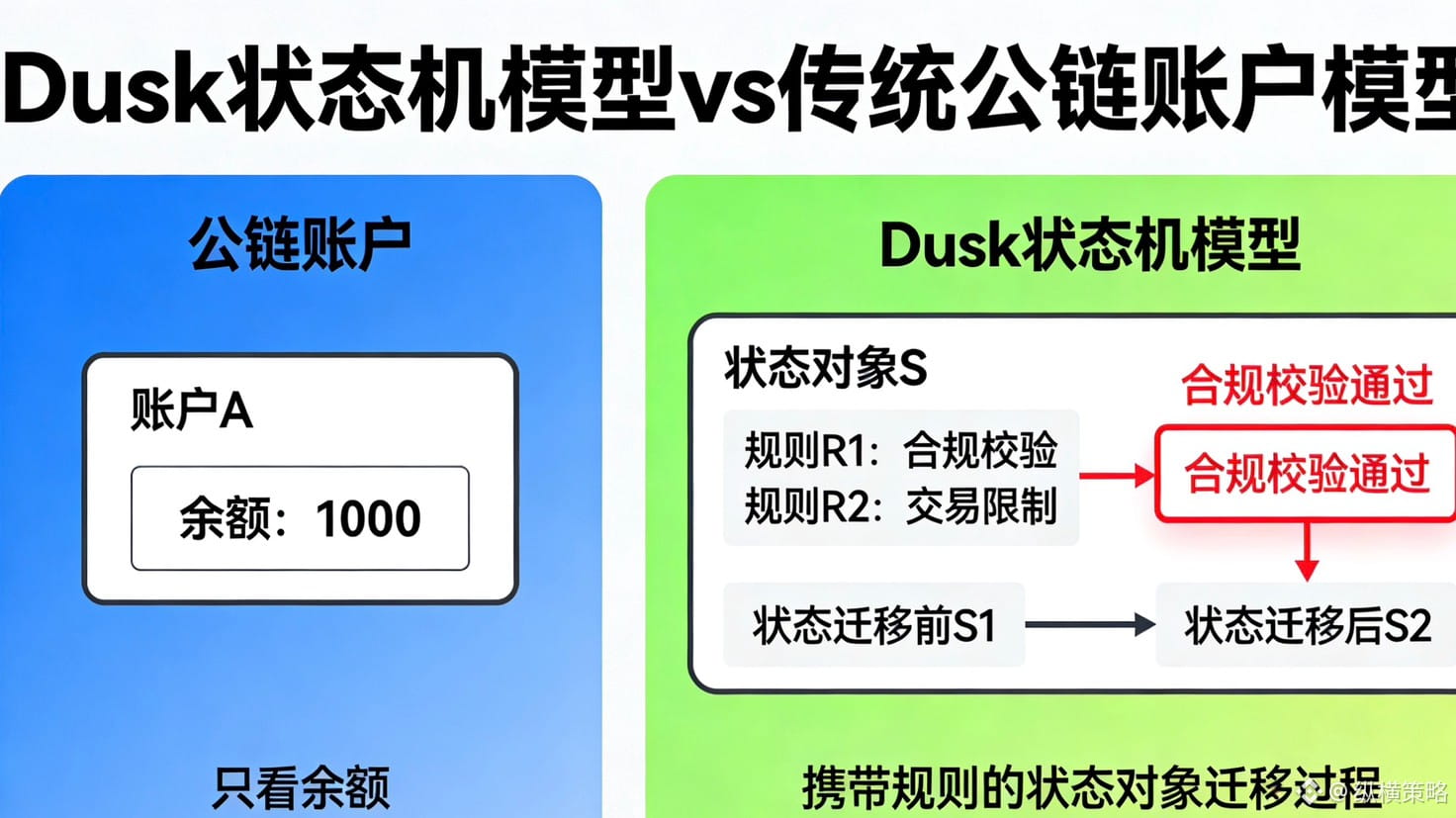
Most public chains we are familiar with use an account model, where the determination of whether a transaction can proceed hinges on a single question: is your account balance sufficient? If yes, it can be transferred; if not, it cannot, with no regard for other rules.
However, the assets in Dusk are not simple 'digital balances' but rather 'state objects' governed by rules. For example, in a shareholding object, it not only records how many shares exist but also notes 'who can hold them', 'what conditions need to be met for transfer', and 'whether they can be pledged'. Each operation is not just a simple transfer, but a 'state transition'—moving assets from one legal state to another.
In this process, the system verifies layer by layer: is the current asset status compliant? Are the conditions for migration met? Does the operator have permission? Are there any prohibited operation combinations? If any one item does not meet the standards, the transaction is directly voided. In simple terms, Dusk has pre-encoded into the blockchain the judgments that in reality require manual review, legal constraints, and oversight by intermediaries, allowing the code to automatically enforce the rules.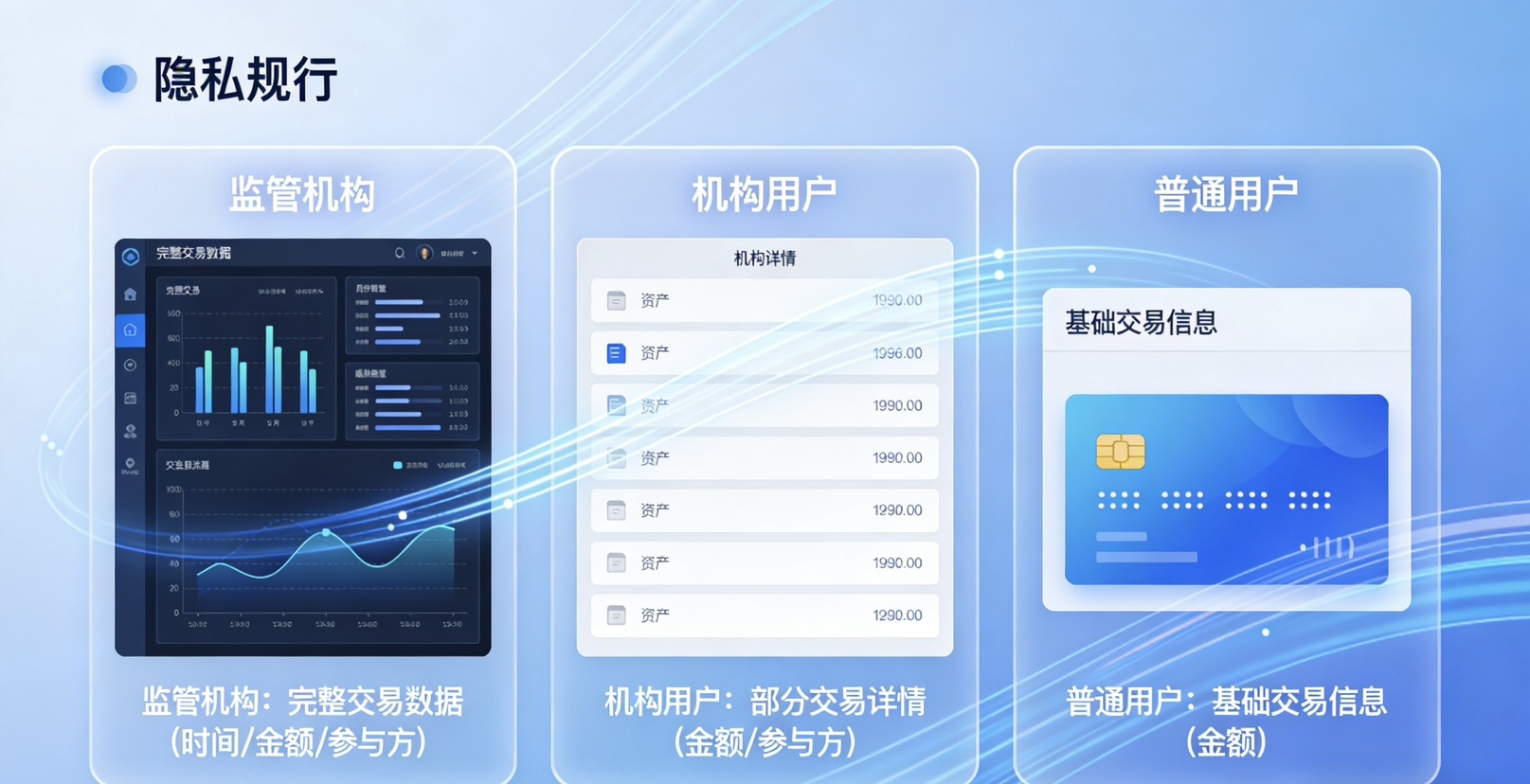
Born for institutions, ordinary retail investors really have no use for it.
I once asked myself an intuitive question: as an ordinary retail investor, do I really need Dusk? The answer is clear: most likely not.
Retail investors engage with blockchain for simplicity, speed, and low costs, wanting to reap rewards and explore novelties; no one cares about the strictness of transaction compliance structures or the reasonableness of permission models. But from an institutional perspective, such as managing a private equity fund's shares on-chain, the situation is entirely different: they do not want outsiders to see the holding proportions, yet must ensure that the incoming party qualifies as an accredited investor, and be prepared for audits when regulatory requirements arise, all without relying on manual confirmation of each transaction.
These demands are almost custom-tailored for Dusk. This explains why Dusk's development pace appears slow: it has never been about competing for user numbers or ecosystem activity but rather about rigorously pursuing the 'correctness' of the system, perfecting every rule and every permission. For institutions, a slower pace is acceptable; avoiding errors and compliance are the top priorities.
The DUSK token does not generate hype; it serves as a 'stabilizer' for the system.
In current blockchain projects, tokens are essentially the core narrative, relying on tokens to generate heat, attract users, and drive trading, as if news favorable to prices emerges daily. However, the DUSK token has a particularly low presence in the entire system, which is precisely its design intention.
The DUSK token does three things: first, it ensures network security, providing rewards and staking for nodes participating in consensus; second, it covers the execution costs of agreements, equivalent to 'transaction fees' on the chain; third, it serves as a long-term incentive for the system, maintaining the stability of nodes and the ecosystem. It does not aim to create short-term heat or drive frequent trading; the value of the token is tied only to the real usage of the network and the long-term trust of institutions, having little to do with short-term activity or emotional speculation.
This design is particularly friendly to institutions, as they do not have to face significant fluctuations in token prices or be swayed by emotions; however, it offers little attraction to retail investors looking to trade coins, as it cannot naturally become a popular asset driven by emotions.
The undeniable downside is that Dusk's path is not easy.
If you only praise Dusk's advantages, that does not count as an objective analysis. In my view, Dusk is currently facing numerous hard challenges, and they are likely costs it must bear.
First of all, the development threshold is too high. Confidential contracts, state verification, and complex permission models are not something ordinary Web3 developers can easily handle. Forget about novices; even experienced developers from conventional public chain backgrounds find it challenging to get started. If development lags, ecosystem expansion will naturally slow down—this is an unavoidable hurdle.
Secondly, the market narrative is too weak. In a bull market, everyone loves to hear stories about '100x coins', 'ecosystem explosions', and 'high-speed expansions', while Dusk talks every day about systems, rules, and long-term compliance. These topics are dry and unappealing, inherently failing to capture retail investors' attention, making it nearly impossible to generate heat through narrative.
Finally, there is a high reliance on the evolution of real-world financial systems. Dusk's core value is to ensure that on-chain assets comply with real regulatory and compliance requirements. If real-world financial regulation does not advance towards 'automatic compliance for on-chain assets', Dusk's value cannot be realized and will remain in a 'foundation-laying' state for a very long time.
My judgment: it is not a 'good project', but it is the 'right project'.
At this point, I feel that using 'good or bad' to evaluate Dusk is meaningless. It has never been a project that caters to the market or pleases retail investors; it resembles a 'multiple-choice question' in the blockchain industry rather than a 'true or false question'.
If you believe that in the future, real-world financial assets will inevitably be massively migrated on-chain, believe that on-chain assets must simultaneously achieve privacy and compliance, and trust that the execution of rules must ultimately move away from manual intervention and intermediaries to be handled by code, then Dusk's existence is reasonable and even necessary. It has established foundational rules that others are unwilling to set up and has maximized the 'correctness' that others have overlooked.
But if you expect a short-term surge in users, a bustling ecosystem, and a continuous rise in token prices, Dusk is likely to disappoint you. The path it takes is destined to be lonely and slow, inherently not favored by the current market.
In the long run, Dusk resembles laying the groundwork for a 'chain-based financial era' that has not yet fully arrived. Many currently buzzing public chains seem to develop quickly, but once real-world financial assets are indeed migrated on a large scale and face compliance, permissions, and privacy requirements, they will likely have to start over. Dusk, however, does not need to.
All the 'slow work' it is doing now is paving the way for a 'correct' future. As for when this future will arrive, no one can be sure, but at least someone is working on it, which is much more meaningful than everyone merely competing on speed and freedom.
