

In just under 36 hours, the global precious metals market has experienced one of the most severe corrections in many years. Gold plummeted from around 5,600 USD to around 4,700 USD. Silver fell freely from 121 USD to nearly 77 USD. Platinum and palladium also did not escape a similar fate.
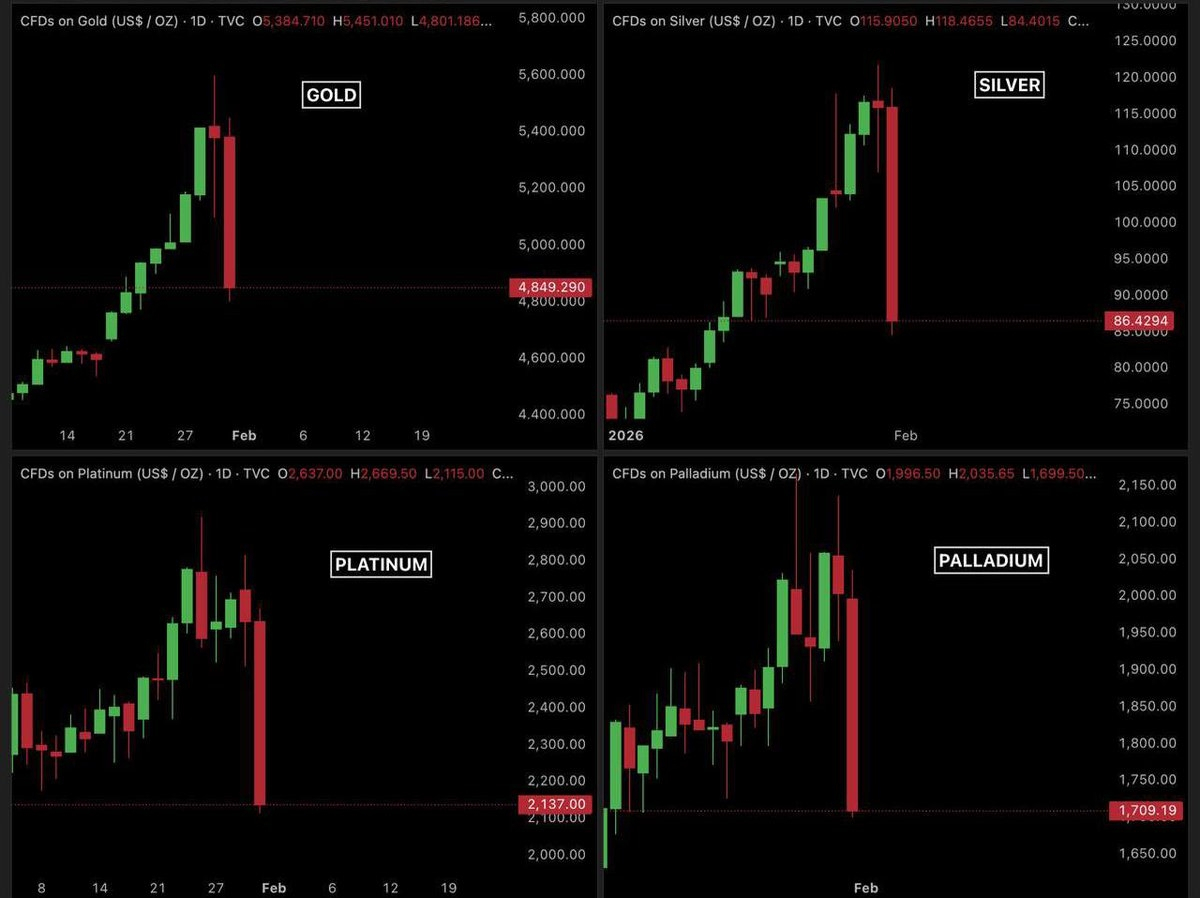
Catalyst: Personnel announcement from the White House
The direct cause of this crash did not stem from economic data or geopolitical crises, but arose from a pivotal political announcement. This morning, President Donald Trump officially announced Kevin Warsh as the chosen candidate for the position of Chairman of the U.S. Federal Reserve (Fed), replacing Jerome Powell when the current term ends in May.
Kevin Warsh is not a stranger to the financial community. He is known as an 'inflation hawk' - a hardliner in controlling inflation, prioritizing the strength of the USD and being cautious with interest rate cuts.
=> this is completely contrary to the expectations that the market has bet on for many months.
The big story has fueled the wave of precious metals.
Prior to the announcement, most traders believed that Trump would choose a Fed Chair inclined towards aggressive easing, ready to cut interest rates sharply and accept a weaker USD to stimulate growth.
In this context, precious metals have become an ideal destination. As confidence in fiat currency weakens, gold, silver, and rare industrial metals are often seen as a value hedge.
As a result, speculative capital is pouring into the precious metals market on a large scale, much of which is using high leverage through futures contracts. Many positions were built entirely on the assumption that interest rates would decrease and the USD would continue to weaken.
When the thesis reverses, leverage becomes a double-edged sword.
Kevin Warsh's nomination has caused the entire investment thesis to collapse in an instant. A Fed with an anti-inflation mindset means a greater likelihood of maintaining high interest rates longer and protecting the strength of the USD.
Immediately, traders betting on the opposite scenario were forced to exit their positions to limit losses. The sell-off happened at an extremely fast pace as the market was 'loaded' with leverage.
When prices start to drop sharply, banks and market makers simultaneously raise margin requirements for precious metal futures contracts. This forces many retail investors to sell off forcibly, whether they want to or not.
With each deeper price drop, the wave of liquidations spreads further, creating a chain reaction of selling.
The strong USD increases the pressure.
Alongside this, the USD appreciates as the market adjusts its expectations for monetary policy. A strong USD makes precious metals more expensive for international buyers, thus reducing demand.
The combination of a rising USD, unwinding leverage, and panic sentiment has pushed precious metal prices down faster and more sharply than any previous forecasts.
Not a supply-demand crisis.
An important point to emphasize is: this crash did not stem from changes in fundamental factors.
China is still maintaining export controls on silver. Supply in the market remains tight. Industrial demand, particularly from the energy sector and high-tech manufacturing, is still present.
Precious metals did not collapse due to a loss of intrinsic value, but because a crowded speculative trade was wiped out when the monetary policy narrative reversed too quickly.