
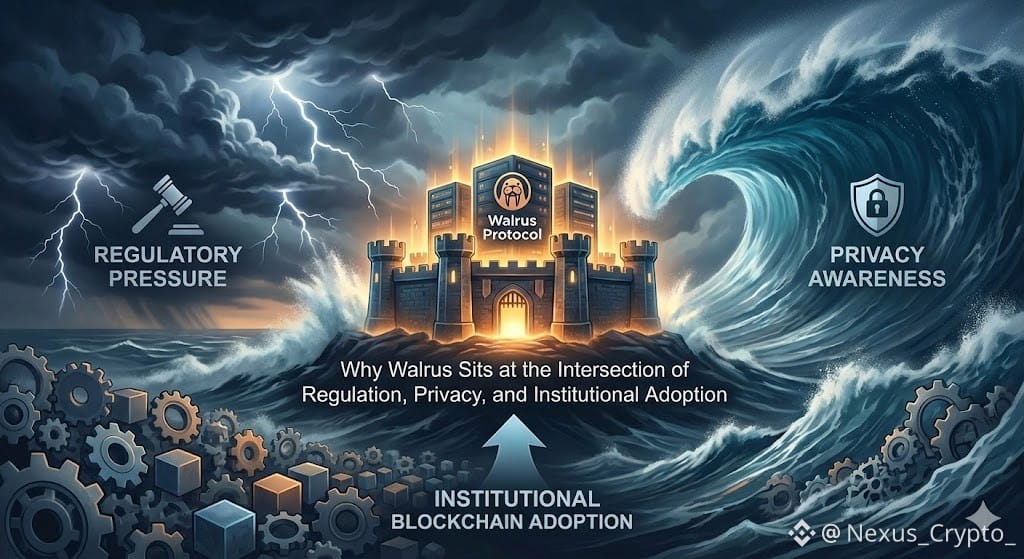
Why Walrus Sits at the Intersection of Regulation, Privacy, and Institutional Adoption 🌪️🏗️
Markets don’t move in isolation.
They move when multiple forces converge.
Right now, three powerful trends are colliding — and together they are creating a once-per-cycle opportunity for decentralized infrastructure. At the center of this convergence sits @walrusprotocol and $WAL. 💎 #Walrus
This is not hype.
This is structural demand.
Force #1: Regulation Is Turning Against Centralized Clouds ⚖️📉
Governments worldwide are tightening data sovereignty laws.
Data must:
Stay within national borders
Be auditable
Be resistant to foreign control
Centralized cloud providers built on global data replication are suddenly liabilities, not assets. Enterprises now face fines, compliance risk, and political exposure simply for storing data in the wrong jurisdiction.
This creates an impossible tradeoff in Web2:
Global scalability vs regulatory compliance
Walrus breaks that tradeoff.
By distributing encrypted fragments across a decentralized network, no single jurisdiction controls the data, and no operator can access it. Compliance shifts from trusting corporations to verifying cryptography.
Regulation doesn’t kill Walrus.
It forces adoption.
Force #2: Privacy Is No Longer a Niche Concern 🧠🔐
Privacy used to be ideological.
Now it’s practical.
Enterprises, institutions, and even governments understand that:
Data breaches are existential risks
Insider threats are real
Centralized honeypots attract attackers
Walrus’ architecture assumes adversarial conditions by default.
Through erasure coding and encryption:
Storage providers see nothing
Compromised nodes yield nothing
Attacks become economically irrational
This is not “privacy theater.”
It is privacy by construction.
As awareness grows, systems that expose plaintext data at rest will be seen as legacy risks.
Force #3: Blockchain Is Entering the Utility Phase ⚡🏗️
Crypto is moving beyond speculation.
We are now seeing:
Institutional on-chain settlement
Tokenized real-world assets
AI agents and DePIN networks producing persistent data
All of this requires reliable, scalable, and verifiable storage.
Speculation doesn’t need storage.
Utility does.
Walrus is positioned not as an app, but as base infrastructure — the layer everything else depends on.
The Market Size Most People Ignore 📊
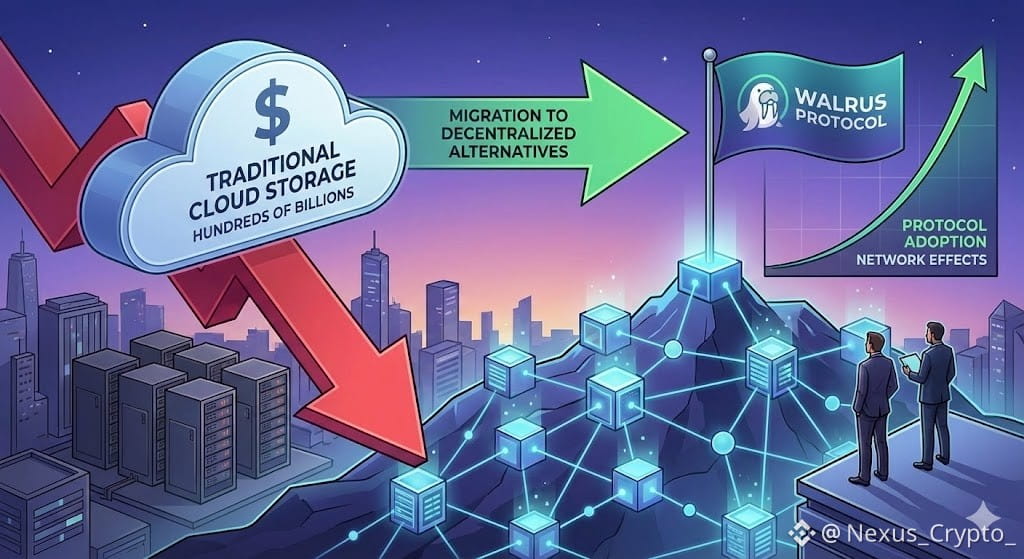
The global cloud storage market is measured in hundreds of billions of dollars annually, and it continues to expand.
Even modest migration toward decentralized alternatives represents:
Massive value creation
Long-term recurring demand
Strong network effects
Walrus doesn’t need to replace AWS.
It only needs to capture a small slice of workloads that demand:
Sovereignty
Privacy
Censorship resistance
That slice is growing faster than the market realizes.
Why Timing Matters ⚡
Infrastructure rewards patience — but early positioning matters.
As Walrus adoption increases:
More data stored → stronger network effects
More users → higher coordination value
More integrations → ecosystem lock-in
Early participants in:
Protocol governance
Staking
Ecosystem advocacy
Position themselves before the adoption curve steepens.
This is how infrastructure value compounds — quietly, then suddenly.
The Sui Advantage 💧
Walrus operates in coordination with Sui, leveraging fast finality and parallel execution to manage storage commitments efficiently.
This gives Walrus:
High throughput coordination
On-chain verifiability
Institutional-grade reliability
For the Sui ecosystem, Walrus is not optional.
It is foundational.
For Sui holders, this is ecosystem validation.
The Real Question Isn’t “If” 🧠
Decentralized storage is no longer an experiment.
Centralized clouds are under regulatory pressure.
Privacy expectations are rising.
Blockchain adoption is becoming practical.
The only real question left is:
Which protocols will dominate this new landscape?
Walrus is not trying to win narratives.
It is aligning itself with inevitable demand.
That is where durable value is built.
Final Thought
Perfect storms don’t announce themselves.
They form quietly, then reshape everything.
Regulation, privacy, and institutional adoption are converging — and infrastructure that satisfies all three will define the next decade of Web3.
Walrus isn’t early by accident.
It’s early by design.
CTA — your perspective matters:
Do you think regulation will accelerate decentralized storage adoption, or slow crypto innovation overall? Which sector will move first — institutions or native Web3 apps? Drop your take below 👇
If you’re tracking long-term infrastructure and Sui-native plays, drop a 🏗️💧 and follow — more deep dives coming.
⚠️ DISCLAIMER: This content is for educational purposes only and does not constitute financial advice. Cryptocurrency investment involves high risk. Always do your own research (DYOR) before investing. The views expressed are my own.