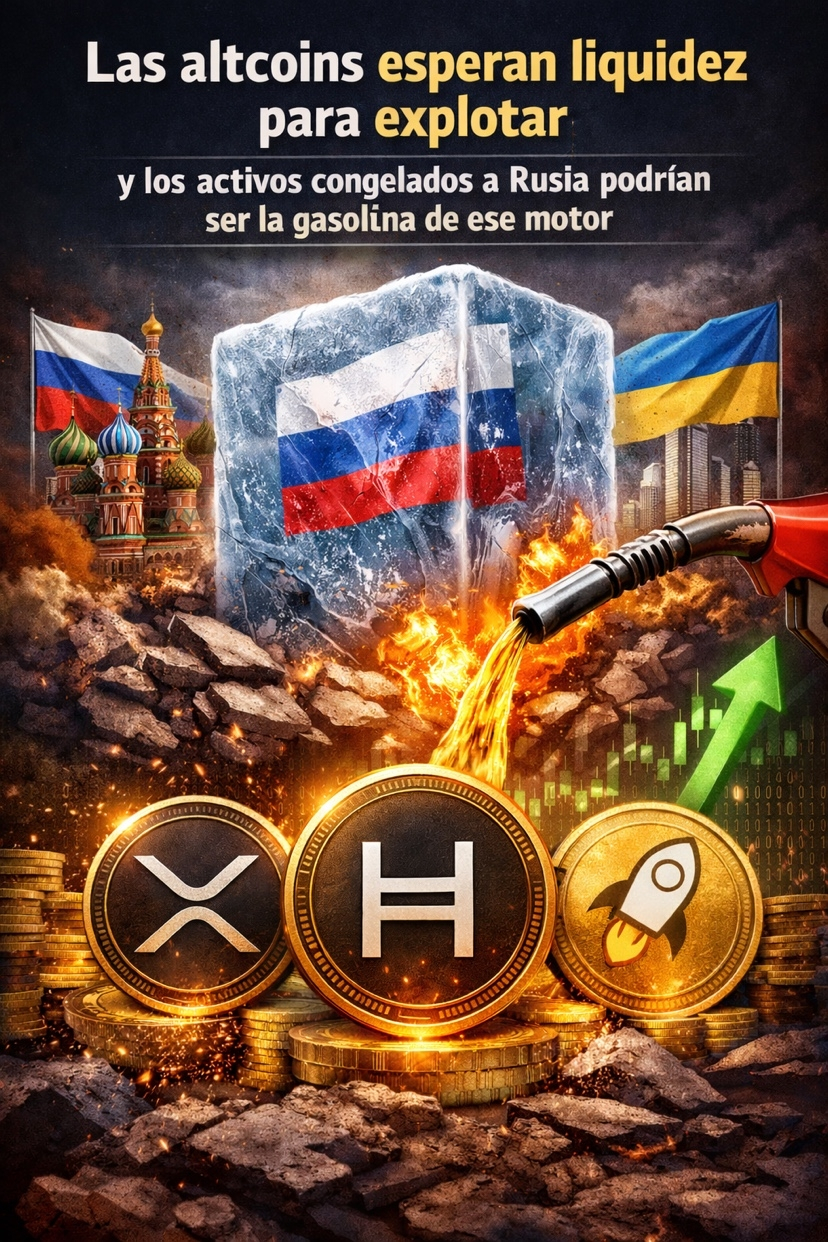
In recent months, diplomatic signals have become more frequent. Indirect contacts, international mediation, and an increasingly less belligerent language suggest that peace negotiations between Russia and Ukraine have entered a more active phase, opening the door —though still without certainties— to a possible resolution of the conflict on a not excessively distant horizon.
Markets do not need signed agreements to start anticipating scenarios. It is enough for them to perceive that the extreme risk begins to decrease. And if the war comes to an end, one of the most relevant economic effects could be the gradual unlocking of frozen Russian assets in the West, an event with the potential to profoundly alter global liquidity flows.
An unprecedented volume of capital
Since the beginning of the conflict, hundreds of billions of dollars in Russian assets have been frozen: central bank reserves, sovereign funds, private capital, and financial assets in the West. This is one of the largest immobilizations of wealth in modern history.
When the conflict ends and some form of political or diplomatic agreement is reached, a significant part of that capital will start to move again. And when large masses of money regain mobility, they seek diversification, protection, and yield.
This is where cryptocurrencies come into play.
Why would cryptocurrencies be a natural destination?
Cryptocurrencies — and especially altcoins — offer three key characteristics for capital that is leaving a traumatic geopolitical scenario:
1. Disintermediation: reduced dependence on traditional Western financial systems.
2. Global mobility: capital that crosses borders without political friction.
3. Asymmetry of profitability: potential for revaluation far exceeding that of mature traditional assets.
Furthermore, greater exposure to decentralized assets would reduce the risk that, in future conflicts or geopolitical tensions, that capital would be immobilized again or used as a tool of political pressure, something that has profoundly influenced financial decisions after this conflict.
For investors, funds, or structures linked to economies that have suffered sanctions, reducing exposure to the traditional financial system ceases to be ideology and becomes pure risk management.
Bitcoin first, altcoins later
Historically, liquidity flows into crypto follow a quite clear pattern:
1. They first enter Bitcoin as a safe haven asset and gateway to the ecosystem.
2. Then they shift towards Ethereum and major base layers, where capital seeks exposure to consolidated infrastructure.
3. Finally, they rotate towards altcoins, the segment of the market where money takes on more risk in exchange for greater potential for revaluation.
Within this last group, the best-positioned altcoins to attract large flows of capital would be those aligned with the ISO 20022 standard, an increasingly relevant requirement for interoperability with traditional financial systems and institutional payments.
Networks like Hedera (HBAR), designed from their inception with a corporate and institutional focus, along with XRP and Stellar (XLM), which have been oriented towards integration with global payment infrastructures for years, could be among the main beneficiaries in a scenario of incoming new liquidity.
If a significant fraction of the unlocked Russian assets enters this cycle, the impact on this type of altcoins could be particularly notable. Many of them are still trading well below their historical highs, with valuations that do not reflect either their degree of technological maturity or their potential role in a more interconnected and standardized financial system.
A dry market needs only a spark
The current altcoin market resembles more a dry prairie than fertile ground: there is no lack of potential, but a lack of liquidity. In that context, enormous flows are not needed to generate explosive movements. Credible new narratives backed by real capital are enough.
The unlocking of assets to Russia would not just be money coming in:
• It would be a change in perception of global risk.
• It would be the beginning of a post-conflict financial reconfiguration.
• It would be a signal that the world is entering a new phase of relative stability.
And markets, always anticipating, would not wait for the money to arrive completely to start positioning themselves.
It's not a prediction; it's a structural possibility
This is not to say that 'Russia is going to buy altcoins'. It is about understanding that when enormous volumes of capital start circulating again after a historic blockade, alternative, liquid, and global markets tend to benefit.
Altcoins have been waiting for their moment for a while. The technology is there. Developments continue. Valuations are compressed.
All that is missing is the fuel.
And it may be that, when the war ends, part of that fuel comes from where almost no one is looking today.