


When I evaluate emerging payment-focused chains, I try to step away from raw throughput comparisons and focus instead on structural durability. Speed and low fees can attract attention quickly, but what tends to matter over time is whether a system builds defensible characteristics — the kind that are difficult for competitors to replicate without redesigning their foundations.
Plasma becomes interesting to me in that context. Its stablecoin-first execution model, combined with external security anchoring, suggests an attempt to differentiate not by being marginally cheaper, but by reshaping how users and institutions think about settlement risk and operational predictability.
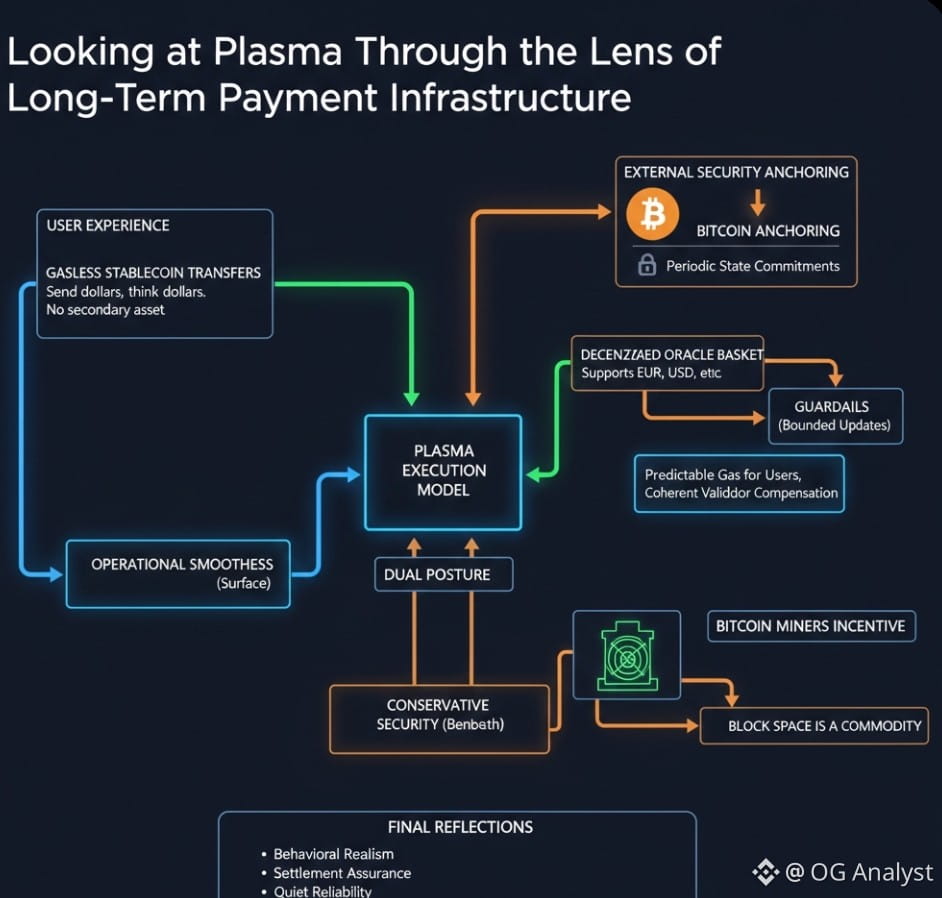
Gasless Stablecoin Transfers + Bitcoin Anchoring: Where the Moat May Form
Low-fee transfers are no longer rare. Several high-performance chains have demonstrated that inexpensive stablecoin movement is achievable at scale. What Plasma appears to be exploring is a different psychological contract with the user.
Gasless transactions remove one of the most persistent sources of friction: the requirement to hold a secondary asset purely for execution. From a behavioral perspective, this simplifies mental models. A user sends dollars and thinks in dollars — nothing else.
But simplicity alone is not a moat. The second layer is where the differentiation starts to emerge: periodic anchoring of Plasma’s state to Bitcoin. Whether used for timestamping or historical verification, anchoring creates an external reference point that is deliberately harder to contest.
The combination produces an interesting dual posture:
Operational smoothness at the surface
Conservative security beneath it
Most systems optimize heavily toward one side. Plasma appears to be attempting both, which is operationally harder to engineer.
To me, the moat is less about outperforming another chain on fees and more about reducing two anxieties simultaneously: execution friction and historical integrity. Replicating that pairing would require architectural intent from day one rather than incremental tuning.
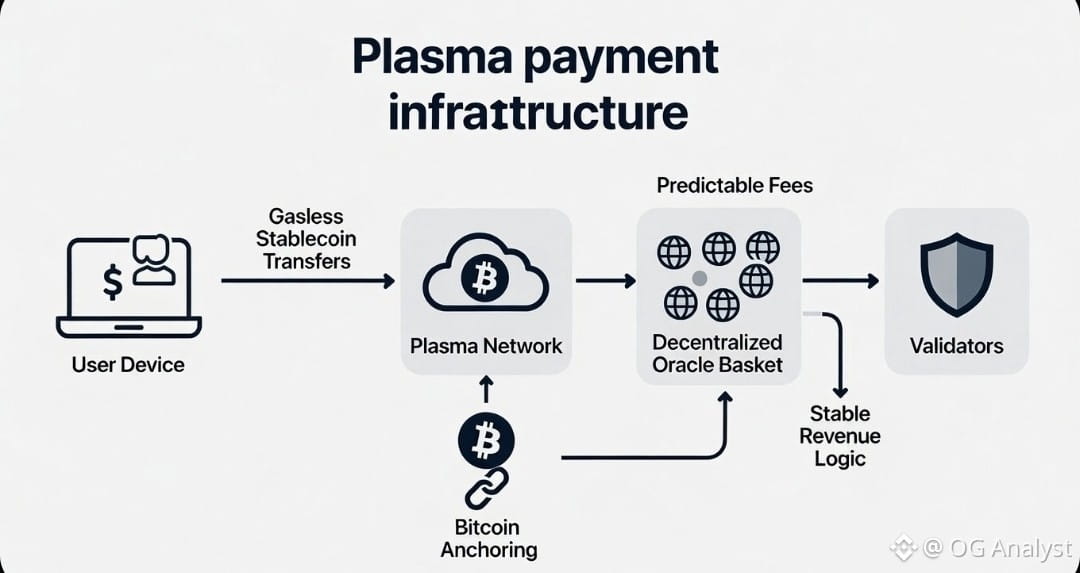
Stablecoin Gas and the Oracle Question
Once a network allows gas to be paid in stablecoins beyond a single USD-pegged asset, pricing becomes less trivial than it first appears.
If someone pays fees in a euro-denominated stablecoin, the protocol still needs a consistent internal measure of execution cost. Otherwise, validators could face subtle revenue volatility depending on FX shifts.
Plasma seems positioned to avoid dependence on a single pricing feed. A decentralized basket of oracle inputs is the more structurally sound approach, typically aggregated and sanity-checked before influencing fee conversion. Multiple feeds reduce the risk that a temporary pricing distortion cascades into execution markets.
Equally important is the presence of guardrails — mechanisms like bounded update intervals or deviation thresholds — which help prevent abrupt repricing events from destabilizing transaction flow.
What I find notable here is the philosophical choice: instead of pretending stablecoins eliminate volatility, the system acknowledges currency variance and manages it transparently at the accounting layer.
In practice, this keeps gas predictable for users while keeping validator compensation economically coherent.
Why Would Bitcoin Miners Include Plasma Checkpoints?
Whenever external anchoring is discussed, I find it useful to strip away narratives and ask a simpler question: why would block producers care?
Bitcoin miners are economically rational actors. If Plasma writes checkpoint data into Bitcoin transactions — commonly through small data commitments — miners include them for the same reason they include any transaction: fees.
There doesn’t need to be ideological alignment or protocol-level coordination. Plasma pays the prevailing transaction fee, and miners prioritize it according to the same mempool logic that governs all block space.
This is what makes the model quietly robust.
It does not rely on partnerships.
It does not require governance approvals.
It does not assume long-term cooperation.
It simply rents security from the most established settlement layer available.
Some implementations may structure these payments through aggregator entities that batch checkpoint submissions, smoothing costs while maintaining regular anchoring intervals. But the underlying incentive remains straightforward: block space is a commodity, and Plasma purchases it when needed.
Final Reflections
The more I study Plasma, the more it feels designed around behavioral realism rather than theoretical elegance.
Users prefer not to think about gas tokens.
Validators need stable revenue logic.
Institutions want verifiable history.
Security should not depend on trust alone.
None of these ideas are individually radical. What stands out is their convergence.
If Plasma succeeds, it likely won’t be because it was the fastest or the cheapest. It will be because it aligned user experience with settlement assurance in a way that feels almost unremarkable — and in payments infrastructure, that kind of quiet reliability is often the hardest advantage to displace.