

Once last year, around the middle of 2025, governance stopped being an idea. I was betting on a smaller L1 when the market went down. There was a lot of talk about an upgrade proposal on the network, but the vote took days because some big validators could not agree. My transaction did not fail; it just sat there, waiting with no clear end. I ended up paying more for gas to take a side bridge. It was a small loss, but the friction and uncertainty about my input made me stop. Why does changing a protocol seem so clumsy and unreliable? The system seems to care only about how fast things get done and not about the people who have to make decisions together without delays or power games.
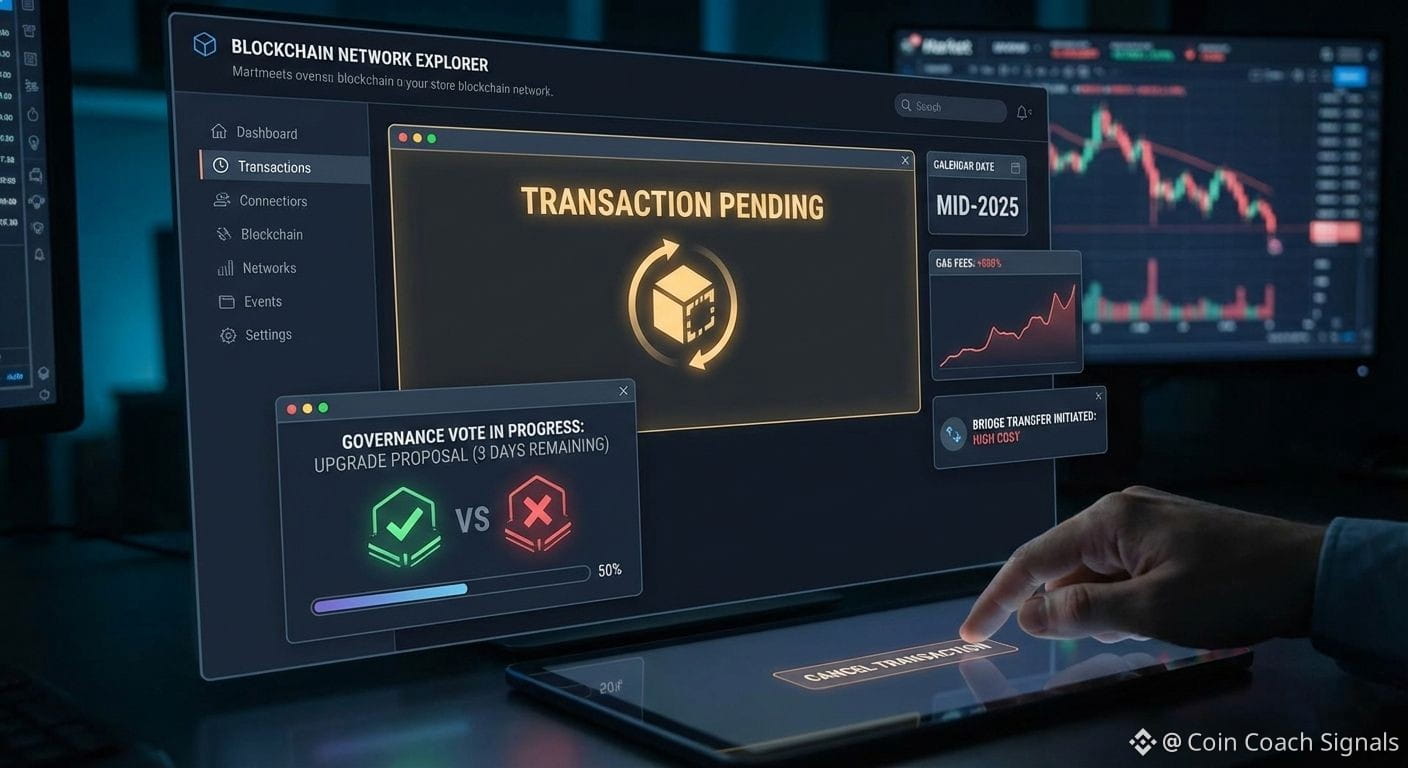
That experience shows that there is a bigger problem with a lot of blockchain infrastructure today. Chains originally designed for low fees or high throughput often add governance as an extra feature. Users experience the consequences. It’s often unclear how decisions actually get made, and influence can end up concentrated in the hands of a small group. Voting systems often have long token lockups with no clear idea of what will happen. Small changes, such as introducing new features or altering fees, become entangled in bureaucratic red tape or the power of whales. Running things becomes exhausting. You invest your money with the expectation of safety and rewards, but when governance becomes chaotic, trust diminishes. Costs rise not only from fees but also from the time people sink into forums or DAOs that feel more like echo chambers than practical tools. The user experience suffers because wallets often complicate the voting process, forcing people to switch between apps, which leads to increased frustration and potential risks.
You can think of it like a neighborhood-owned grocery store. Everyone gets a say in what goes on the shelves, but if the same loud voices always show up to vote, the result is half-empty aisles or products nobody actually wants. That model can work for small groups. Without clear rules, scaling it up leads either to chaos or to nothing moving forward. Governance needs structure to work once participation grows.
Vanar Chain takes a different approach here. It is an L1 that works with EVMs and is built with AI in mind. It has modular infrastructure for things like semantic memory and on-chain reasoning built right into the core. The goal is to combine AI tools with the basics of blockchain so that apps can change in real time without relying too much on off-chain systems. Vanar does not try to put every feature into the base layer. Instead, it puts scalability for AI workloads, like decentralized inference, first, while keeping block times under three seconds and fees around $0.0005. In practice, this feature is important because it moves the chain away from just moving value and toward applications that can react and change with little human oversight.
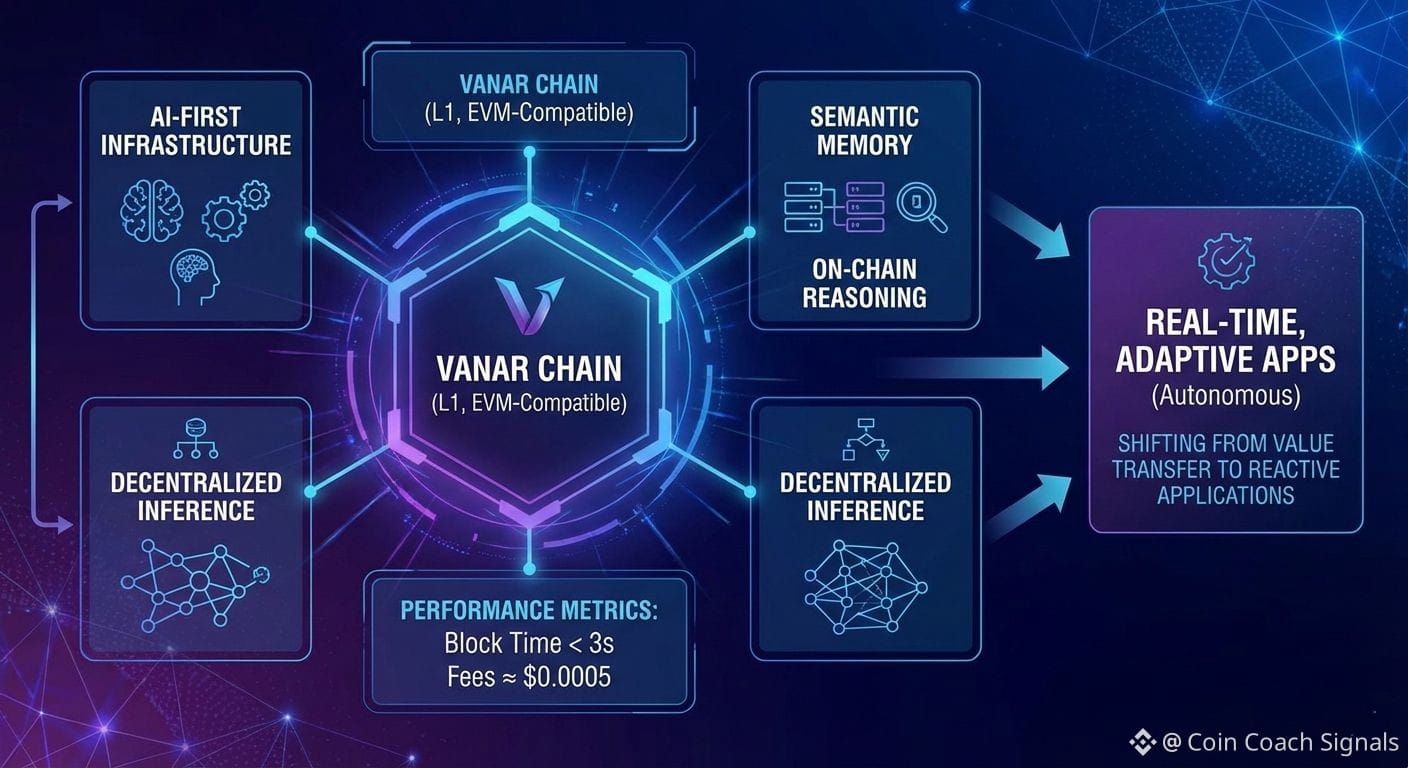
Vanar makes a clear trade-off on the side of consensus. It starts with Proof of Authority for stability. Then it adds proof of reputation, which means that validators are chosen based on their community-earned reputation instead of just their raw stake. That means giving up some early decentralization in exchange for reliability, with the goal of getting more people involved over time without encouraging validator cartels.
The VANRY token does a simple job. It pays for gas fees on transactions and smart contracts, which keeps the network going. Staking is based on a delegated proof-of-stake model, which means that holders can delegate to validators and get a share of block rewards without having to run nodes themselves. Contracts that tie payouts directly to performance make settlement and rewards clear. VANRY connects most clearly in governance. Token holders vote on things like upgrades and how to spend the treasury. They can even vote on AI-related rules, like how to reward people for using ecosystem tools. The token does not have a big story behind it. It simply serves as a means of participation and alignment. As of early 2026, the total supply of VANRY is limited to 2.4 billion. More than 80% of this amount is already in circulation, and daily trading volumes are around $10 million.
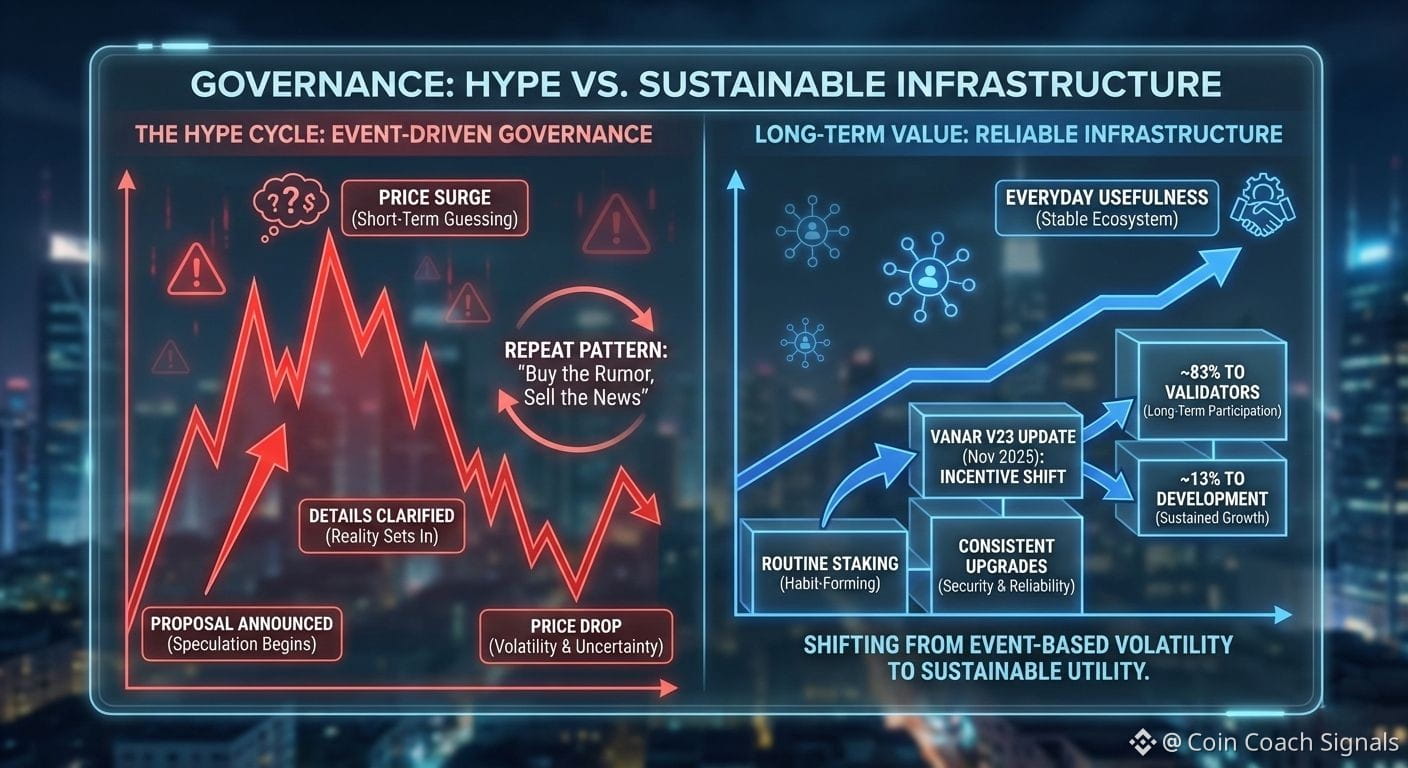
Governance is often considered a hype trigger in short-term trading. A proposal comes out, the price goes up because people are guessing, and then it goes back down when the details are worked out. That pattern is well-known. Infrastructure that lasts is built differently. What matters most is reliability and the habits that form around it over time. Staking turns into a routine when upgrades and security roll out without disruption. Vanar’s V23 protocol update in November 2025 is a positive example. It adjusted reward distribution to roughly 83% for validators and 13% for development, shifting incentives away from quick flips and toward long-term participation. That means going from volatility based on events to everyday usefulness.
There are still risks. If the incentives are not right, Proof of Reputation could be gamed. When AI-driven traffic spikes, even a validator with a strong reputation can struggle to perform, which may slow settlements or put extra strain on the network. Competition is also important. Chains like Solana focus a lot on raw speed, while Ethereum benefits from being well-known and having a large, established ecosystem. If Vanar's focus on AI does not lead to real use, growth could slow down. Governance 2.0 itself is uncertain because giving holders direct control over AI parameters makes it challenging to find the right balance between decentralization and speed of decision-making.
Ultimately, success in governance is often subtle and understated. The first proposal is not the real test. The second and third are. When participation becomes routine and friction fades, the infrastructure starts to feel familiar. That’s when Vanar’s governance model truly begins to work, when holders take part without having to think twice.
@Vanarchain