

Last night, as usual, I was browsing the crypto community when a discussion suddenly caught my eye: "While everyone is chasing hot tokens, smart money is quietly laying the groundwork for a project that can truly solve the pain point of 'data on-chain.'" Upon clicking in, the repeatedly mentioned name was Vanar. To be honest, my understanding of it at that time was almost zero, but the description "transforming blockchain from an automated ledger to a cognitive coordination layer" instantly energized me as an old player.
The evolution from "ledger" to "smart brain"
The Bitcoin and Ethereum we are familiar with are essentially top-notch 'accounting ledgers.' They can faithfully record: 'A gave B 10 coins,' but this record itself is silent; the blockchain cannot understand whether these 10 coins represent wages, payments, or a loan. This leads to a fundamental embarrassment when real-world assets (RWA) go on-chain: a $1 million bond contract on-chain often can only store a data fingerprint (hash), while the actual legal text must be placed on an off-chain server that could be tampered with or lost.
Vanar's ambition is to equip blockchain with the ability to 'understand' the meaning of data. Through its core Neutron semantic memory layer, it directly transforms unstructured data such as PDF contracts and legal documents into on-chain queryable and programmable 'smart objects.' Imagine a tokenized bond, where its interest payment time and default clauses directly become part of the on-chain asset, and smart contracts can automatically read and execute — this is the ultimate form that RWA should have.
Even cooler is its Kayon contextual reasoning layer. It allows smart contracts to no longer just mechanically execute 'if A, then B' instructions but to perform on-chain reasoning and automated logical judgment based on the semantics of the data, even enabling real-time compliance verification without the need for oracles. This is akin to allowing blockchain to evolve from 'reflex actions' to 'independent thinking.'
A history of growth for a pragmatic tech faction
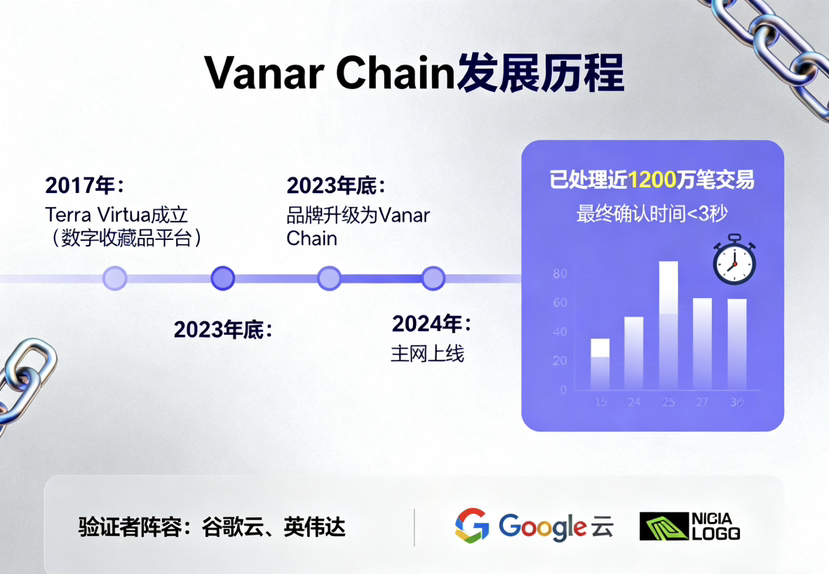
Upon deeper investigation, I found that Vanar is not a concept that appeared out of nowhere. Its predecessor, Terra Virtua, started back in 2017 as a digital collectibles platform. It was that experience dealing with VR/AR and NFTs that made them acutely aware of how fragile 'off-chain data links' can be — a centralized server outage could mean the 'death' of digital assets.
Thus, the team decisively transformed at the end of 2023, upgrading the brand to Vanar Chain, aiming to build a high-performance Layer1 network born for massive on-chain data. This problem awareness, which grows out of real applications, convinces me more than purely theoretical frameworks.
Their pragmatism is also reflected in the data: since the mainnet went live in 2024, it has processed nearly 12 million transactions, with final confirmation times of less than 3 seconds and a per-transaction cost of just a few cents. What surprised me even more was its lineup of validators — industry giants like Google Cloud and NVIDIA have joined, providing the network with enterprise-level reliability and support for AI and data-intensive workloads.
Why do I feel it is stepping on the next trend?
Currently, the market's hot rotation is very fast, but there are two trends that I see as certain long tides:
1. Deep integration of AI and Web3: Countless projects are telling AI stories, but Vanar is natively 'AI-ready' from the underlying architecture. Its tech stack directly serves AI agents and data markets, with high throughput and low gas fees that are naturally friendly to AI application developers.
2. The scaling of traditional financial assets on-chain (RWA): This is a widely recognized trillion-dollar track, but traditional financial institutions would never place core assets on unstable, high-cost, and ambiguous chains. Vanar's modular architecture can flexibly adapt to global regulations, and its characteristic of 'data and logic on-chain' precisely meets the stringent requirements for transparency and verifiability in financial-grade applications.
In my view, Vanar is not merely chasing higher TPS (transactions per second) numbers but has chosen a more challenging yet fundamental path: addressing the 'survival' of data on the chain, providing a home for applications that cannot tolerate data turning into 'dead chains.' When the internet itself may be interrupted, your critical assets and protocol logic still run on-chain permanently and verifiably — this value proposition will become increasingly significant in the era of AI and financial digitization.
Of course, any innovation comes with challenges. As a relatively new ecosystem, Vanar needs to attract more top developers to build 'killer applications,' proving that its technological advantages can translate into real user demand and network effects.
But when I saw its clear roadmap — launching the public developer portal in Q3 2025, starting the builder grant program in Q4, and continuously optimizing performance — I could feel that this is a team focused on 'building' rather than 'hype.'
In the crypto world, noise always surrounds the loudest places, while true value often grows in quiet corners. Vanar has shown me the next-generation possibilities of blockchain technology moving from 'value storage' to 'intelligent coordination.' It may not be the hot topic that skyrockets tomorrow, but it is solidifying what could be the infrastructure supporting the interaction between Web3 and the real world for the next decade. As an observer, I choose to stay attentive and look forward to it continuously telling this story about 'truly bringing data to life on the chain' through future product iterations.
