
A lot of crypto projects love to start with big promises. Fully open. Fully permissionless. Fully decentralized from day one. I have watched this story repeat enough times to know how it usually ends. The moment real payments show up or uptime actually matters, those ideals start bending. Vanar Chain takes a different route, and honestly, it feels far more realistic.
Instead of pretending everything is decentralized immediately, Vanar Chain works on what I would call a trust ladder. The idea is simple. People adopt systems when they feel stable first. Decentralization can grow after. It is not flashy, but it mirrors how the internet, cloud services, and even fintech platforms actually scaled.
Vanar does not hide this philosophy. It places it directly inside its consensus design rather than treating it as marketing language.
A network that grows trust before it expands power
When I read through Vanar’s structure, what stood out to me was the starting point. The network begins with a small group of known and tested operators spread across different regions. These participants are evaluated over time. As reliability builds, access expands.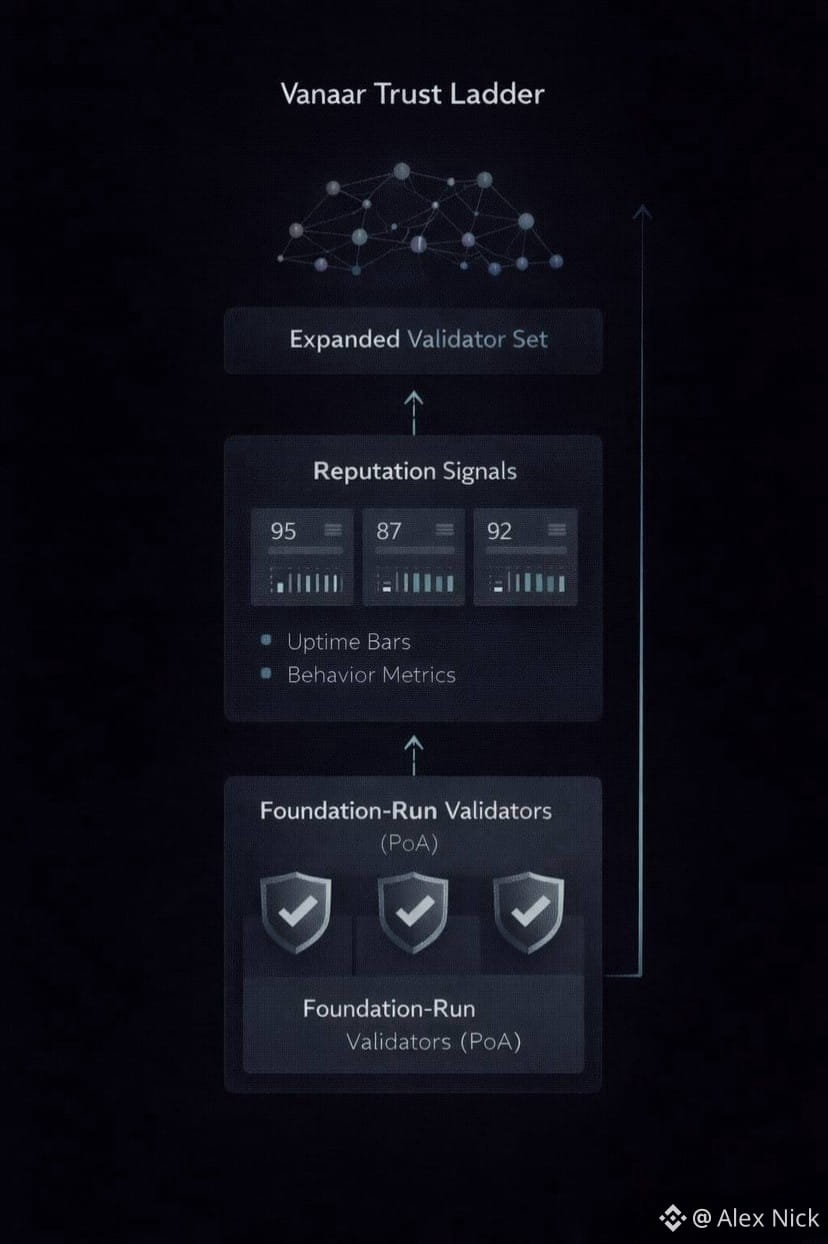
Most chains say they believe in progressive decentralization. Vanar actually writes it into how validators are introduced. That difference matters. It shows intention instead of aspiration.
From my perspective, this approach accepts an uncomfortable truth. Early networks fail not because they are not decentralized enough, but because they are unstable, unpredictable, or fragile under pressure.
Why Vanar does not rely on stake alone
One of the most overlooked design choices is that Vanar does not treat capital as the only source of security. Many networks reduce everything to how much money someone can lock up. Whoever buys the most influence wins.
Vanar goes another direction. It combines Proof of Authority in the early stage with Proof of Reputation over time. At first, the foundation runs validators. Later, independent validators enter based on performance, behavior, and consistency.
When I think about it, that makes sense. Money can be borrowed. Stake can be rented. Reputation cannot be faked easily over long periods.
The chain is asking a different question. Who has proven they behave well over time, not who can afford the most influence today. That does not make it perfect, but it does reduce common failure modes like temporary capture or short term speculation driven control.
Why this model fits real payments and operations
Crypto culture often criticizes Proof of Authority for being too controlled. I get that reaction. But when I think from a business point of view, ideology is rarely the biggest problem.
Downtime is. Unclear finality is. Validators behaving unpredictably is.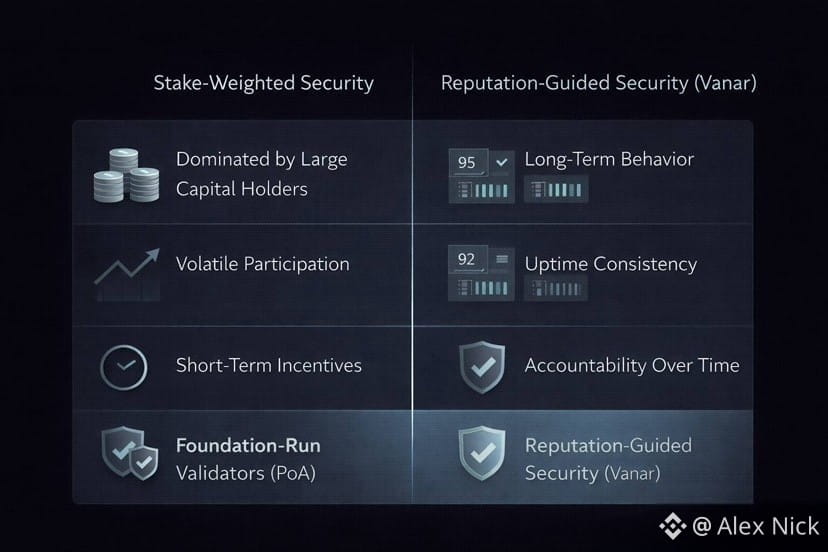
For a payments focused network, stability matters before philosophy. Vanar seems to acknowledge that. The early phase is designed for reliability, while later stages focus on opening access gradually as trust metrics become available.
That mindset aligns closely with the partners and use cases Vanar talks about. Payments and enterprise systems do not tolerate chaos. They tolerate boring.
Compatibility as the quiet growth engine
Something else I keep coming back to is compatibility. The biggest graveyard in Web3 is not failed chains. It is wasted developer time.
Even strong technology dies when builders have to relearn everything just to ship a product. Vanar leans heavily into being compatible with existing tools so teams can deploy without rewriting their entire stack.
To me, this is not about elegance. It is about survival. Builders move toward the path of least friction. Compatibility opens the door first. Advanced features come later.
If Vanar AI and data layers are the long term differentiator, then compatibility is what actually brings people in the door.
Neutron is less about compression and more about ownership
People often talk about Neutron in terms of compression ratios. Twenty five megabytes becoming tens of kilobytes sounds impressive, but that is not the part that caught my attention.
What matters more is the storage model.
Neutron seeds are designed to live off chain for performance while being anchored on chain for verification, ownership, and integrity. That tells me Vanar is not chasing ideological purity. It is choosing pragmatism.
Heavy data moves fast where it needs to. Cryptographic truth lives on chain where it belongs. This hybrid model feels far easier to adopt than trying to push everything fully on chain and hoping performance problems magically disappear.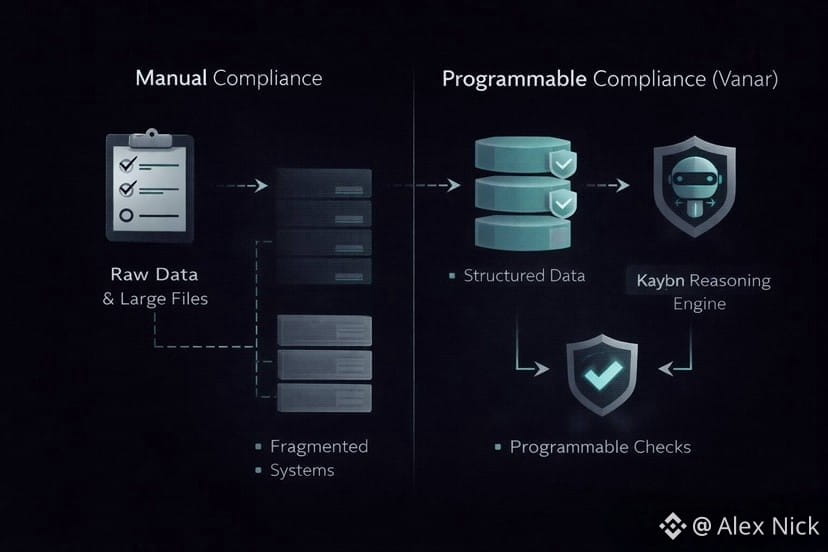
Kayon turns compliance into software instead of paperwork
When Vanar talks about Kayon, the framing is important. It is not about humans checking boxes. It is about systems asking questions.
Kayon is designed as a reasoning layer that can query structured data, interpret context, and automate compliance logic across Neutron, blockchains, and enterprise systems.
I find this angle interesting because compliance today is mostly manual. It lives in back offices, spreadsheets, and delayed reviews. Vanar is trying to make compliance something that can be encoded, queried, and replayed.
If that works, it shows up in boring places. Audits. Disputes. Reporting. Payment checks. And honestly, that is where budgets actually live.
Staking as security not as speculation
Vanar also treats staking in a grounded way. It is not presented as a yield game. It is framed as participation in network security.
Stake, support the network, earn rewards. Simple.
What matters long term is how staking ties into reputation. If validator access truly expands based on consistent behavior rather than raw capital, staking becomes part of a trust system instead of a dominance contest.
That shift would be subtle, but meaningful.
Ecosystem growth through builders not noise
I noticed that Vanar focuses quietly on builder support rather than headline partnerships. The Kickstart programs and developer tooling show an intention to reduce friction for teams launching on the chain.
In my experience, ecosystems do not grow because of logos. They grow because builders ship products that users actually touch.
If Vanar succeeds here, growth will not look explosive. It will look steady. Projects launch. Users stay. Feedback loops tighten. Credibility builds slowly.
A system that tries to explain itself
One part of the architecture that resonates with me is the focus on explainability. Crypto already struggles with trust. AI struggles even more. Combining both without explanation is dangerous.
Vanar seems designed to answer why questions. Why was a payment approved. Why did a rule trigger. Why was a document valid.
In the real world, those explanations are not optional. They separate prototypes from deployable systems.
The real bet Vanar is making
At its core, Vanar is betting that the next phase of Web3 looks less like speculation and more like invisible infrastructure. Predictable validation. Verifiable data. Compliant logic. Tools builders can rely on.
It is not an exciting bet. It is a serious one.
When I try to evaluate it casually, I do not ask whether it sounds revolutionary. I ask whether it reduces friction in real systems. Whether it makes things easier to trust, easier to explain, and easier to run over time.
Vanar is building trust one rung at a time. In a market obsessed with instant decentralization, that slower approach may end up being its strongest signal.
