
Imagine a world where AI agents are making million-dollar calls in the blink of an eye. You can’t risk your data sitting out in the open, vulnerable. Walrus gets that. They’ve built a chain-agnostic storage system on Sui that doesn’t just store your data—it armors it, verifies it, and spreads it out across a network so tough, it shrugs off single-point failures like they’re nothing. Centralized servers? Old news. Walrus gives you decentralized blob storage with cryptographic proofs that guarantee your data’s always there. No drama. No downtime. Builders who want real resilience are flocking in.
Here’s how they pull it off: Walrus chops big files into encoded chunks called slivers, using smart erasure coding. Then, it scatters those slivers across more than a hundred independent storage nodes. Forget the old way of making 10 or 20 copies of everything—costs spiral and it’s just not efficient. Walrus keeps storage overhead to just four or five times the original size but somehow manages “twelve nines” of durability. That’s 99.9999999999% reliability. We’re talking about the kind of odds where you might lose a file once every million years or so. The magic mix? Their Asynchronous Complete Data Storage (ACDS) and the Asynchronous Challenge Protocol (ACP/WACP). These systems check your data’s integrity without waiting around for every node to answer at once. Even if the network’s messy, delayed, or half the nodes drop out, your data hangs tight. You only need a chunk of the slivers to bring it all back. It’s built to handle chaos and still guarantee cryptographic integrity at every turn.
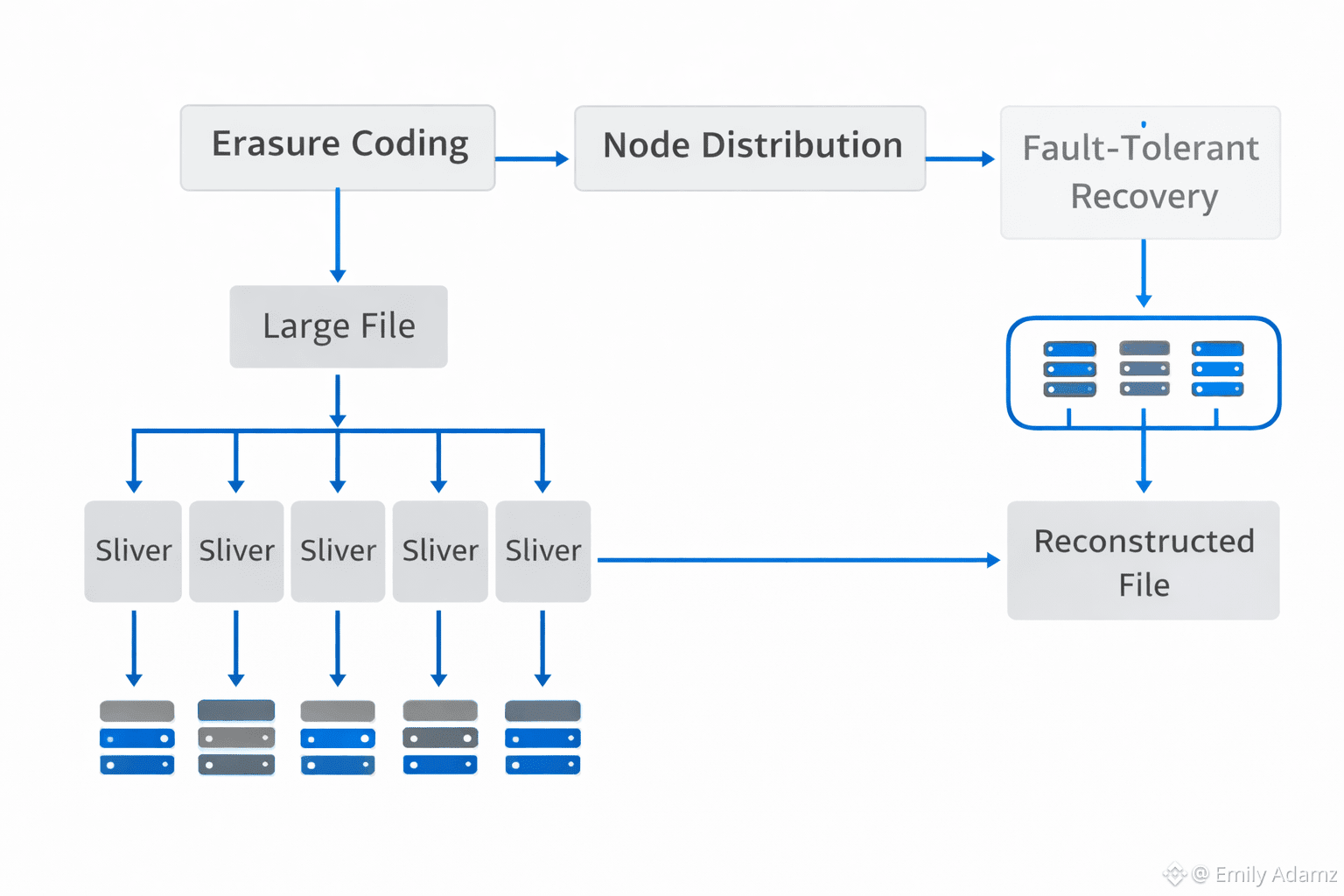
But Walrus isn’t just safe storage; it’s programmable. Your data blobs become on-chain objects, managed by Sui smart contracts. Developers can wire in rules about who can access, renew, or delete data—right into their apps. For AI projects, this is a game-changer. Suddenly, you can prove exactly where your data came from, who touched it, and under what conditions—all cryptographically, no more relying on trust or reputation. It’s all hard evidence, no hand-waving. The modular setup also separates data storage from computation, so even massive AI datasets that would choke a blockchain are now manageable. This opens the door for true open data markets—creators monetize, buyers verify, and middlemen don’t get to skim off the top.
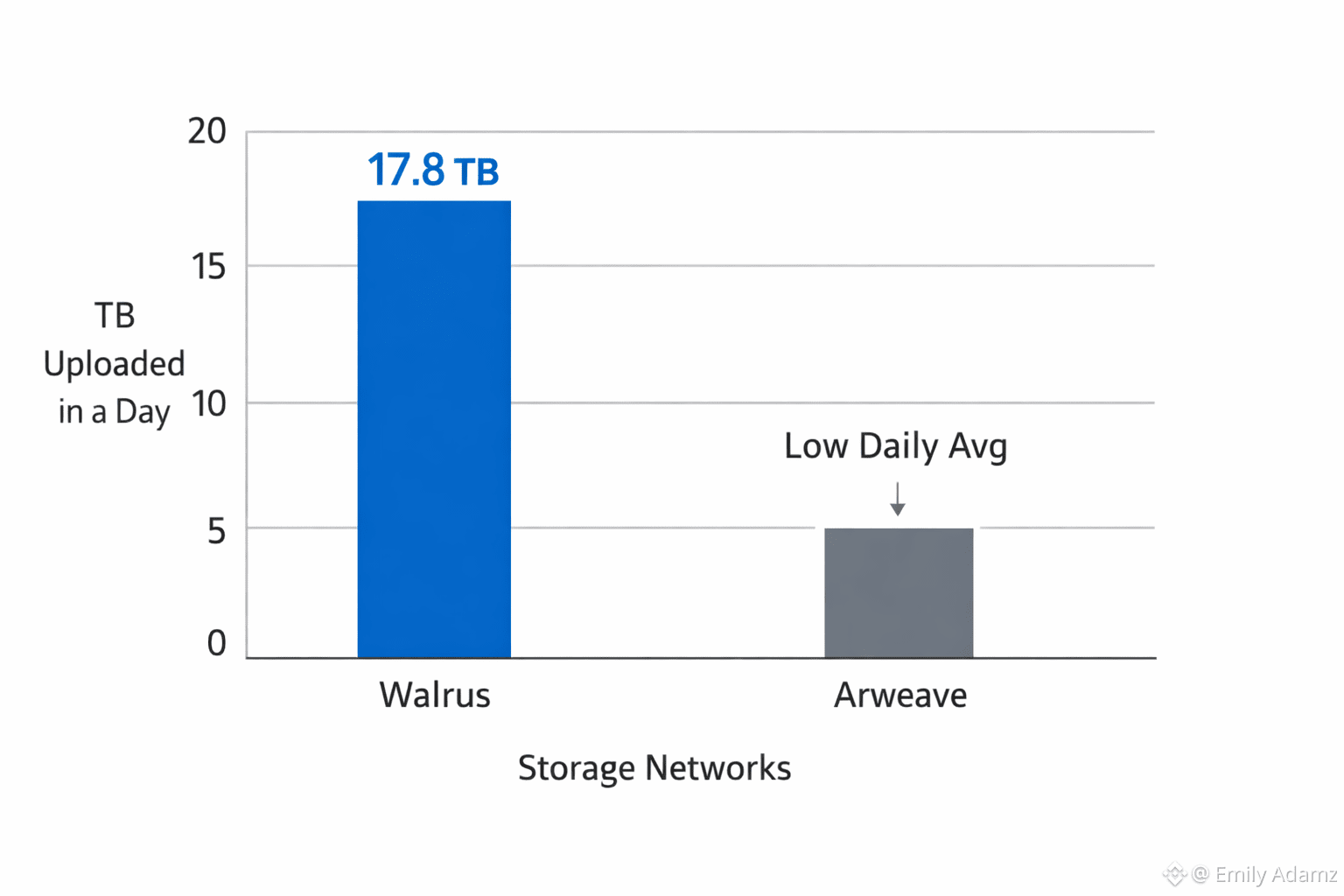
And it’s not just hype—people are already using it. Since launching on mainnet in March 2025, Walrus has carried nearly a year’s worth of real production traffic. Projects like RealTBook park their NFTs here for good, and Unchained Podcast keeps their whole media library safe from central failures. The numbers tell the story: total network capacity is up to 833 TB, with nearly 79,000 GB already in use across more than 4.5 million blobs. January 2026 saw a record 17.8 TB uploaded in a single day, with several other days over 5 TB. That’s faster growth than Arweave, which sits at about 340 TB after years. Big players are jumping in too—Alkimi Exchange is using Walrus for ad data in Trusted Execution Environments, Omura is layering on AI search for easier discovery, and Team Liquid just moved their massive video archives over. That’s one of the biggest datasets the system’s ever seen.
Walrus isn’t stopping at storage. Their Wal.app platform lets people run truly decentralized apps and sites—no wallets or servers needed. Apps like Flatland and Snowreads run right on it, with Web2-level costs but way more resilience. For developers, it’s a dream: cross-chain compatibility, smart shard assignments to keep things efficient, and dynamic redistribution to stop any one node from getting too much power. Node operators stake WAL tokens for rewards, but this isn’t for hobbyists—they need serious specs: 16-24 CPU cores, 100 GB RAM, and 52 TB disk space. Backing it all is $140 million in funding, and AI agents are already tapping into Walrus for payments, supply chains, and more, all with tamper-proof data flows.
In short, Walrus isn’t just storing data—it’s building the backbone for AI’s decentralized future. Here, proof beats promises, and scale meets security head-on. As word gets out, expect Walrus to set the bar for data markets that actually work.$WAL @Walrus 🦭/acc #Walrus