
Watching a stablecoin transfer stall feels antithetical to its entire purpose. The promise is digital cash, but the experience often remains stubbornly crypto. What if the chain itself was molded around that singular function. That is the premise I see in Plasma, a Layer 1 where every technical decision, starting with its consensus mechanism, appears engineered for one outcome, making stablecoins move like they should. PlasmaBFT is not just another consensus algorithm, it is the foundational logic for a blockchain that wants to be a settlement rail, not a general purpose computer. My review of its architecture suggests a deliberate trade off, favoring the predictable finality that financial activity demands over the more flexible but slower probabilistic finality of chains like Ethereum.
The core technical document, the Plasma whitepaper, frames the network as a high performance, delegated Proof of Stake system. The key is PlasmaBFT, a Byzantine Fault Tolerance variant engineered for what the team terms "sub second finality." This means a transaction is irreversibly settled in under a second, a metric that shifts the user experience from hoping a payment will clear to knowing it has. For a chain positioning itself as a dedicated stablecoin settlement layer, this is non negotiable. You cannot build a payments system on maybes. The design choice here is stark, optimize for the speed and certainty that commerce requires, even if that means a more centralized validator set typical of BFT derived systems. The whitepaper details a two phase process for this, separating block proposal from finalization to streamline the path to that irreversible state.
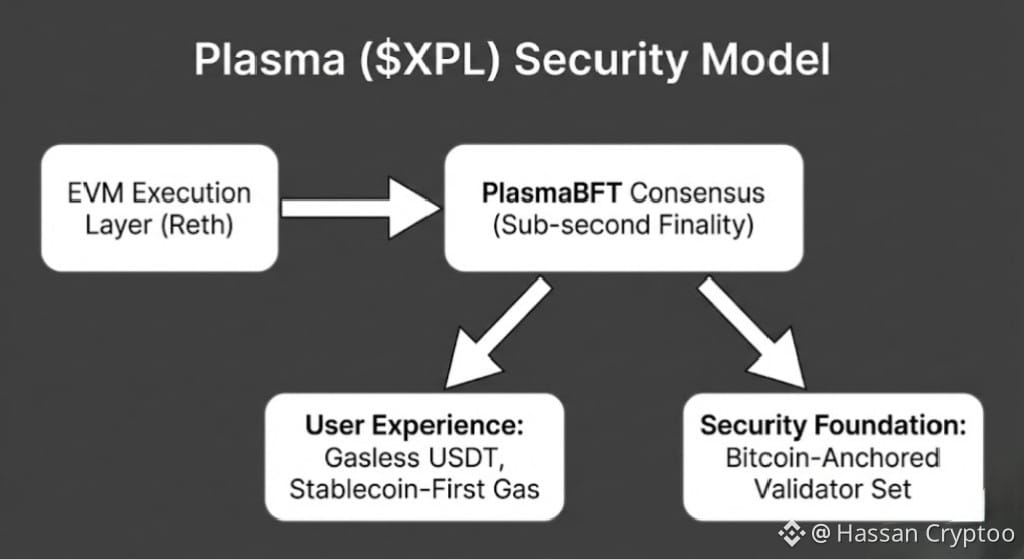
This technical architecture directly enables the user facing features that define Plasma. Gasless USDT transfers and stablecoin first gas are not just marketing points, they are logical endpoints of a chain built from the ground up for this asset class. If the base layer settles with sub second finality, then abstracting away gas fees in the dominant stablecoin becomes a viable economic model. It reorients the entire chain's economy around USDT and its peers. The narrative is not about hosting the next thousand meme coins, it is about being the most efficient venue for a specific, massive financial primitive. The target users, retail in high adoption markets and institutions in payments, are not looking for a new smart contract playground. They need a highway where their stablecoins do not hit toll booths or traffic jams.
Plasma's specialized utility is further cemented by incorporating what the project terms "Bitcoin anchored security". The network functions with its own independent set of validators, yet it consistently records checkpoints to the Bitcoin blockchain. The objective here is not to utilize Bitcoin's computational power for transaction consensus. Instead, it harnesses Bitcoin's matchless neutrality and resilience against censorship to act as a secure, immutable notary service. For institutions, this creates an immutable, time stamped audit trail on the most secure network in existence. It is a hybrid model, the speed and low cost of a purpose built PoS chain, with the final, historical security guarantee of Bitcoin. This addresses a critical hesitation for large scale adoption, providing a cryptographic safety net that general purpose EVM chains do not inherently offer.
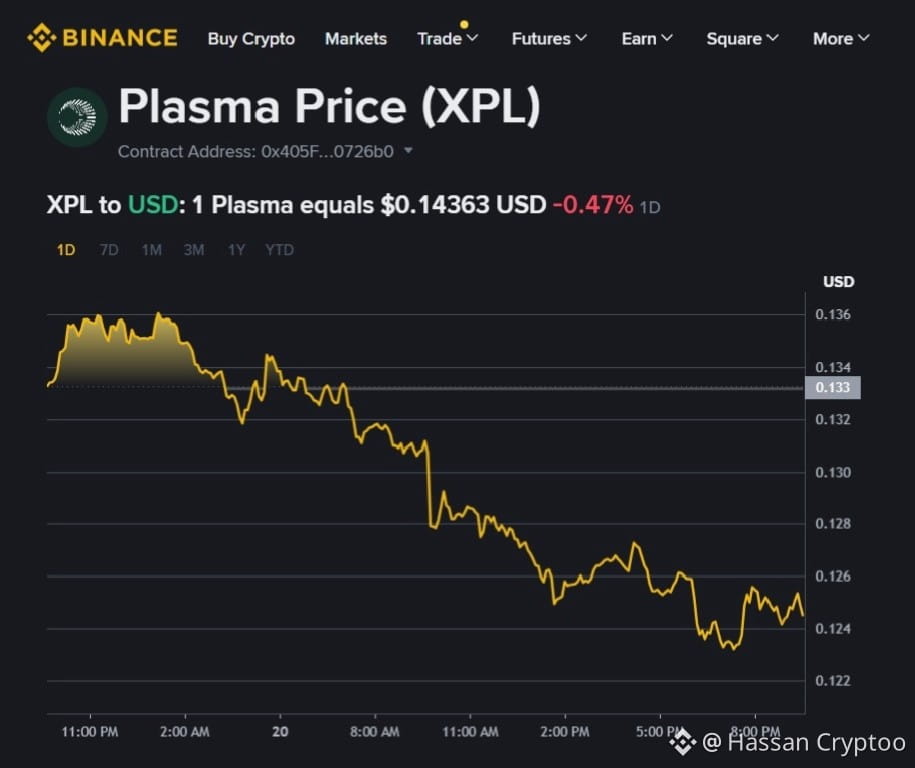
A review of the XPL token on the Binance Spot market shows a digital asset fundamentally connected to this ecosystem's goal. The token's primary utility is staking to secure the network as a validator or delegator, which ties its demand directly to the safety and operational activity of the Plasma chain. Through governance, holders can vote on essential parameters, potentially encompassing fee market designs and new stablecoin integrations. While the daily chart price shows volatility, the fundamental value proposition remains linked to the network's adoption as a dedicated stablecoin settlement layer. The true measure to monitor will not be near-term price moves but the increase in stablecoin transaction flow and total value processed on Plasma, as this has a direct relationship with the security demand for XPL.
The project's information channels, like its official website and documentation, consistently emphasize this stablecoin first roadmap. The design philosophy is less about what the chain can do, it is fully EVM compatible via the Reth client, and more about what it is optimized to do. This is a vital difference. For developers, this compatibility permits applications to be transferred with little effort. Yet, the network's core architecture deliberately emphasizes, supports, and incentivizes actions focused on stablecoins. Most layer-one networks compete to be multi-purpose platforms. In contrast, Plasma has intentionally narrowed its focus to establish itself as the dominant specialist. The protocol is built on the premise that a huge, underserved market exists for stablecoin payments requiring speed, robust security, and minimal cost a niche large enough to justify an entire blockchain. Success, however, is contingent on delivering robust technology and achieving mainstream traction. The technical base, established first with PlasmaBFT, has been laid with a clear and exclusive focus on this goal.
by Hassan Cryptoo