
I honestly expected to see Walrus operators start dropping off when the token broke $0.10 and instead I'm looking at the same 105 nodes that were there at $0.16. WAL sits at $0.0910 right now with RSI at 16.34—that's panic-level oversold that should have infrastructure collapsing. The token briefly touched $0.0879 overnight. That's a 16% crash in 24 hours on top of weeks of sustained decline. And those storage nodes? Still processing availability challenges. Still serving data. Still running infrastructure like nothing happened.
That kind of persistence during capitulation isn't accident. It reveals something about who actually built Walrus.
Most crypto infrastructure would be shedding nodes by now. Operators who planned for $0.12 break-even would be losing serious money at $0.09. The economic signals all point toward exit. Revenue in fiat terms has collapsed while costs stayed constant. Bandwidth still costs the same whether you're earning it in WAL at $0.16 or $0.09. Power consumption didn't drop. Hardware maintenance is still expensive. Every rational operator should be calculating whether continued losses make sense.
But they're not leaving. Which means the operators running Walrus today aren't the rational profit-optimizers. They're the believers.
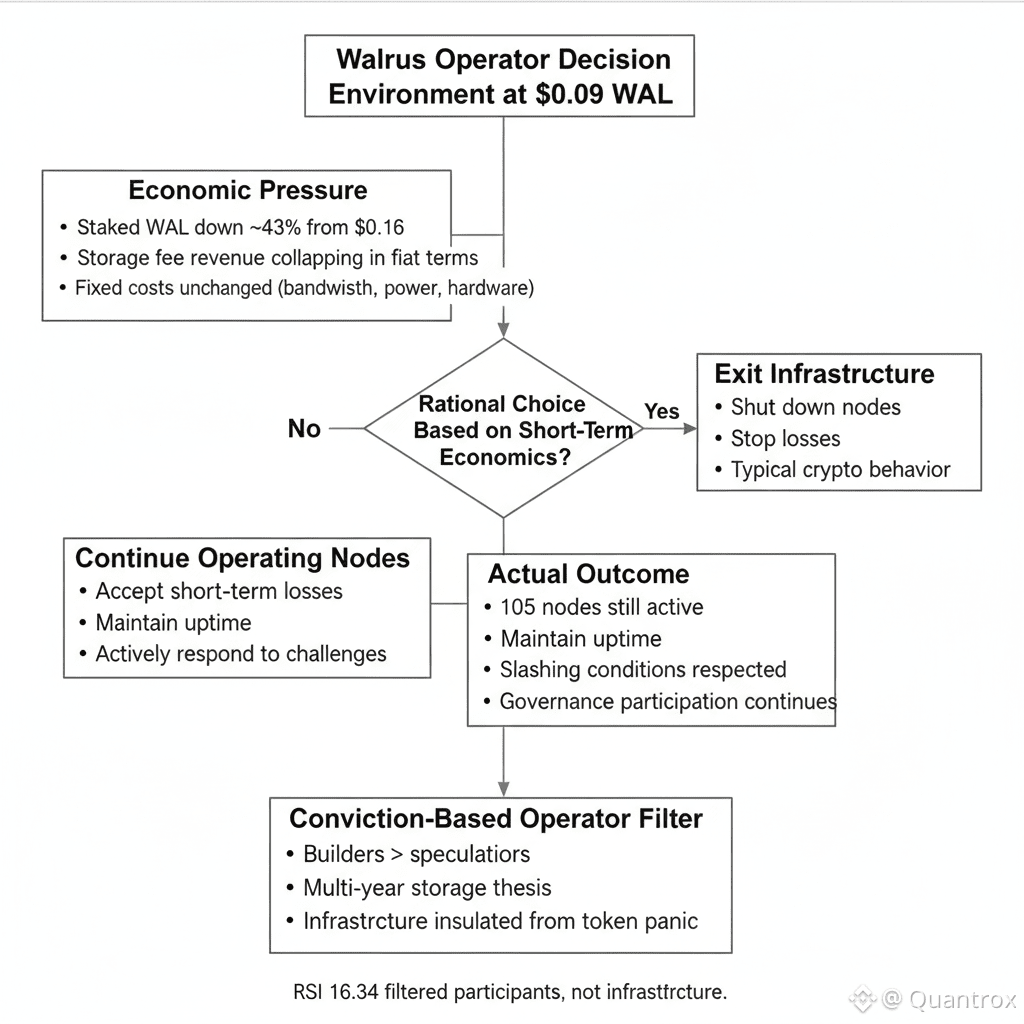
Here's what caught my attention. RSI at 16.34 is extreme even by oversold standards. That's capitulation territory where weak hands panic sell and momentum completely breaks. The kind of price action that makes speculators question everything. Yet Walrus infrastructure doesn't care. The nodes keep running because the operators running them aren't reacting to RSI readings or price crashes. They're executing on multi-year plans that anticipated exactly this kind of volatility.
Walrus operators stake WAL to participate. At $0.0910, that staked capital is worth 43% less than it was at $0.16 just weeks ago. They're watching their collateral value evaporate in real-time. Their revenue from storage fees keeps declining in fiat terms. Every economic metric says this was a terrible investment that's getting worse. And they keep operating nodes anyway.
That's conviction that price charts can't shake.
Maybe I'm romanticizing it. Could be operators are just slow to react. Could be they're paralyzed by sunk costs and don't know what else to do. Could be they're hoping for recovery and delaying the inevitable. But I keep coming back to the same observation—105 nodes is the same count that existed months ago. Zero attrition through weeks of token decline. That's not coincidence or paralysis. That's commitment.
The operators who would quit at $0.09 never joined in the first place. The ones running Walrus infrastructure today are the ones who planned for this scenario. They knew tokens don't go up forever. They knew infrastructure requires surviving volatility. They knew the bet was on storage adoption over years, not token appreciation over months. And they're proving they meant it by continuing operations when every market signal says stop.
Walrus processed over 12 terabytes during testnet when there was zero revenue. Operators ran infrastructure at a loss for months to test the network. That was preparation for sustainable mainnet economics. Mainnet launched in March 2025, and WAL is now at $0.09 while operators earn fees worth a fraction of what they anticipated. The original plan didn't work out. But the operators are still executing anyway.
Here's a concrete reality about what $0.09 WAL means for operations. An operator who set up infrastructure expecting $0.14 average pricing is now earning 35% less revenue than planned. If they were targeting 20% profit margins, they're probably at break-even or small losses now. If they were already tight on margins, they're bleeding money every month. The economics don't work at current prices for most operators unless they had massive buffers.
But they're still there. Still maintaining uptime. Still responding to availability challenges within required timeframes. Still voting on storage pricing every epoch. That's work that requires active engagement, not passive holding. You can't phone it in when slashing penalties exist for failed challenges. The operators still doing this work at $0.09 are choosing to do it despite economics that don't justify it.
My gut says this is the filter Walrus needed. The operators who stayed through the crash to $0.09 are the core that actually matters. They're not here for quick profits or token speculation. They're here because they believe decentralized storage on Sui becomes essential infrastructure. Whether they're right or wrong doesn't matter as much as the fact that they believe it enough to keep operating through panic-level price action.
The circulating supply of 1.58 billion WAL out of 5 billion max means more unlocks are coming. Price could fall further. Economic pressure could intensify. More operators could eventually quit if conditions worsen. But the 105 who are still running today survived the worst crash so far. They're the stress-tested infrastructure that persists when speculation dies.
Volume of $1.31M during the crash shows real selling happening. This wasn't just thin market volatility. People were actually exiting with conviction. But the operator community didn't join that exit. They watched their staked capital and fee revenue crater and chose to keep maintaining infrastructure anyway. That divergence between trading behavior and infrastructure behavior is what decentralization looks like when it's real.
Walrus applications storing 333TB on the network don't care about the token price. They care whether data is available when they need it. And it is. Every availability challenge gets answered. Every storage request gets processed. The infrastructure layer is completely insulated from the panic happening in token markets. That's what you pay infrastructure operators for—reliability regardless of market conditions.
This is where Walrus differentiates from pure speculation. Speculators are gone. They left at $0.14 or $0.12 or $0.10. The people still involved at $0.09 are builders and believers. They're running nodes because they think Walrus matters, not because they think WAL goes up. That mentality creates resilient infrastructure that survives when speculation dies.
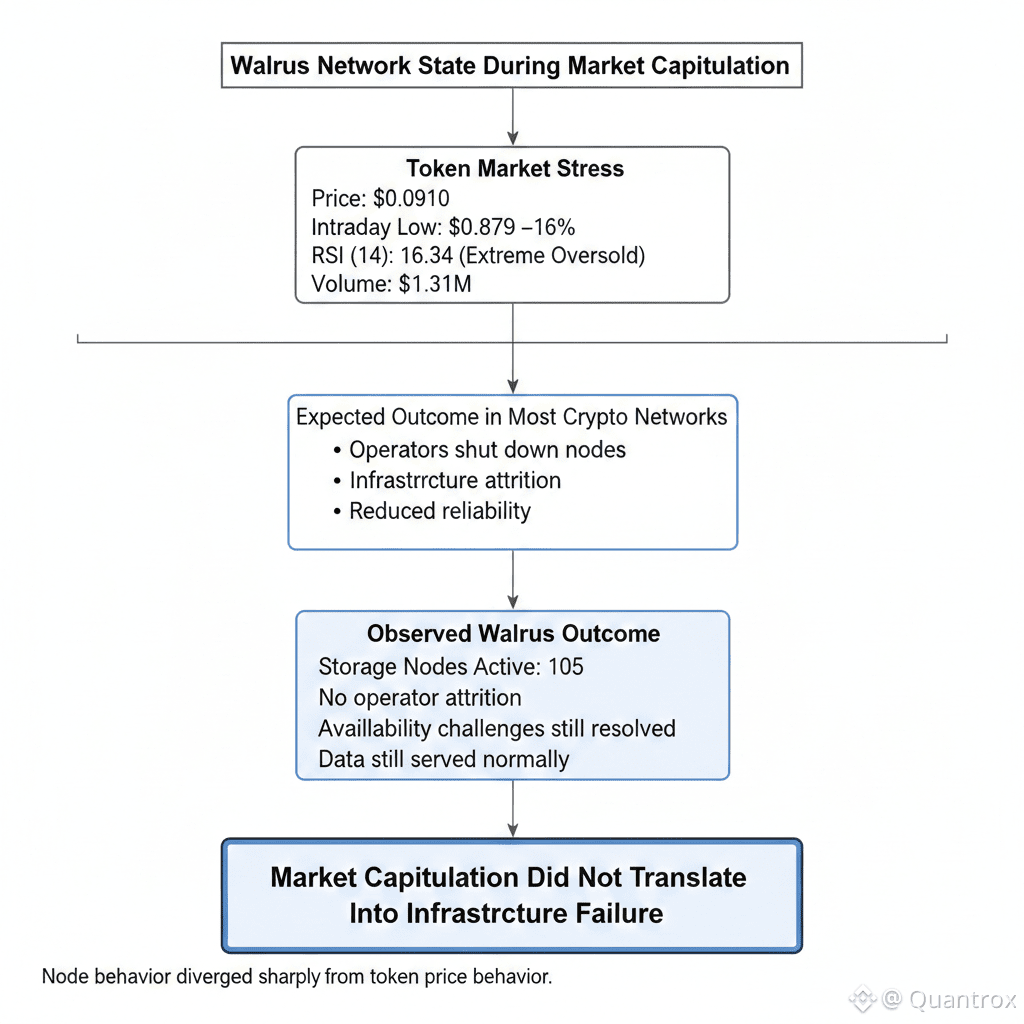
Time will tell whether their conviction pays off or whether they're stubbornly clinging to a failing project. But the fact that infrastructure persists through an RSI of 16.34 and a crash to $0.09 says something meaningful about foundation quality. Weak projects shed operators when tokens crash. Strong projects reveal which operators were serious all along. Walrus just showed you who was serious.
The 105 operators still running storage nodes today aren't making that decision lightly. They're actively choosing to continue operations despite catastrophic token performance. They're maintaining infrastructure through conditions that would break most crypto projects. And they're doing it because they believe in what they're building more than they believe in what they're trading. That conviction matters more than any single day's price action, even when that price action is a crash to $0.09.

