
when I thought about the constraints of traditional blockchain implemented as AI applications, and how a stateless architecture (as many Layer 1 networks use) can make intelligent systems impossible to scale. In stateless designs a transaction history is reconstructed into state each time, and is good at simple ledgers but expensive at AI, where persistent memory is needed to reason over and learn about data. Vanar Chain will solve this issue by integrating native memory mechanisms, which are more appropriate to AI at scale.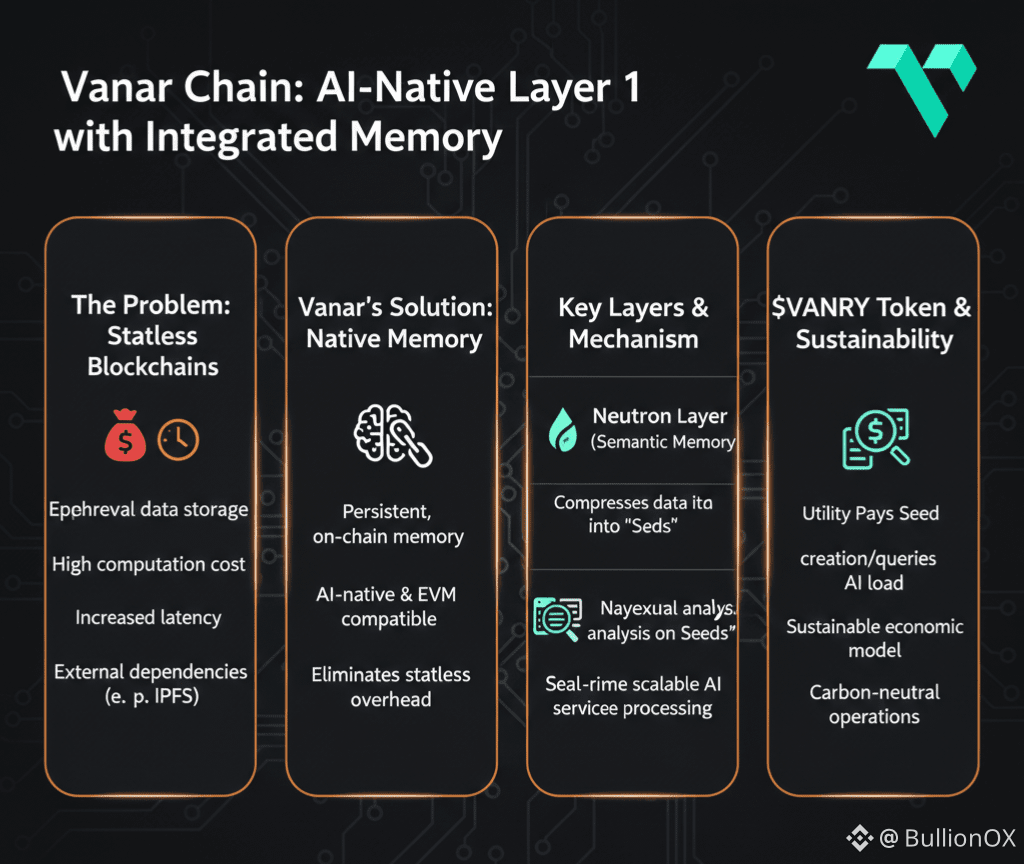
Vanar Chain is an AI native, EVM compatible Layer 1 blockchain. Stateless blockchains use ephemeral or off chain storage of data, which creates more computation overhead, and increases the cost of recreating a state, and exposes it to external dependencies such as IPFS. In the case of AI agents with a necessity to have context of past interactions (e.g. review of transaction history or legal records), that leads to inefficiency and possible loss of data, restricting complexity applications in terms of scalability.
The stateless design cost is especially notable in the AI at scale. Rebuilding state on each query is costly, which decreases performance and increases gas bills. This may render operations in high-volume applications such as PayFi or tokenized real-world assets impractical since AI systems must access and recalculate data many times. External storage introduces the risks of centralization, where the availability of the data is subject to the third party providers, and this will compromise the decentralization. Vanar Chain addresses such problems using the five layer stack, in which memory is constructed upwards and downwards to accommodate persistent knowledge on the chain.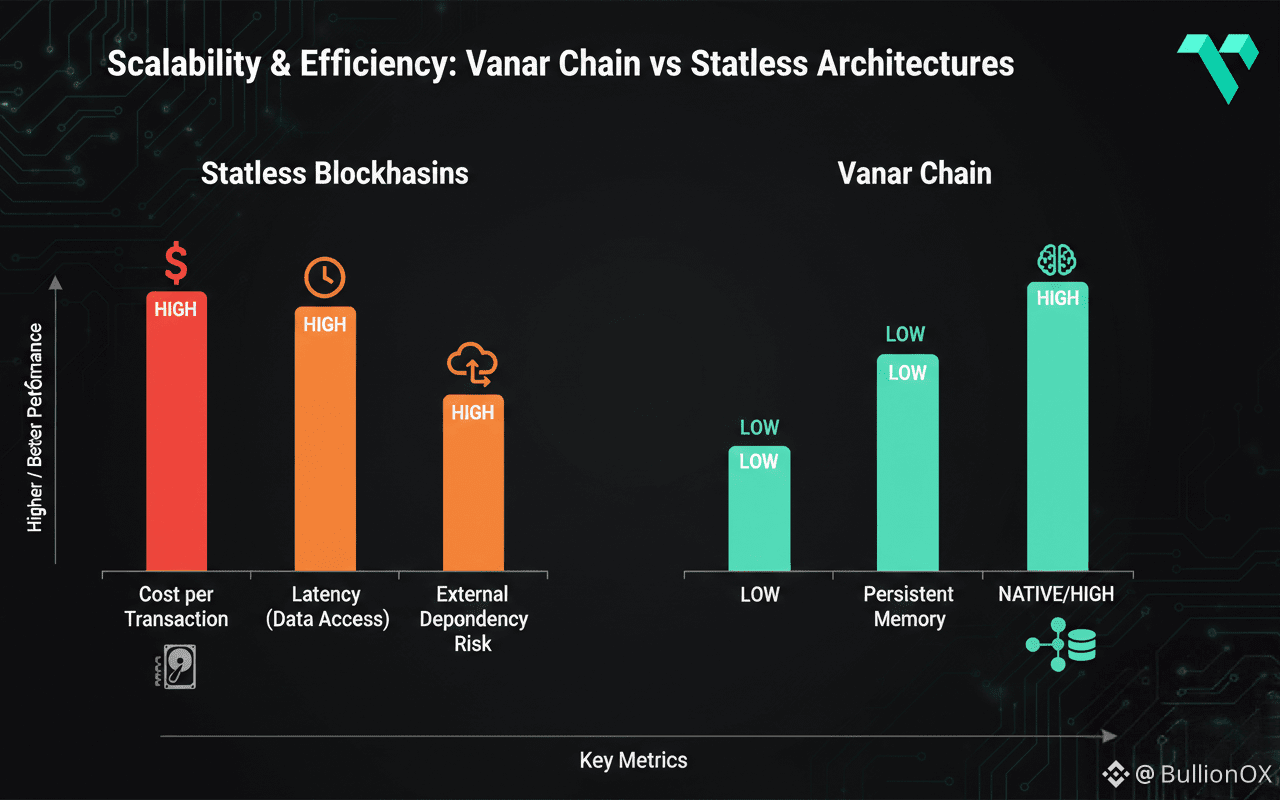
The semantic memory is based upon the Neutron layer. It algorithmically and heuristically compresses raw files, documents, or records into condensed programmable objects called Seeds. These Seeds store vital meaning, context and relationships and are stored directly in the Vanar Chain blockchain. This is unlike stateless models which do not guarantee data is native, verifiable or can always be accessed without overhead of reconstruction. In AI at scale, Seeds allow agents to be session wise history aware, which eases computation and is more efficient.
The reasoning layer, named Kayon, is using this memory to execute a contextual analysis over the Seeds in real time. These enable scalable AI services, e.g. automated compliance checks in RWAs or conditional validations in PayFi, both on chain. It makes the integration cost effective because data becomes persistent and queryable without incurring the high costs of rebuilding without a state. More recent changes, such as optimization of the V23 protocol, have improved it further to reduce latency and resource consumption, allowing it to be used in larger scale AI applications.
These memory and reasoning processes are facilitated by $VANRY . It pays gas charges on Seed creation and storage, inquiries and logic, basing the utility of the token on real AI load requests. With the size of AI applications, the cost of vanry diminishes in the same proportion, which forms a sustainable economic model. Staking vanry also provides the network with a reputation enhanced consensus, which is reliable when at scale.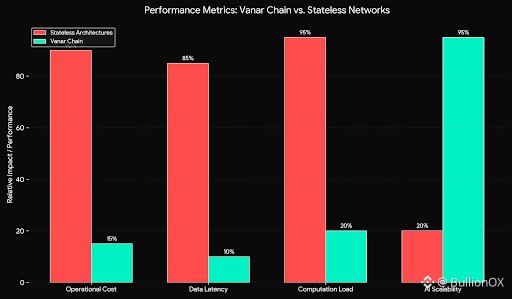
On Neutron and Kayon, Vanar gives extensive technical documentation on the way the memory layer is used to circumvent stateless constraints. The operation of the platform is carbon neutral, which is made possible through the use of renewable energy and contributes to its scalability because the operation complies with regulations and environmental conditions.
Vanar Chain's focus on built in memory shows why it is important to AI at scale: it eliminates the hidden costs of stateless design, and allows more efficient and decentralized intelligent systems to be built. This strategy is sustainable to increase Web3 AI applications.