
When I first started reading about tokenized assets, I assumed it mostly meant putting stocks or bonds on a blockchain and letting people trade them like tokens. Over time I realized that idea barely scratches the surface. Real capital markets are not just about buying and selling. They depend on legal documents, investor classifications, transfer limits, reporting rules, settlement cycles, and liability protection. If any of those pieces are missing, the asset may live on a chain, but it is not truly a security.
This is where Dusk Network starts to feel very different from most crypto projects I read about. Dusk is not trying to simply add privacy to existing DeFi flows. It is trying to rebuild the internal plumbing that real capital markets rely on, but in a blockchain native way.
What surprised me is that privacy is not even the main story. It is just one requirement among many.
Why tokenization usually stops halfway
A lot of projects talk about bringing real world assets on chain, but when I look closely, many of them stop at surface level. They mint a token, add a label like security or RWA, and hope liquidity appears.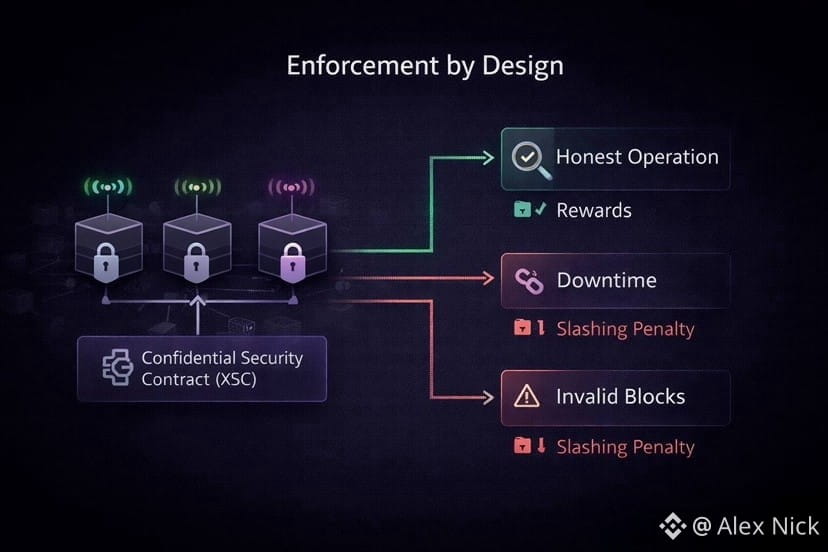
In real markets that does not work. Securities must know who can own them, who can transfer them, how dividends are paid, when voting is allowed, and what disclosures are legally required. Without these controls, regulators do not see a financial instrument. They see a mislabeled token.
Dusk approaches this from the opposite direction. Instead of starting with tokens and adding rules later, it starts with rules and builds the asset around them.
Why Dusk feels closer to market infrastructure
What pulled me deeper was realizing that Dusk treats regulation as something that belongs inside the asset itself. Sensitive data stays protected, but compliance is not handled off chain by lawyers and spreadsheets alone.
The blockchain is designed so that regulatory logic can live inside the contract. This is not about avoiding oversight. It is about making oversight verifiable without exposing everything publicly.
That shift moves Dusk away from typical DeFi and much closer to how real financial systems operate.
The importance of the XSC standard
One of the most overlooked parts of Dusk is its asset standard called the Confidential Security Contract or XSC. I kept thinking of it as something similar to ERC twenty, but with far more responsibility built in.
Securities are not simple balances. They carry ownership rules, eligibility checks, corporate actions, and sometimes recovery mechanisms. XSC is designed so those requirements exist at the protocol level, not as optional add ons.
When I read this, it clicked. Dusk is not chasing issuers with hype. It is setting strict requirements because serious issuers actually need those guardrails.
In that sense, XSC is not trying to attract everyone. It is trying to attract the right type of market.
Why privacy matters more for assets than transfers
Most privacy chains focus on hiding transactions. Dusk goes deeper. It focuses on hiding sensitive market structure.
In real equity markets, you never see a public list of every investor and their exact position. That information is protected for good reasons. Public disclosure would enable surveillance, manipulation, and competitive harm.
Dusk recognizes that asset level confidentiality matters more than transaction secrecy alone. Issuers and investors need privacy by default, with the ability to prove compliance only when required.
That feels much closer to how traditional finance actually works.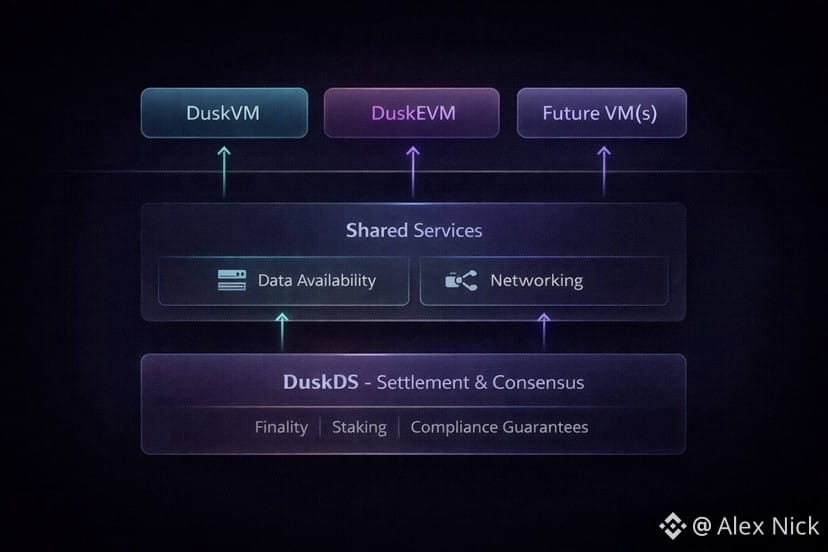
Modular architecture built for institutions
Another detail I found interesting is how Dusk structures its chain internally. Instead of one rigid execution model, it uses a modular setup.
At the base sits DuskDS, which handles settlement, consensus, and data availability. On top of that, different execution environments like DuskVM and DuskEVM can exist.
From my perspective, this is not about technical elegance. It is about risk management. Institutions do not want their entire system tied to one virtual machine forever. They want stable settlement at the base and flexibility above it.
That separation mirrors how real financial systems evolve over decades.
Reliability is treated as a legal obligation
In crypto culture, downtime is often brushed off as inconvenience. In regulated markets, it is a crisis.
Dusk treats validator reliability as a professional responsibility. Slashing is real. Operators can lose stake for poor performance or invalid behavior. There are both soft and hard penalties.
This design makes participation less casual and more accountable. That aligns with Dusk’s target audience. Financial infrastructure cannot be experimental once real assets are involved.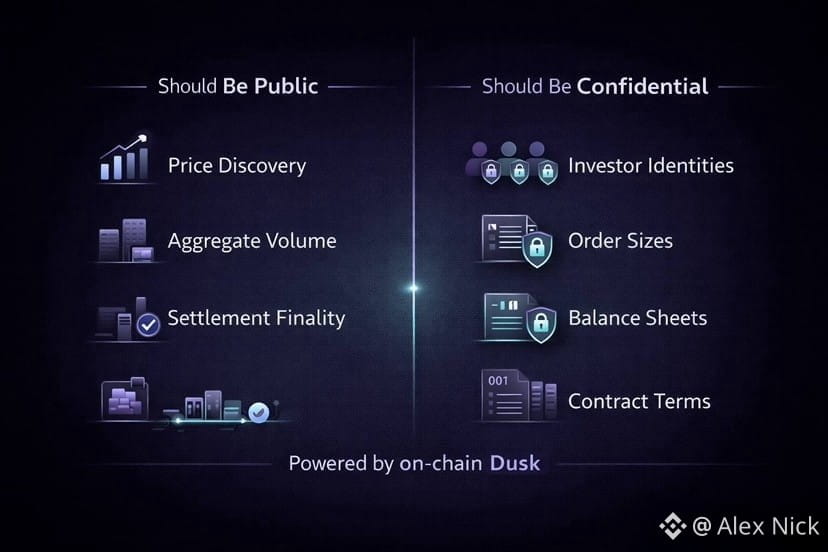
Long horizon security planning
Another thing that stood out to me was the token supply strategy. Dusk is not designed for short cycles.
The supply is capped at one billion tokens, with emissions stretched over more than three decades. That timeline says a lot. It signals that security funding is meant to last as long as markets themselves.
Stock exchanges and clearing systems are not built for hype cycles. They are built for longevity. Dusk seems to be aiming for the same mindset.
Adoption through regulated partnerships
What makes all this feel grounded is that Dusk is not trying to bootstrap liquidity through memes or farming incentives. It is pursuing regulated partnerships.
The collaboration with NPEX in the Netherlands and later with 21X under European DLT frameworks shows how slow and procedural this path is. Licenses matter. Legal approvals matter. Infrastructure must fit into existing regulation.
This is not fast adoption, but it is credible adoption.
What real usage could look like
I often imagine a simple scenario. A small company wants to issue a bond. The investor list must stay private. Coupon payments must be automated. Transfers must be limited to qualified participants. Auditors must be able to verify records.
Dusk aims to make that entire workflow native to a blockchain. The asset contains its own rules. The settlement layer provides finality. Disclosure happens only when legally required.
If that works, the blockchain stops being a speculative venue and starts behaving like financial infrastructure.
The question that matters going forward
At this point, the technology story is largely written. The real question is execution.
Will issuers actually launch assets using these tools. Will marketplaces support them. Will real trading volume emerge under regulated conditions.
If that happens, Dusk stops being a privacy project and becomes something rarer. A blockchain that resembles the backbone of capital markets.
That path is harder. It is slower. It does not trend easily.
But if it succeeds, it is also far more durable.
