

For more than a decade, financial infrastructure has struggled with a mismatch between how money actually moves in the real world and how blockchains are designed to settle value. Payments systems, whether retail or institutional, are built around predictability. Transactions are expected to finalize quickly, fees must be understandable in advance, and settlement assets need to be stable enough that accounting, compliance, and treasury operations are not exposed to unnecessary volatility. Most public blockchains, however, were not designed with this reality in mind. They treat volatile native tokens as the center of economic activity, rely on variable fee markets, and accept probabilistic or delayed finality as an acceptable trade-off for decentralization.
This gap becomes more pronounced when stablecoins enter the picture. Stablecoins are widely used because they behave more like money than speculative assets. They are used for payroll, remittances, merchant payments, and treasury management, especially in regions with high inflation or fragile banking systems. Yet on most blockchains, stablecoins remain second-class citizens. Users must still pay fees in volatile assets, tolerate congestion-driven cost spikes, and accept settlement semantics that are difficult to reconcile with real-world payment guarantees. For institutions, this creates operational and reputational risk. A failed or delayed settlement is not an inconvenience; it is a compliance issue.
Plasma is positioned as a response to this structural problem rather than an attempt to generalize blockchain design for every possible use case. Its core assumption is narrow but consequential: if stablecoins are to function as serious settlement instruments, the infrastructure supporting them must be designed around their specific requirements. That means prioritizing fast and deterministic finality, predictable costs, and neutrality at the base layer, even if doing so limits flexibility in other dimensions.
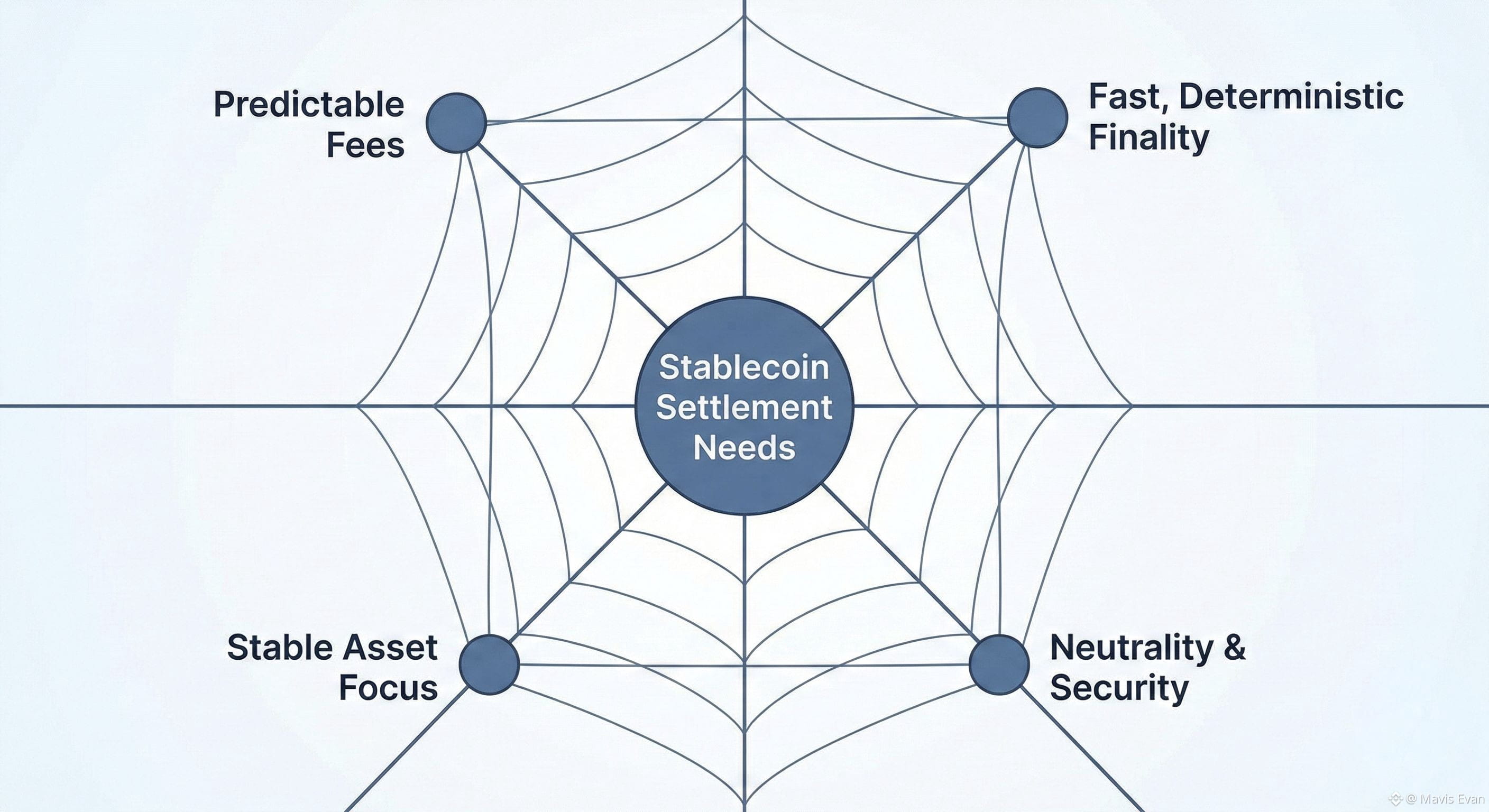
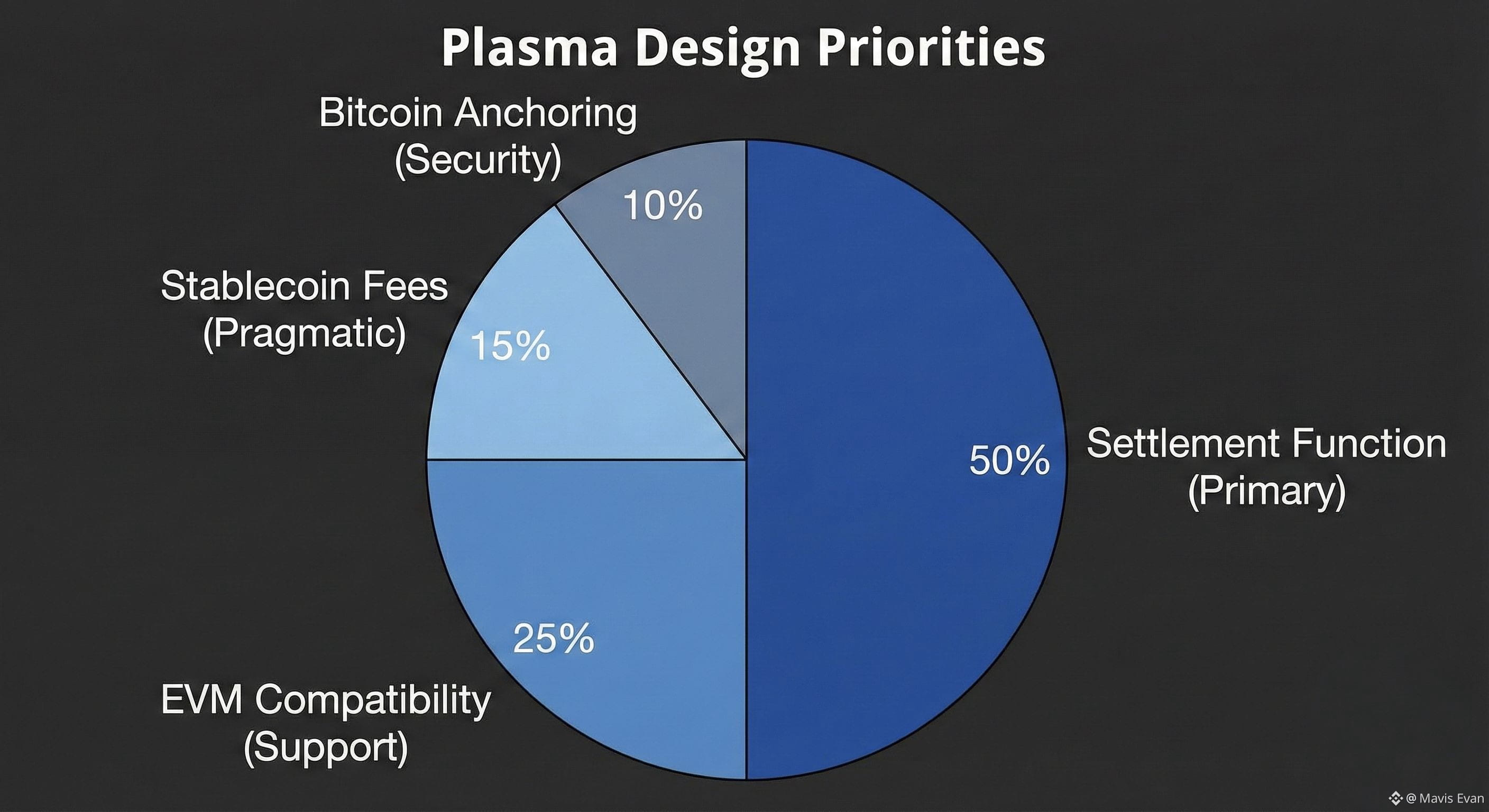
At a conceptual level, Plasma treats settlement as the primary function of the network. Execution and programmability exist to support that function, not to compete with high-complexity application platforms. Full compatibility with existing EVM tooling lowers integration friction for developers and institutions, but the emphasis remains on how transactions are confirmed and finalized. Sub-second finality is not framed as a performance milestone, but as a practical necessity for payment flows where users and counterparties expect near-immediate certainty.
One of the more pragmatic design choices is the treatment of fees. In traditional payment systems, users do not think about which asset they must hold to pay transaction costs. Fees are denominated in the same unit as the transaction itself. Plasma mirrors this logic by allowing stablecoin-first gas and, in some cases, gasless transfers for widely used stablecoins. This is not about user convenience alone. For institutions managing large volumes of transactions, holding volatile assets purely for fee payment introduces balance sheet noise and accounting complexity. By aligning fee mechanics with stable settlement assets, Plasma reduces friction that would otherwise push activity back toward centralized rails.
Security and neutrality are addressed through anchoring to Bitcoin, not as a marketing signal, but as a conservative trust assumption. Bitcoin’s role here is not to provide programmability or execution, but to act as a widely recognized and difficult-to-capture reference point. For payment infrastructure, perceived neutrality matters. Institutions and users alike are wary of systems where settlement assurances depend too heavily on small validator sets or governance structures that can shift unpredictably. Anchoring to a broadly accepted security base trades some flexibility for a clearer trust model, which is often a worthwhile exchange in regulated or high-volume contexts.
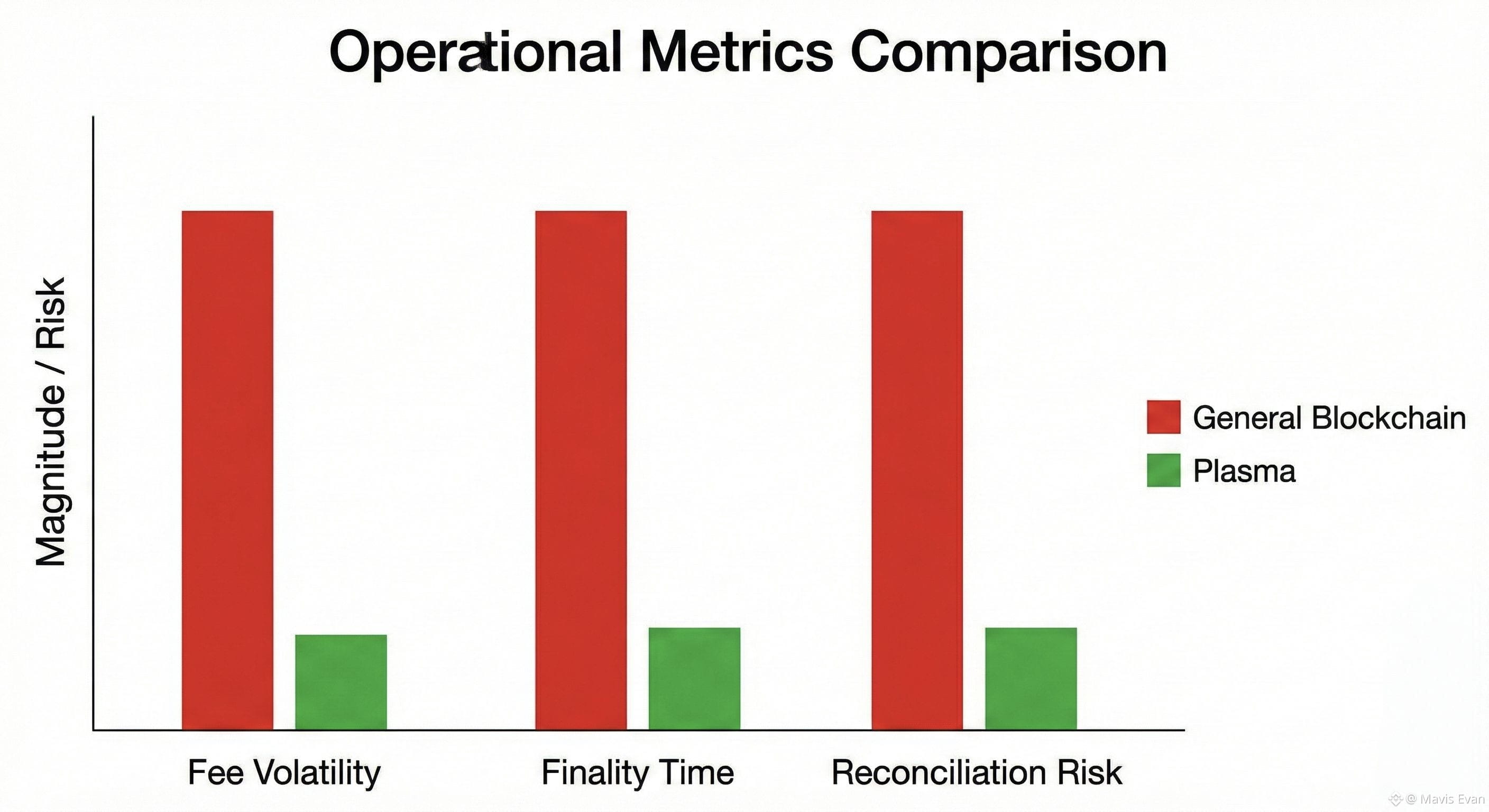
The relevance of these choices becomes clearer when viewed through realistic scenarios. Consider a payments provider operating in a high stablecoin adoption market. Customers expect instant transfers, merchants require predictable fees, and the provider must reconcile transactions daily for reporting and compliance. On a general-purpose blockchain, fee volatility and uncertain finality introduce reconciliation gaps and customer support overhead. On Plasma, settlement behaves more like a dedicated payments network, while still retaining on-chain verifiability and integration with existing smart contract systems.
Institutional settlement presents similar dynamics. A fund using stablecoins for internal treasury movements or cross-border settlement is less concerned with composability and more focused on certainty. Transactions must finalize within defined time windows, and the underlying infrastructure must be defensible to auditors and regulators. Plasma’s design aligns with these priorities by narrowing the problem space. It does not attempt to be all things to all users, which reduces surface area for unexpected behavior.
The native token within the Plasma network serves a functional role tied to network security, validator incentives, and coordination. It exists to ensure that those responsible for ordering and validating transactions are economically aligned with the network’s reliability. It is not positioned as a settlement asset itself, nor as a proxy for network usage. This separation reinforces the stablecoin-centric focus of the system.
In the longer arc of blockchain infrastructure, Plasma reflects a broader shift away from maximal generality toward purpose-built systems. As stablecoins continue to integrate into everyday financial activity, the infrastructure supporting them will be judged less on ideological purity and more on operational fit. Plasma does not claim to redefine finance or displace existing systems wholesale. Instead, it offers a narrowly scoped settlement layer that aligns with how money is already used, accounted for, and regulated. That alignment, more than any technical novelty, is what determines whether blockchain infrastructure can persist beyond experimentation and into sustained, real-world use.

