
Dusk began in 2018 with a clear and deliberate goal: to build a Layer 1 blockchain that could actually work for regulated finance rather than forcing institutions to adapt to systems designed mainly for open, permissionless experimentation. From the start, the project recognized a gap in the blockchain space. Public blockchains offered transparency and decentralization, but they fell short when it came to privacy, legal certainty, and regulatory compliance, all of which are non-negotiable in traditional financial markets. Dusk was designed to close that gap by combining decentralized infrastructure with built-in privacy and auditability, allowing financial institutions, enterprises, and regulators to operate on-chain without abandoning the rules that govern real-world finance.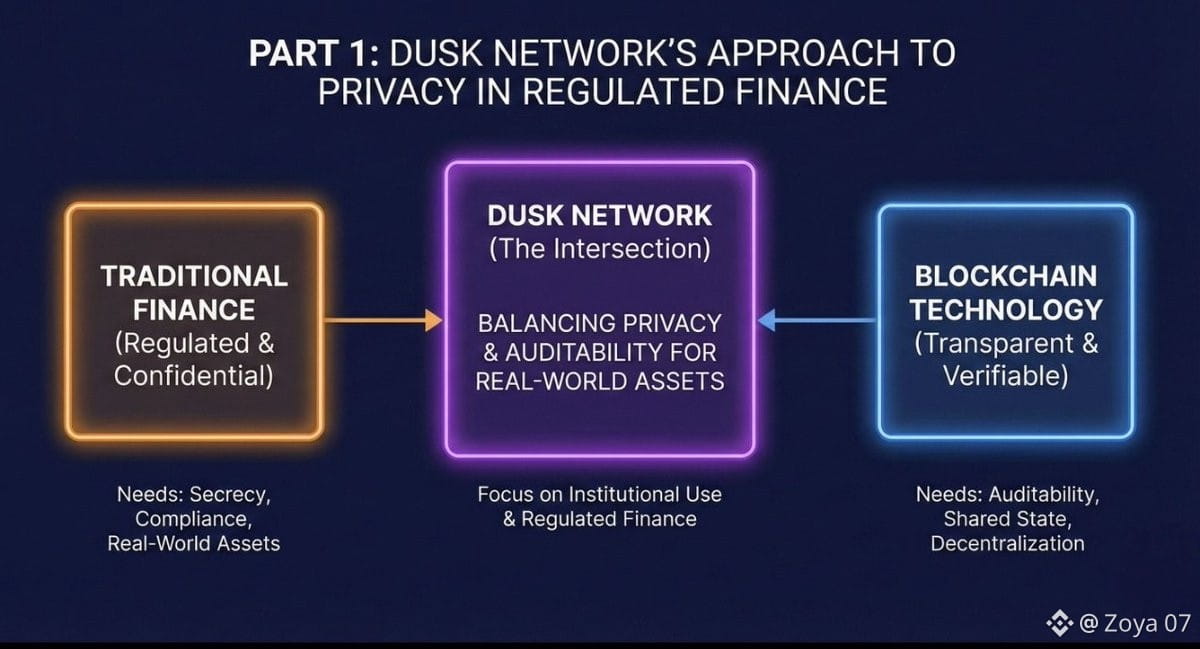
At its foundation, Dusk is a privacy-first blockchain built specifically for financial use cases such as compliant DeFi, tokenized real-world assets, and institutional-grade applications. Instead of exposing every transaction and balance to the public, the network uses advanced cryptography, including zero-knowledge proofs, to ensure that sensitive data remains confidential while transactions remain verifiably correct. This approach allows participants to prove that transfers, settlements, or contract executions follow all required rules without revealing underlying financial details. Privacy on Dusk is not an optional add-on but a core design principle, carefully balanced with transparency where it is legally required.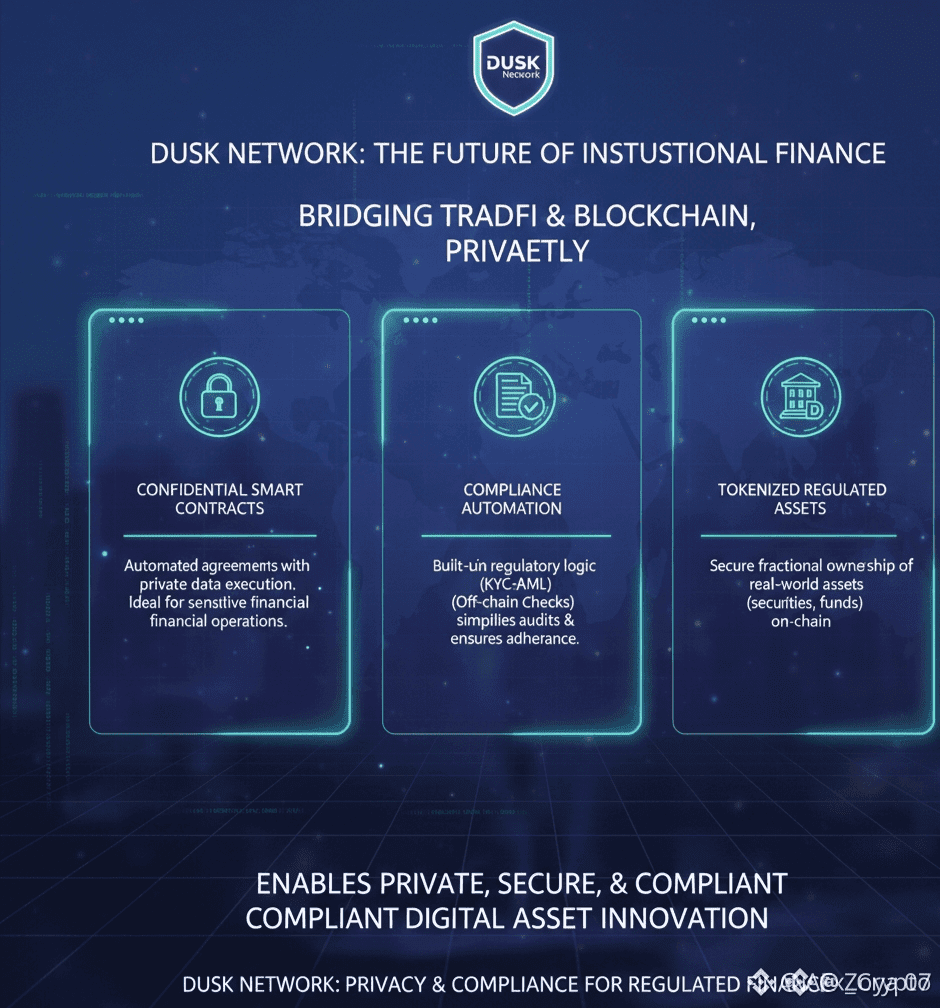
The architecture of the network reflects this philosophy. Dusk is modular by design, separating core settlement and consensus from execution environments. Its base layer provides secure data availability and deterministic finality through a proof-of-stake consensus mechanism, ensuring that once transactions are confirmed, they cannot be reversed. This level of finality is critical for financial instruments that carry legal weight. On top of this settlement layer, Dusk supports execution environments that are compatible with Ethereum tooling, enabling developers to build smart contracts using familiar languages while benefiting from Dusk’s privacy and compliance features. This modular structure makes the network flexible, future-proof, and capable of supporting a wide range of financial applications.
A defining feature of Dusk is its focus on compliance by design. Rather than treating regulation as an external constraint handled off-chain, Dusk embeds compliance logic directly into the protocol. This includes mechanisms for identity, permissioning, and selective disclosure, allowing applications to enforce rules such as KYC, AML, jurisdictional restrictions, and investor eligibility without exposing personal data publicly. Through privacy-preserving identity solutions, users can prove specific attributes about themselves without revealing who they are, giving institutions confidence that regulatory requirements are met while users retain control over their information.
This balance between privacy and auditability is what makes Dusk especially relevant for tokenized securities and other real-world assets. Traditional financial markets rely on multiple intermediaries for issuance, trading, clearing, and settlement, processes that are often slow, expensive, and opaque. On Dusk, these functions can be automated through smart contracts while maintaining confidentiality and regulatory oversight. Assets such as equities, bonds, or funds can be issued on-chain with embedded rules that govern how and by whom they can be transferred, how dividends or interest are distributed, and how reporting is handled. Settlement that once took days can occur in minutes or seconds, with cryptographic proof replacing manual reconciliation.
Over the years, Dusk has steadily evolved from concept to a mature financial blockchain platform. The team has refined its cryptographic foundations, expanded its modular architecture, and aligned its development roadmap with emerging regulatory frameworks, particularly in Europe. As global regulators increasingly define rules for digital assets, Dusk’s early focus on compliance positions it as infrastructure that institutions can adopt without uncertainty. Its ongoing development, including the rollout of EVM compatibility and ecosystem tools, aims to attract developers, financial service providers, and enterprises looking to build regulated applications on-chain.
In a broader sense, Dusk represents a shift in how blockchain technology can be applied to finance. Rather than framing decentralization as an alternative to regulation, it treats regulation as a design requirement and privacy as a fundamental right. By doing so, Dusk creates a bridge between traditional financial systems and decentralized technology, enabling real-world assets and compliant financial products to exist natively on a blockchain. The result is a network designed not for speculation alone, but for the long-term modernization of financial markets, where efficiency, trust, privacy, and legal certainty coexist on a single decentralized infrastructure.