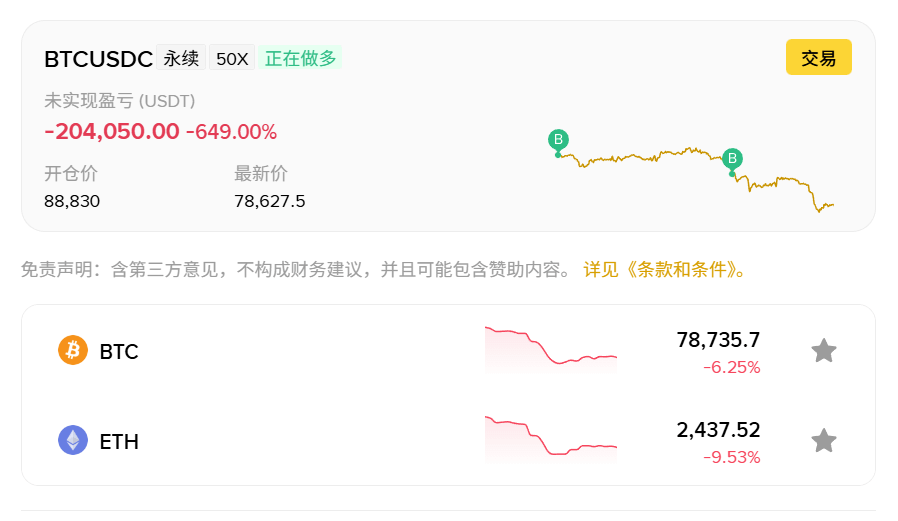
The CEO of Origin made a long position with 88.88W big pancakes, today suffering a blood loss of 649%
This big pancake is really enough, with a continuous decline, a single-day drop of nearly 10%, and ETH has even dropped by several points~ Altcoins are hard to look at, generally dropping by more than a dozen or twenty points~~ It's already at the diamond bottom, and I didn't expect to dig a deep well on this bottom.
However, despite the short-term performance of the market being less than optimistic, I still believe in the future of stablecoins in the long run, especially in the payment field. Returning to the positioning of Plasma—if we see it as infrastructure prioritizing 'stablecoin payments', the applications most likely to emerge in the early ecosystem should not be those complex financial derivatives, but tools that directly reduce payment friction and enhance transaction success rates.
In my opinion, there are six main types of applications that are most suitable for the Plasma ecosystem:
Wallet and account experience: Enhance the wallet usage experience so that newcomers can more easily choose networks, pay transaction fees, and check transaction statuses. This 'fool-proof' design can significantly increase the success rate of newcomers and enhance user stickiness.
Payment SDK and collection components: Develop a simple and easy-to-use payment SDK that allows developers to integrate stablecoin collection, callback notifications, order status management, and other functions with just a few lines of code. Standardized and modular tools will greatly promote the development and popularization of the ecosystem.
Merchant reconciliation and settlement tools: Provide merchants with a complete set of reconciliation and settlement tools, including invoice generation, report export, API interfaces, and batch reconciliation functions. These are the core applications that merchants are willing to connect to and use in the long term.
Subscription payment and revenue sharing functions: Stablecoins are naturally compatible with high-frequency scenarios such as content payment, SaaS, and membership subscriptions. The key lies in how to achieve a good experience for automatic deductions and retrying on failures.
Batch payment/salary tools: In scenarios such as project incentives, team salaries, and supplier settlements, stablecoins can provide traceable, exportable, and auditable fund management tools, ensuring the transparency and security of fund flow.
Lightweight DeFi tools: Low-risk, low-threshold fund management tools that allow funds to enter the stablecoin ecosystem while maintaining liquidity. These tools will provide users with better returns and fund turnover experiences.
The common characteristic of these six types of applications is that they are closer to 'real payments' and can truly keep users' daily payment behaviors on the chain. For developers, whoever can first make these tools stable and easy to use is more likely to become one of the earliest builders to benefit from the Plasma ecosystem.
Although the current market is changing rapidly, if we can improve the tools for stablecoin payments based on user needs and practical applications, the future ecosystem will welcome more stable growth.