For developers building on blockchain, scalability has long been the primary bottleneck. When networks experience high usage, transaction fees rise sharply, confirmations slow down, and user experience deteriorates. These conditions are not edge cases—they occur precisely when applications begin to succeed. Most existing solutions force an uncomfortable compromise: accept congestion and degraded performance, or rely on centralized execution paths that undermine decentralization. Plasma is designed to eliminate this tradeoff.
At its core, Plasma approaches scalability as an architectural problem rather than a surface-level optimization. Instead of pushing every transaction onto the base layer, Plasma separates execution from verification. Transactions can be processed efficiently in scalable execution environments, while final state commitments are verified on-chain. This preserves the security and trust assumptions of decentralized systems without overwhelming the base layer.
The Scalability Bottleneck Developers Face
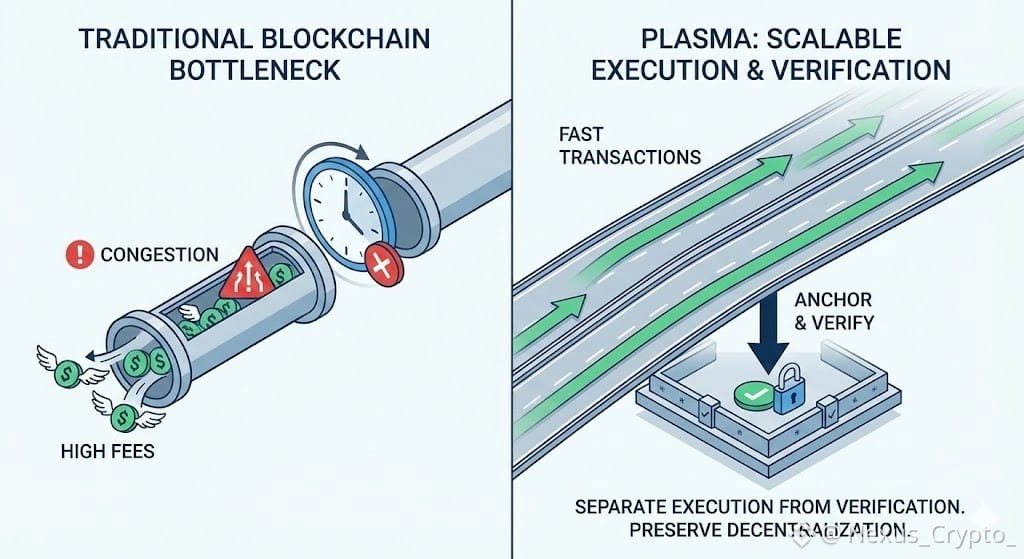
As decentralized applications grow, they encounter predictable limitations. High-frequency interactions become prohibitively expensive. Transactions fail during periods of congestion. Applications that rely on composability suffer when dependent protocols cannot execute atomically. These issues force developers to redesign systems defensively or limit functionality to accommodate network constraints.
Traditional scaling approaches often improve performance by introducing new trust assumptions. Centralized sequencers, opaque execution environments, or off-chain shortcuts may reduce costs temporarily, but they weaken the guarantees that make blockchain valuable in the first place. Plasma is built to avoid these compromises entirely.
Execution Efficiency Without Trust Erosion
Plasma enables efficient execution while maintaining on-chain verification. Every state transition remains accountable, and correctness can be independently verified. Rather than trusting execution blindly, participants rely on cryptographic guarantees enforced by the protocol. This model ensures that scalability does not come at the expense of transparency or security.
By reducing the load placed on the base layer, Plasma minimizes congestion at its source. Applications no longer compete aggressively for limited block space, leading to more predictable fees and consistent performance. This is especially critical during market volatility, when demand spikes expose the weaknesses of inefficient architectures.
A Better Developer Experience

From a developer perspective, Plasma simplifies one of the most painful aspects of blockchain engineering: performance uncertainty. Predictable execution costs and stable throughput allow teams to design applications around user needs rather than network limitations. High-frequency use cases that were previously impractical become viable without architectural contortions.
Plasma integrates cleanly with on-chain verification logic, enabling developers to maintain composability and security while scaling. Complex applications can interact reliably without worrying about execution failures caused by congestion. Entire classes of performance-related vulnerabilities common in monolithic execution environments are removed.
Built for Real-World Demand
Plasma is designed for environments where usage is continuous and demanding. DeFi protocols require frequent state updates. Games depend on responsiveness and low latency. Payment systems need predictable costs and reliable settlement. Plasma assumes these conditions as a baseline rather than an exception.
By separating execution from verification, Plasma allows systems to scale horizontally as demand increases. Performance improves without introducing hidden dependencies or centralized control points. This makes Plasma particularly well-suited for applications aiming for long-term adoption rather than short-term experimentation.
Scalability as Foundational Infrastructure
Crucially, Plasma treats scalability as foundational infrastructure, not a feature layered on after deployment. This ensures that decentralization, security, and performance evolve together instead of competing. Protocols built on Plasma are better positioned to endure growth without fragmentation or trust erosion.
In decentralized systems, architectural decisions compound over time. Infrastructure that works under pressure becomes indispensable as ecosystems mature. Plasma is designed with this long-term reality in mind.
Conclusion
Blockchain adoption will not be driven by theoretical benchmarks or temporary narratives. It will be driven by systems that remain reliable as demand grows. Plasma delivers scalability through architectural clarity—efficient execution, on-chain verification, and preserved decentralization.
For developers serious about building scalable decentralized applications, Plasma is not a shortcut or an optimization.
It is the infrastructure that makes sustainable growth possible.