When people talk about cryptography in blockchain systems, the conversation usually stays at a comfortable distance. It focuses on concepts like privacy, zero-knowledge proofs, or performance benchmarks. At that level, cryptography is treated almost like a plug in. Choose a scheme, integrate a library, and move on. From the outside, it can look as though the hard work is finished once the math checks out.
From an engineering perspective, that framing misses where most of the difficulty actually lies. Cryptography does not live in isolation. It lives inside long-running systems that must operate continuously, adapt to changing requirements, and survive years of maintenance, upgrades, and unexpected stress. The real challenge is not proving that a cryptographic primitive works in theory, but ensuring it behaves predictably and efficiently once it becomes part of a production environment.
This is where discussions around efficiency often become misleading. Efficiency is commonly reduced to raw performance. How fast can proofs be generated. How many transactions fit into a block. How low can fees go under ideal conditions. In real operating environments, efficiency looks different. It is about resource predictability, failure containment, upgrade paths, and the ability to reason about system behavior under load. These qualities tend to matter far more over time than peak throughput in a controlled setting.
In long lived software systems, early architectural assumptions have a habit of compounding. Choices made at the beginning shape what is easy and what is painful years later. I have seen systems where a convenient abstraction turned into a permanent constraint, and others where a small performance shortcut quietly became a stability risk that no one dared to remove. Cryptography is particularly unforgiving in this respect. Once it is deeply embedded, changing it becomes expensive, risky, and often politically difficult within an ecosystem.
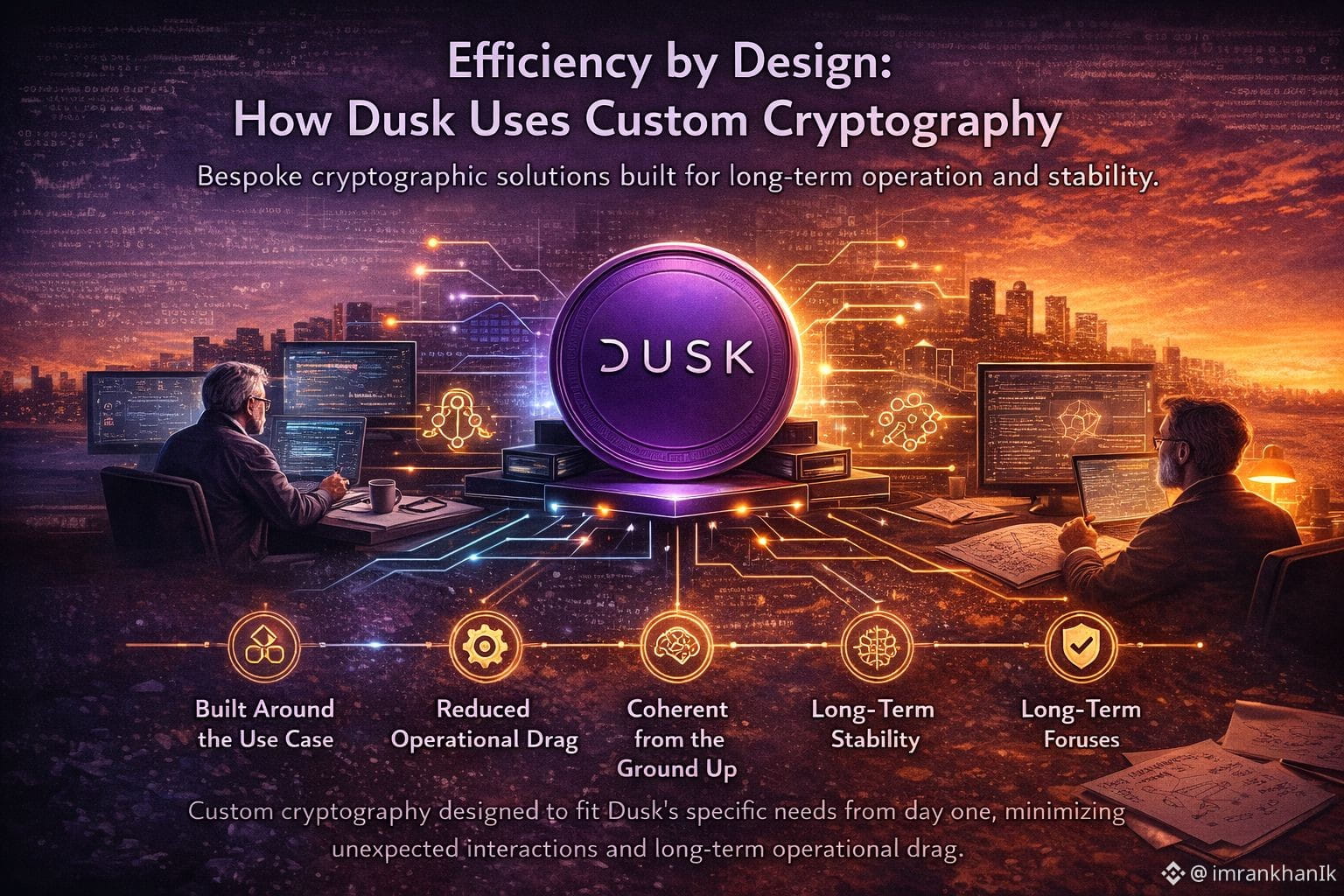
This is why custom cryptography, such as the approach taken by Dusk, is best understood as an architectural decision rather than a feature. Instead of adapting general-purpose cryptographic tools after the fact, Dusk designs cryptographic mechanisms around its specific operating assumptions. Those assumptions include selective disclosure, predictable settlement, and compatibility with regulated financial activity. The goal is not to be clever, but to reduce long-term friction between privacy guarantees and system behavior.
Systems that adopt cryptography retroactively often do so because their original architecture did not anticipate privacy or compliance requirements. That is not a flaw in itself. Many systems evolve this way. The tradeoff is that retrofitting introduces layers. Each layer adds complexity, increases maintenance burden, and creates new failure modes. Over time, engineers end up managing interactions between components that were never designed to work together. Performance issues become harder to diagnose, and upgrades become more fragile.
By contrast, designing cryptography alongside execution and consensus shifts those tradeoffs. The cost is upfront complexity. Custom schemes are harder to build, harder to audit, and slower to iterate on. Tooling matures more gradually. Developer onboarding takes more effort. These are real constraints, not abstract ones. But the benefit is coherence. Privacy, verification, and execution share the same mental model, which makes system behavior easier to reason about as it grows.
From a systems engineering standpoint, this coherence shows up most clearly in maintenance. When cryptographic assumptions align with execution logic, changes can be scoped more narrowly. When they do not, a small update can ripple across the stack. Over years of operation, those ripples accumulate into operational risk. Stability is not the absence of change. It is the ability to change without breaking core guarantees.
Markets and narratives tend to lag behind these realities. It is easier to measure transactions per second than upgrade risk. It is easier to market flexibility than to explain why constraints can be valuable. As a result, systems designed for durability are often underestimated early on, while systems optimized for rapid experimentation receive disproportionate attention. That imbalance usually corrects itself, but only after real-world use exposes the cost of early shortcuts.
Dusk's use of custom cryptography fits into this broader pattern. It reflects an assumption that financial infrastructure should behave more like long lived systems than like short-lived products. Efficiency, in this context, is not about squeezing out the last bit of performance. It is about reducing long-term operational drag, minimizing unexpected interactions, and keeping the system understandable to those who must run and govern it.
There are limits to this approach. Custom cryptography narrows design space. It increases reliance on specialized expertise. It can slow adoption in environments that prefer familiar tools. These are not trivial downsides. They represent conscious tradeoffs made in favor of stability and alignment over flexibility and speed.
In the end, the question that matters most is not whether a system can demonstrate efficiency today, but whether it can sustain that efficiency over years of real use. When cryptography is treated as a foundational design element rather than an add on, that question becomes easier to answer. And in systems meant to support real economic activity, that answer often determines whether the system remains viable long after the narratives have moved on.