

Modern blockchains were built on a simple but fragile assumption: transparency equals trust. By exposing every balance, transaction, and interaction, early crypto systems believed that public verifiability alone could prevent abuse. That assumption held during the experimental phase of crypto, when activity was limited and stakes were relatively low. It begins to fail, however, once real financial behavior enters the system. Markets do not collapse because information is hidden; they break when information is exposed without restraint. Dusk begins from this uncomfortable reality and designs its architecture around a different idea: financial visibility must be controlled, not maximized.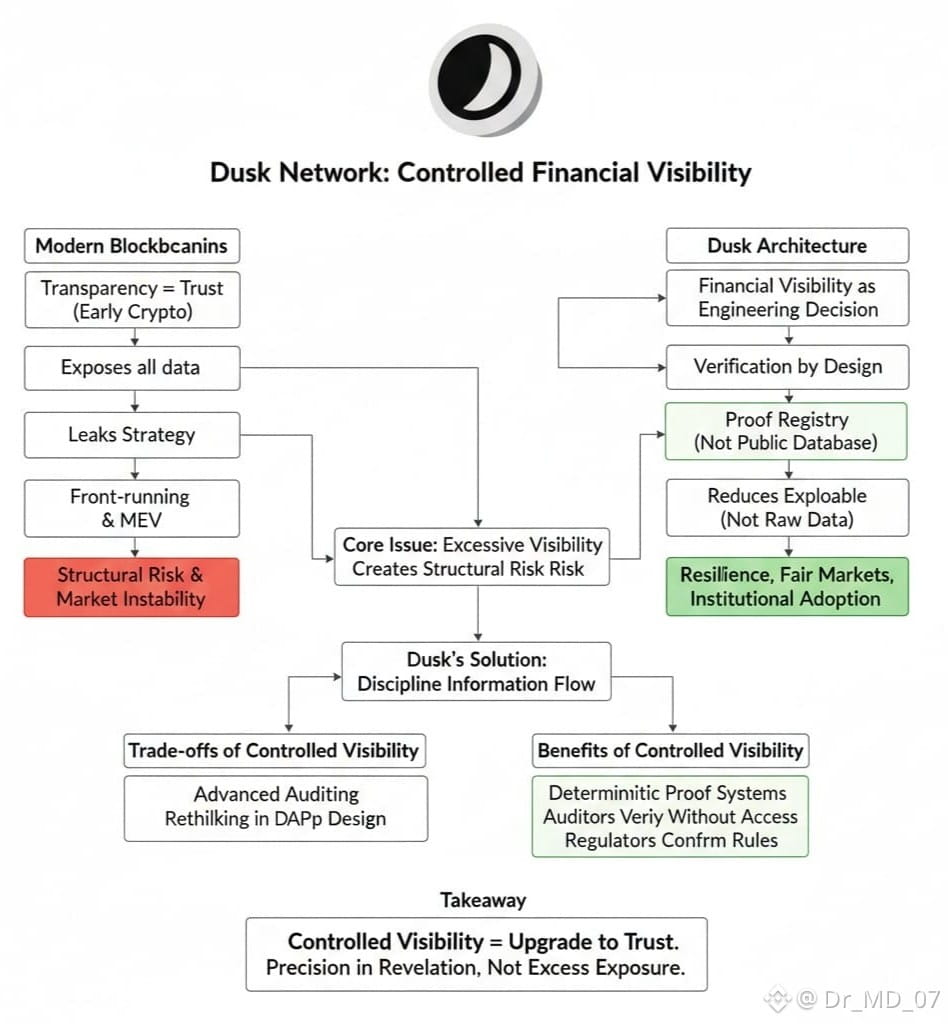
The core issue Dusk addresses is often misunderstood as a debate about privacy. In reality, the problem is structural risk created by excessive visibility. Open ledgers leak strategy through transaction graphs. Wallet histories expose positioning. Counterparties can infer intent before settlement finalizes. Over time, this creates an uneven playing field where participants with advanced analytics gain disproportionate advantage—not by producing value, but by extracting insight from leaked data. In traditional finance, this would be considered a market integrity failure. In crypto, it is often treated as a feature.
Dusk reframes visibility as an engineering decision rather than a philosophical stance. Instead of broadcasting full financial state, the system enforces a separation between what must be verified and what must remain private. Ownership, balance constraints, and compliance rules are validated cryptographically without exposing sensitive underlying data. This is not secrecy for its own sake. It is verification by design, where correctness is provable without disclosure.
Technically, this shifts the role of the ledger itself. Rather than acting as a public database of financial behavior, the ledger becomes a proof registry. Participants submit cryptographic proofs demonstrating that transactions satisfy protocol rules. The network verifies these proofs without observing raw values such as balances, counterparties, or transaction size. By design, this sharply reduces the amount of exploitable information available to adversaries, analysts, or opportunistic actors. Less observable state means fewer attack vectors.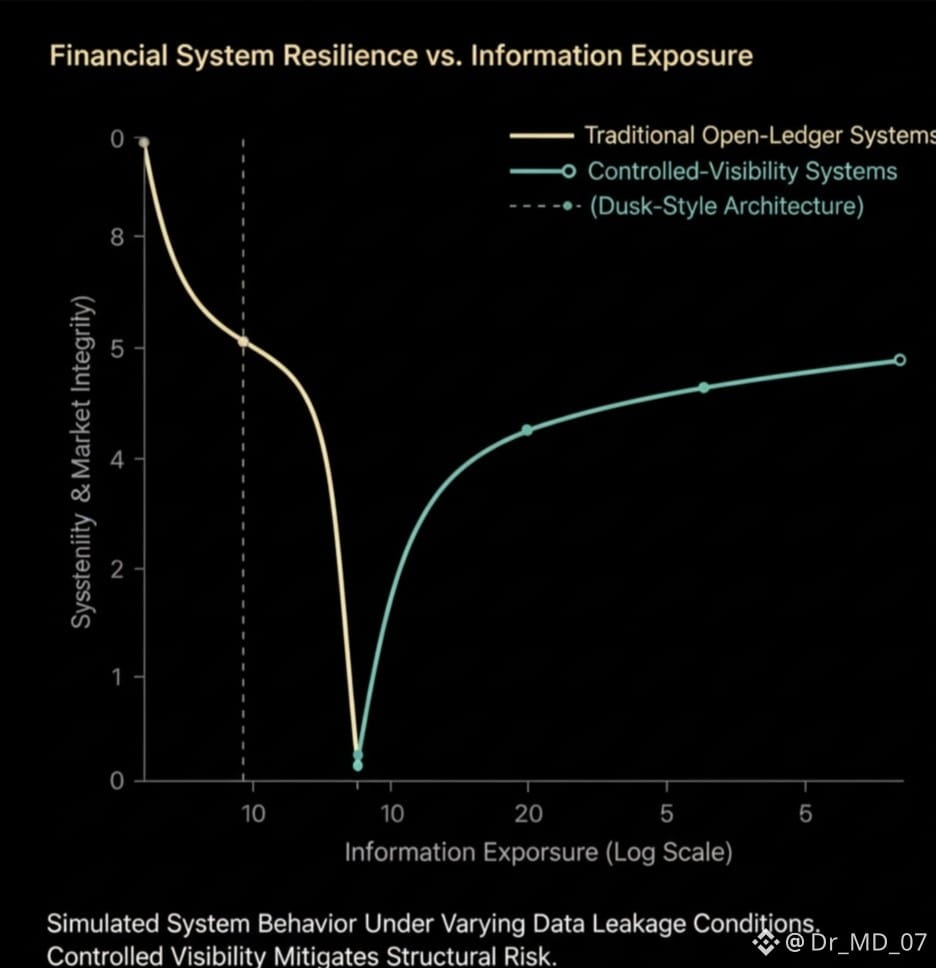
This design choice matters now more than ever. Crypto markets are moving toward institutional participation, structured financial products, and regulated assets. These participants do not fear decentralization; they fear uncontrolled exposure. Institutions cannot deploy meaningful capital if every position becomes a public signal. Traders cannot manage risk if strategy is visible before execution completes. Builders cannot design compliant financial instruments if compliance requires full disclosure of sensitive state. Dusk aligns with current market reality by treating visibility as a configurable parameter rather than a fixed default.
Evidence for this need already exists across crypto markets. MEV extraction thrives on transparent transaction ordering. Front-running is a direct outcome of excessive visibility. On-chain analytics firms profit by monetizing behavioral leakage, often at the expense of participants themselves. These are not accidental side effects; they are structural consequences of overexposed systems. Dusk’s architecture reduces these risks by minimizing what can be observed while preserving full verifiability. Fewer leaked signals lead to fewer exploitable patterns.
Controlled visibility does introduce trade-offs. Reduced transparency complicates passive monitoring and requires more advanced auditing methods. Users must place confidence in cryptographic proofs rather than visually inspecting raw data. Developers accustomed to full disclosure must rethink how they design applications. These are real costs, not theoretical ones, and Dusk does not attempt to deny them.
What offsets these costs is how trust is anchored. Instead of relying on social consensus or reputational assumptions, Dusk grounds trust in deterministic proof systems. Auditors can verify correctness without privileged access. Regulators can confirm rule adherence without mass data exposure. This mirrors how mature financial systems actually operate, where oversight exists without universal transparency.
My personal perspective is that Dusk is not attempting to hide finance. It is attempting to discipline information flow. That distinction is critical. Privacy here is not ideological or political; it is functional. By reducing unnecessary exposure, Dusk limits adversarial behavior, aligns participant incentives, and allows financial systems to operate without continuously undermining themselves through data leakage.
My suggestion for builders, investors, and analysts is to stop equating transparency with safety. The next generation of crypto infrastructure will be evaluated not by how much information it reveals, but by how well it controls what is revealed. Systems that leak less data create stronger markets, fairer execution, and more sustainable participation. Dusk is positioned on the right side of that transition.
Takeaway:
Controlled financial visibility is not a retreat from trust it is an upgrade. In modern digital finance, resilience comes from precision in what is revealed, not excess in what is exposed.
