
Attention is a tradable scarcity. On modern publishing platforms the most reliable truth is as simple as it is unforgiving: distribution is algorithmic, fleeting, and heavily path-dependent. A well-timed opening line on the wrong day can vanish under a shifting feed the same way a well-structured storage contract can be undermined by inconsistent availability. For builders and analysts focused on infrastructure, that parallel matters. The same constraints that force protocol designers to trade off durability, cost, and access also shape how ideas travel, persist, and accrue authority in public forums. Recognizing that symmetry changes how one writes, how one evaluates narrative returns, and how one thinks about the long game.
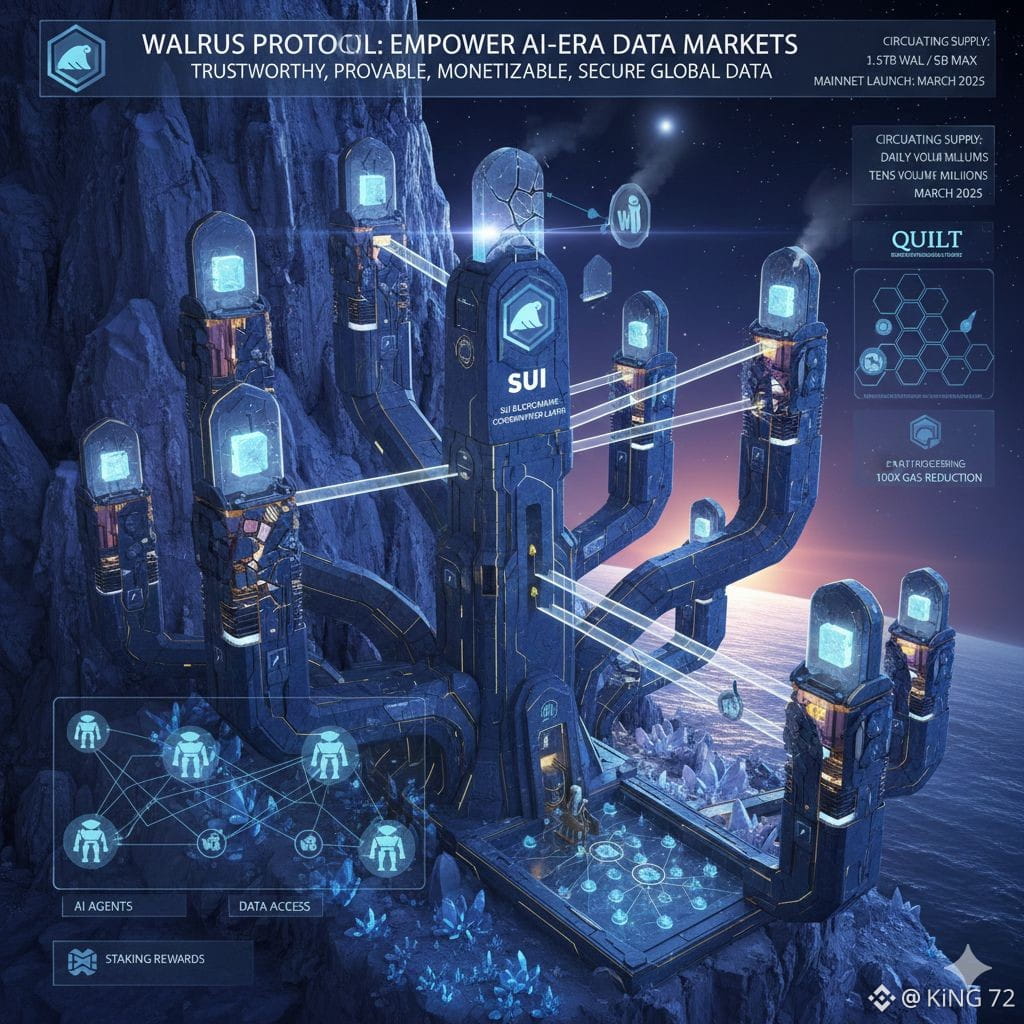
The reality of platform distribution is not an editorial mystery; it is market microstructure. Every read, share, and comment is a unit of liquidity that algorithms price and route. Opening lines act as order flow: they trigger immediate attention the way low-latency proofs trigger on-chain validation. Early interaction signals — measured in seconds and minutes — determine which items receive the further scrutiny necessary to reach durable placement. That immediacy favors clarity and a strategic rhythm in tone and information density. It does not reward noise. It rewards the quiet authority that can be conveyed in the first sentence and sustained through the intellectual arc that follows.
This dynamic explains why a protocol description that feels like a single chain of reasoning often outperforms a collection of disconnected talking points. Traders and institutional readers operate by an internal narrative economy: they prefer to follow one coherent line of logic from premise to implication. When a piece opens with a clear market reality, then proceeds through technical consequence, ends with measured implications, and embeds empirical signals along the way, it behaves like a disciplined trade idea — not a marketing brochure. That continuity makes it easier for busy professionals to complete the article, and completion is the metric that matters. Platforms favor content readers finish, and finished reads compound the same way repeated on-chain proofs compound trust.
Length and structure matter in parallel ways. Shortness can capture attention; excess length can cause drop-off. But length should be chosen to support a single reasoning trajectory, not to satisfy arbitrary word counts. When the narrative requires nuance — for example to explain an erasure-coding architecture, token economics, and verifiability incentives — length becomes an asset rather than a liability. The key is architecture: paragraphs that are compact and purposeful, transitions that connect one idea to the next without rhetorical detours, and a cadence that mirrors a trader's internal deliberations. In practice, that means a format that balances immediate, signal-rich opening lines with a progressive deepening of detail. The opening acts as the order ticket; the middle is the execution rationale; the close is the position sizing and risk framing.
Contrarian, assumption-challenging headlines play a distinct role within this ecosystem. The headline functions as a market bid: it stakes a position in the reader’s attention with an implied payoff curve. When a headline challenges a prevailing assumption — when it posits that durability should take precedence over instant throughput, or that sparse fragmentation can outperform naive replication at scale — it invites cognitive curiosity. That curiosity is not about shock value; it is about changing the expectation set before the first paragraph is read. Contrarian framing works best when the body of the piece sustains the contrarian premise with evidence and a disciplined chain of logic. In that sense, contrarian headlines are most effective for infrastructure topics precisely because they orient the experienced reader to look for systemic trade-offs rather than product features.
There is an analog here to token design. A token that claims to be the future of payments without explaining why it solves a unique economic coordination problem will attract short-lived attention. Similarly, an article that baits with contrarianism but offers weak reasoning will generate comments but few durable reads. The market rewards consistency of substance more than the occasional spike in volume. Real authority grows when contrarian claims are repeatedly substantiated across multiple, well-argued pieces. Over time, that creates a recognizable analytical voice — a brand in the best sense — that signals to professional readers: this author thinks in probabilities, traces incentives, and values robustness over rhetorical flourish.
Engagement is the practical currency of visibility, but the relationship is directional, not prescriptive. Early comments and interaction extend an article’s life because they feed the algorithmic imperative for "freshness" and "relevance." When professional readers engage — by annotating, questioning, or expanding the argument — they supply the social proof that pushes the piece into broader distribution windows. That does not require explicit calls to action. Instead, a well-placed observation that invites correction or an open-ended analytic point implicitly encourages the type of engagement that most platforms reward. The result is an extended tail: initial distribution creates the conditions for later discovery, and later discovery feeds back into distribution in a virtuous cycle, provided the piece sustains intellectual value.
This is why consistency outperforms one-time virality. A single viral article is analogous to a flash of trading volume: it moves the needle temporarily but rarely changes long-run market structure. Consistency builds reputation capital. Reputation capital changes how algorithms and audiences treat subsequent content: editors and curators are more likely to amplify pieces from known contributors who produce reliably useful analysis, and readers are more likely to allocate attention to a familiar voice. For infrastructure narratives, where adoption creeps forward, the slow accrual of authority in a niche can have outsized effects. A developer or institutional reader who repeatedly encounters clear, empirically grounded thinking about system design is far more likely to consider integration or collaboration than a reader exposed once to a flashy announcement.
Writing as a single reasoning path also contributes to a recognizable voice. Traders do not list scenarios; they narrate a trade from idea to execution. They explain why they believe a market is mispriced and then estimate the likelihood of various outcomes. When a technical or economic argument is written in that mode, it becomes easier for informed readers to follow, evaluate, and internalize. The piece behaves less like an advertisement and more like a position paper: it offers a worldview that can be tested against data and time. That testability is what makes an analytical voice trustworthy. Readers learn the author’s priors and decision framework and can then update on future information relative to those priors.
There is also an important interplay between form and audience. Mobile-first paragraphs, clear lead sentences, and a rhythm that alternates between high-level insight and specific signals respect the way institutional readers consume content in the field. Many readers will scan the opening lines on a phone during a break and decide within seconds whether to continue. Those seconds behave like micro-order books: they accept or reject the piece into the reading queue. The best pieces are structured so that the initial scan rewards the reader with a coherent thumbnail of the argument, and the subsequent paragraphs repay the attention with precise evidence and disciplined inference. Completion follows from that exchange, and completion is the metric that ensures the piece is treated as durable by distribution systems.
Technical credibility amplifies reach in ways that are mechanistic rather than mystical. When a protocol publishes verifiable metrics, or when an analyst links to reproducible data, readers can perform their own micro-verifications. Those micro-verifications are the analytic equivalent of cryptographic proofs: they reduce uncertainty about the claims and increase the probability of subsequent citations, integrations, and references. The institutional reader values that immediacy of verification. They value parsimonious claims supported by concrete metrics over rhetorical exuberance. That preference shapes how narratives propagate across professional networks.
The economics of tokens and staking also offer a metaphor for content dynamics. Inflationary rewards can temporarily boost participation, but long-term sustainability depends on structural alignment between incentives and utility. Content that attempts to monetize attention without delivering utility will see engagement evaporate when incentives change. Conversely, narratives that help audiences navigate structural questions — tradeoffs between throughput and durability, the economics of delegation, or the consequences of cross-chain coupling — produce utility that endures even when platform incentives shift. The consequence is that visible authority is less about chasing spikes and more about consistently solving the same class of problems for a defined audience.
It is worth noticing how comments function in this environment. They are not merely social features; they are feedback loops. Thoughtful critique, pointed questions, and supplementary data points convert a static article into an evolving conversation. That conversation provides fresh signals to distribution systems, and it allows the author to refine positions publicly. Over time, the comment threads become an organic record of how claims hold up under scrutiny. For infrastructure builders who care about adoption, those threads are market research. They reveal early adopter concerns, operational pain points, and integration pathways. Engaged commentary therefore extends the life of content by converting one-off readership into a living forum for ongoing analysis.
This does not require performative engagement. What matters is a focus on material that invites authentic professional reaction. A well-placed technical caveat, an unresolved empirical question, or a provocative framing of a known trade-off will attract the kind of expert responses that themselves become distribution fuel. In practice, that means privileging substance over spectacle. The institutional audience rewards the exactness of the puzzle more than the drama of the claim.
Finally, there is an art to developing a recognizable analytical voice that maps onto institutional expectations. That voice is not a marketing persona; it is a consistent set of priors, a preference for evidence, a moderate understanding of risk, and a willingness to admit uncertainty. When an author reliably demonstrates those qualities, their work becomes a heuristic for busy professionals. The heuristic reduces transaction costs: editors, CTOs, and portfolio managers can scan less and learn more, because they know what to expect. That is a durable advantage. It is the same kind of advantage that a robust protocol design seeks through verifiable incentives and predictable performance.
The practical implication for those writing about protocols and markets is subtle but profound: think in terms of compound returns. A single article can produce a transient spike; a sequence of thoughtful, linked, and analytically rigorous pieces produces persistent capital in the form of trust, repeat readership, and strategic partnerships. Build narratives that respect the platform’s mechanics but do not bend to them; use opening lines to stake a clear premise, structure the body as a single line of evidence-driven reasoning, and allow early commentary to refine rather than distract. Over months, not days, those choices determine whether a narrative becomes infrastructure or remains a headline.
The final observation is simple. Durable attention and durable infrastructure share a common currency: predictability. Readers and integrators value predictable reasoning and predictable performance. A storage network that trades off cost for verified persistence is judged by its track record. A writer who prefers a steady sequence of rigorous analysis over viral theatrics will be judged by the same metric. In both cases the payoff is not immediate applause but the quiet confidence of being relied upon. That is the point at which platforms stop being noisy marketplaces and start functioning like foundations.