Why Walrus Finally Extends Ownership Beyond Money to Data Itself 🏗️🧠
We’re living through a quiet contradiction at the heart of Web3.
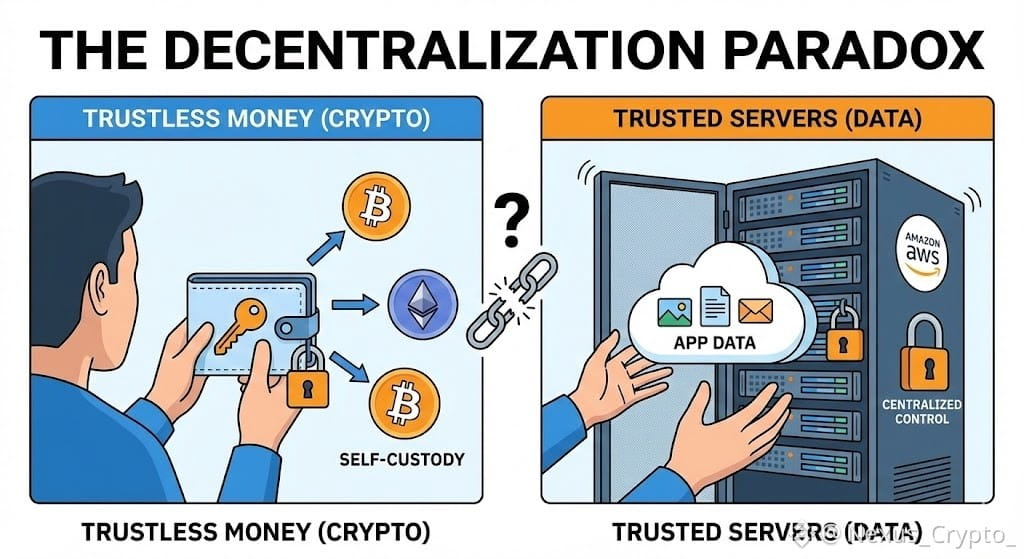
You self-custody your crypto.
You control your private keys.
You manage DeFi positions without banks.
Yet the data powering your “decentralized” applications still lives on Amazon servers.
This paradox undermines the entire promise of decentralization — and most people don’t even notice it.
That’s why @walrusprotocol on Sui matters. And why $WAL represents more than just another infrastructure token. 💎 #Walrus
Trustless Money, Trusted Servers? 📉
Web3 solved one half of the problem.
We built:
Trustless money
Trustless settlement
Trustless finance
But we quietly accepted a fatal compromise:
Centralized storage
Permissioned access
Reversible data
If your app’s backend lives on AWS, your decentralization is conditional. It exists only as long as a cloud provider, platform, or regulator allows it.
That’s not sovereignty.
That’s delegated permission.
Why Data Ownership Is the Missing Layer 🧠
Money is only one form of power.
Information is the other.
Consider the practical reality:
Social posts deleted by moderators
Business files frozen during payment disputes
Creative work lost when startups shut down
Archives erased under political pressure
None of this requires hacking.
It only requires control over storage.
Until users truly own their data, decentralization remains incomplete.
Walrus treats this as a core design problem — not a philosophical footnote.
Shattering the Paradox with Math 🧠⚡
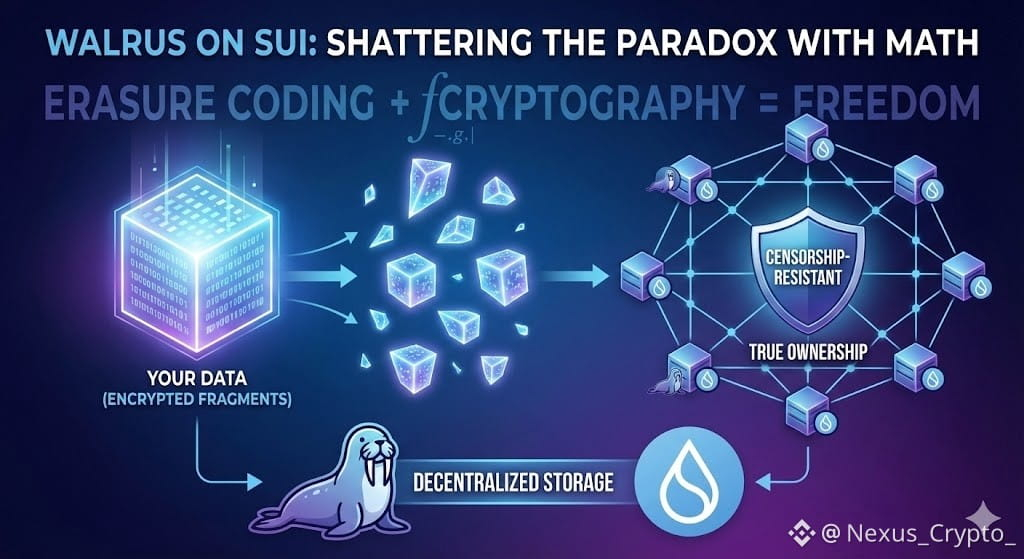
Walrus doesn’t “promise” decentralization.
It enforces it architecturally.
Through erasure coding — the “Red Stuff” — data is:
Encrypted
Split into fragments
Distributed across many independent nodes
No single entity holds the data.
No authority can selectively deny access.
No provider can seize or delete content.
As long as a threshold of fragments is available, the data is recoverable.
This is not policy-based freedom.
It’s mathematical freedom.
What This Means in the Real World 🏗️
This isn’t abstract theory. The implications are immediate:
Your social content can’t be erased by platform policy changes
Your business documents can’t be frozen by intermediaries
Your creative work doesn’t disappear when companies fail
Your data survives jurisdictional and political shifts
Walrus extends self-custody from assets to information.
You don’t just own tokens.
You own your digital existence.
Trustless Storage Completes the Stack ⚡
We now have:
Trustless execution (blockchains)
Trustless finance (DeFi)
Trustless coordination (DAOs)
What was missing was trustless storage.
Without it:
Smart contracts depend on centralized data
dApps rely on gateways and APIs
Censorship resistance is cosmetic
Walrus completes the stack by making data:
Verifiable
Censorship-resistant
Sovereign
Execution without sovereign data is incomplete.
Walrus fixes that.
Why Sui Matters Here 💧
Walrus is coordinated on Sui, enabling:
Fast finality for storage commitments
Verifiable availability guarantees
Scalable coordination without congestion
This allows developers to build fully decentralized apps without architectural compromises.
For the Sui ecosystem, Walrus isn’t an add-on.
It’s foundational infrastructure.
Beyond Crypto: Digital Rights 🧠🌍
The implications go far beyond tokens.
As the world digitizes:
Data becomes identity
Storage becomes power
Access becomes control
Systems that guarantee data ownership reshape:
Free expression
Business autonomy
Information freedom
Walrus isn’t just building for crypto users.
It’s building for a future where digital rights are enforced by code, not institutions.
Why This Is an Infrastructure Supercycle Play ⚡
The market often underestimates storage because it’s invisible — until it fails.
But every serious application:
Generates data
Depends on availability
Requires persistence
Decentralized storage isn’t optional.
It’s inevitable.
The real question isn’t if trustless storage wins —
It’s which protocols define it.
Walrus is positioning itself exactly where long-term value accrues: at the base layer of ownership.
Final Thought
We learned how to own money without banks.
Now we’re learning how to own data without platforms.
That transition will define the next decade of Web3.
Walrus doesn’t just solve a technical problem.
It resolves a philosophical contradiction.
And once you see it, you can’t unsee it.
CTA — real discussion:
Do you think true decentralization is possible if data remains centralized? Where have you personally felt this paradox? Share your experience below 👇
If you believe data ownership is the next frontier, drop a 🏗️🧠 and follow — more deep infrastructure analysis coming.
⚠️ DISCLAIMER: This content is for educational purposes only and does not constitute financial advice. Cryptocurrency investment involves high risk. Always do your own research (DYOR) before investing. The views expressed are my own.