


I’ve seen crypto markets long enough to know one rule never changes: when charts go red, people don’t just look for explanations… they look for someone to blame. And because Binance is the biggest venue in the room, the headline almost always becomes @CZ — even when the move has nothing to do with him. That’s why this latest update matters to me, because it’s not a tweet, not a meme, not a PR spin — it’s the kind of action that speaks in the only language markets respect: reserves.
A real protection fund isn’t a slogan — it’s a balance sheet
The Secure Asset Fund for Users (SAFU) was built for the ugly days — the days when something breaks, the days when users need certainty, and the days when trust gets tested. It’s designed as a user protection fund with publicly viewable addresses, and Binance itself explains that the fund’s assets and composition can be adjusted over time as part of its ongoing management.
That detail matters because people often talk about “safety” in crypto like it’s a vibe. But user protection isn’t a vibe — it’s an operational decision: what assets you hold, how liquid they are, and how quickly they can be mobilized if the market hits a shock.
The move: rotating ~$1B toward $BTC
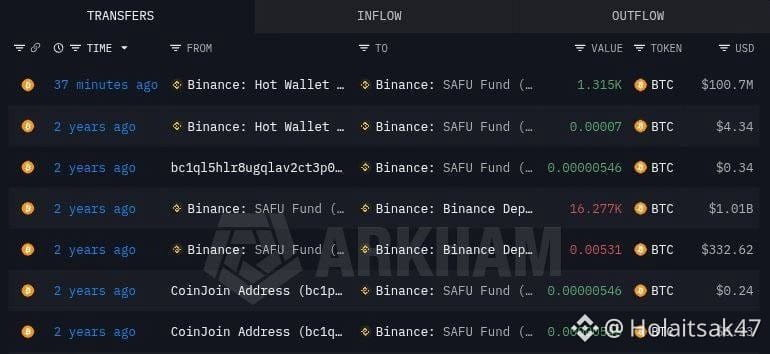
According to multiple reports summarizing Binance’s plan, the SAFU fund’s structure is being adjusted by gradually converting about $1 billion of stablecoin reserves into Bitcoin reserves, targeted to be completed within 30 days.
And there’s an important risk-management line attached to that plan: if market volatility pushes the fund’s value down below a threshold (reported as $800M), the fund can be replenished back toward the $1B level. That’s not hype — that’s literally describing a reserve-maintenance policy.
Why I like this timing (even if the market is moody)
This is happening in a market where sentiment is fragile: people are tired, overleveraged accounts get punished, and every sharp candle becomes a conspiracy story. In that environment, shifting a protection fund toward a more widely recognized reserve asset is a confidence move — not because $BTC can’t dip (it can), but because it signals something deeper:
Long-term alignment: You’re not managing a protection fund like a short-term trader.
Liquidity + credibility: In a crisis, the market understands $BTC instantly.
Skin in the game: It’s easy to tell users “funds are SAFU.” It’s harder (and louder) to show the market you’re actively strengthening reserves.
And this is also why the “they still have $900M left to buy” narrative is catching on: if you think of it as a planned rotation schedule, the first chunk is only the opening step — the rest is the follow-through.
About the “$100M / 1,3xx BTC” headline
A lot of people are circulating the specific figure that the SAFU fund bought roughly ~$100M worth of BTC (often framed as ~1,315 BTC depending on price at the time), with the remainder expected to be rotated in subsequent tranches. That exact number is being tracked and echoed via on-chain monitoring chatter and community reporting around the conversion process.
Even if you ignore the exact BTC count for a second, the core point is simple: this is not a “we might someday” statement. The market is watching a process unfold.
What critics get right — and where the internet goes too far
Let me be fair: exchanges should always be questioned on transparency, listings, system incidents, and how they communicate during volatility. That scrutiny is healthy. Crypto grows up by facing hard topics.
But there’s a difference between valid criticism and turning one person into the universe’s default villain. When someone gets liquidated because they used too much leverage, it’s emotionally easier to say “manipulation” than to say “I had no plan.” When a chart disappoints, it’s easier to accuse the biggest name than to accept the uncomfortable truth: markets don’t care about our feelings.
And that’s why Changpeng Zhao becomes a lightning rod. Not because he controls everything — but because when you build the tallest building in the city, every storm looks like it’s aiming for you.
My takeaway: builders stay, moods rotate
This SAFU rotation is not a magic shield, and it doesn’t erase every complaint people have. But it does show a builder mindset: strengthen the foundation when the crowd is loudest, not when it’s easiest.
In a cycle where everyone is performing outrage for engagement, I respect actions that reduce uncertainty for users. Quiet accumulation inside a user protection fund is one of those actions.
Not financial advice. I’m just sharing how I read the signal: when a protection fund starts rotating into BTC during a stressful market, that’s not panic — that’s preparation.
