
Subtitle: Moving past digital art, Non-Fungible Tokens are poised to solve some of healthcare’s most intractable problems: data silos, counterfeit drugs, and patient sovereignty.
For most of the world, the acronym "NFT" still conjures images of pixelated punks or high-priced digital apes. But as the crypto winter thaws, the conversation is shifting decisively from speculative mania to real-world utility.
Nowhere is this utility more critical, or the stakes higher, than in medical science.
Healthcare is an industry plagued by fragmentation. Data is siloed in incompatible server rooms, verifying credentials takes weeks of bureaucracy, and supply chains are vulnerable to deadly counterfeits. Blockchain technology offers a solution to the trust problem, but NFTs provide the specific mechanism to identify, track, and manage unique assets within that complex ecosystem.
If we strip away the hype, an NFT is simply a unique, immutable digital identifier registered on a ledger. In medicine, that uniqueness isn't a bug feature for collectors; it's a requirement for safety.
Here is how NFTs are transitioning from web3 novelties to essential medical infrastructure.
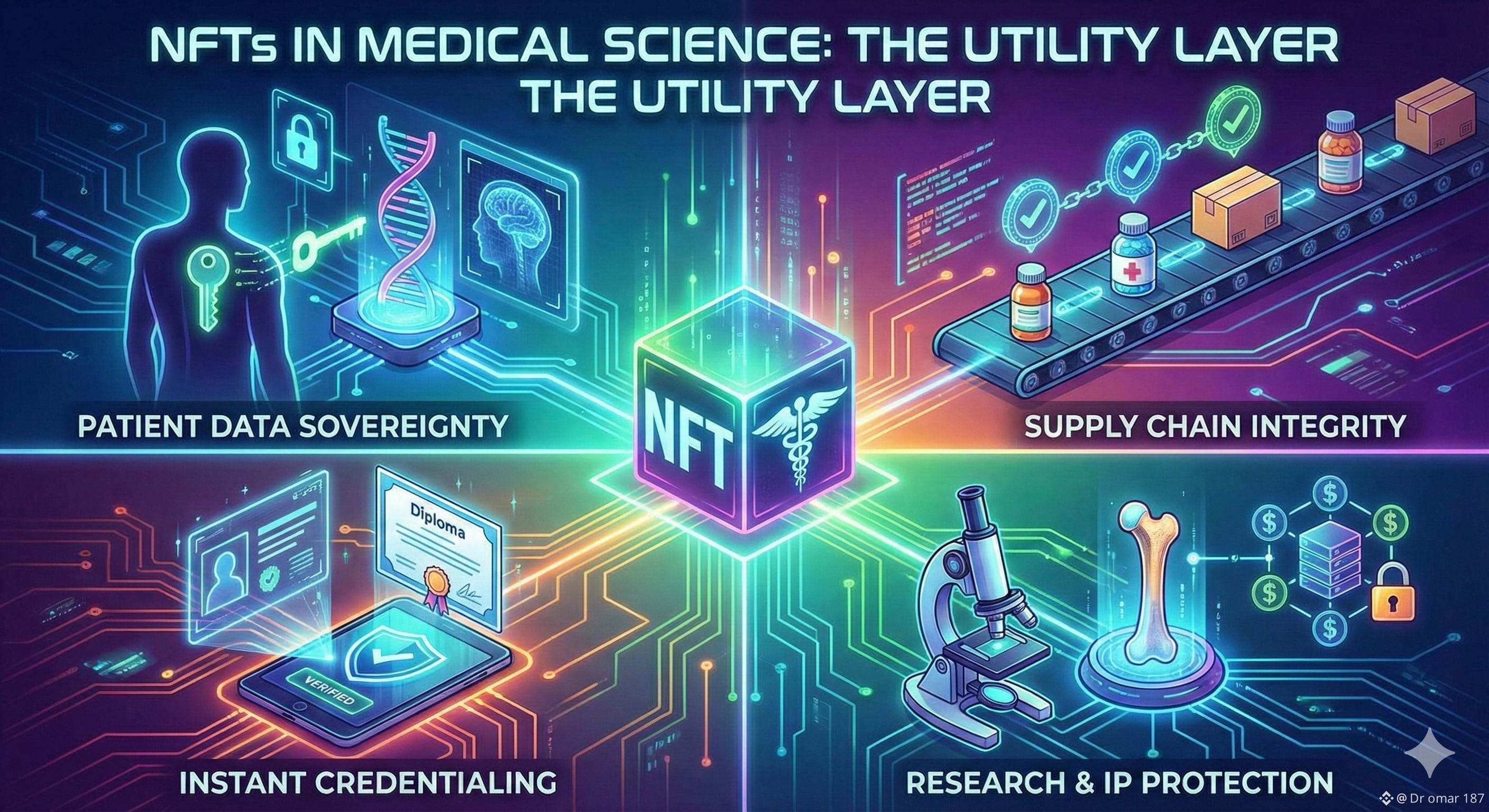
1. The New Paradigm: Patient Data Sovereignty
The current model of electronic health records (EHRs) is institution-centric. Your data lives with the hospital that created it. If you move cities or see an out-of-network specialist, transferring that history is often a chaotic mix of faxes, emails, and fragmented files.
NFTs can flip this model to become patient-centric.
By tokenizing medical records, a patient effectively holds the "private key" to their health history in their own digital wallet. The NFT doesn't necessarily contain the massive raw data files (like an MRI scan); instead, it acts as a secure, programmable access token pointing to encrypted off-chain storage.
When visiting a new doctor, the patient grants temporary access via the NFT. When they leave, they revoke it. This ensures portability and gives individuals true ownership over their most sensitive information.
The "Verify-to-Earn" Genomics Model
Furthermore, NFTs open the door to ethical data monetization. Pharmaceutical companies spend billions acquiring genomic data for research. Currently, patients rarely see a dime of that value.
In the near future, individuals could mint their anonymized genomic sequence as an NFT. They could then license access to research institutions via smart contracts, receiving direct compensation (perhaps in stablecoins or governance tokens) whenever their data contributes to a study.
2. Securing the Supply Chain: The Digital Twin
The World Health Organization estimates that 1 in 10 medical products in low- and middle-income countries is substandard or falsified. This isn't just fraud; it's a life-or-death issue.
NFTs act as "digital twins" for physical medical products.
When a pharmaceutical manufacturer produces a batch of life-saving cancer drugs, they can mint a corresponding batch of NFTs. As the physical pallet moves—from manufacturer to distributor, to wholesaler, and finally to the hospital pharmacy—the NFT is transferred along the blockchain.
At any point, a pharmacist or even a patient could scan a QR code linked to that NFT and see an immutable, unbroken chain of custody back to the original lab. If the digital chain is broken, the physical product is suspect. This is equally vital for tracking the cold chain logistics of vaccines or the provenance of donated blood and organs.
3. Instant Credentialing and IP Protection
How do you know your remote telehealth specialist is actually licensed in your jurisdiction?
Currently, verifying medical credentials is a slow, manual process involving phone calls to universities and medical boards. This bottleneck is disastrous during global health crises when personnel need to be mobilized instantly.
Medical degrees, licenses, and specialized training certificates can be issued as soulbound NFTs (non-transferable tokens). These provide instant, cryptographic proof of a doctor’s qualifications. If a license is revoked for malpractice, the issuer can burn or update the token status immediately on-chain, providing a real-time source of truth.
Furthermore, NFTs are protecting medical intellectual property. As 3D printing becomes standard for custom prosthetics or dental implants, the source files need protection. An NFT can serve as the DRM (digital rights management) for these files, ensuring a hospital pays the designer for each use and, crucially, guaranteeing the file hasn't been tampered with before printing.
The Road Ahead: Obstacles and Adoption
The potential is immense, but the integration of healthcare and web3 is not without challenges.
The primary hurdle is regulatory compliance. Blockchains are inherently public; medical data must remain private. Solutions currently involve Zero-Knowledge Proofs (ZKPs) and decentralized identifiers (DIDs) that allow verification without revealing underlying data, ensuring compliance with stringent laws like HIPAA in the US or GDPR in Europe.
Furthermore, the industry requires massive interoperability standards. Different hospital networks must agree on which chains to use and how their legacy systems interact with them.
Conclusion: The Utility Bull Run
While the crypto market focuses on price charts, the real revolution is happening in the infrastructure layers.
Medical science requires absolute trust, verified uniqueness, and secure transfer of value—the exact properties that NFTs and blockchain technology provide. We are moving away from an era where NFTs represented cartoon flexing, toward an era where a unique digital token might just save your life. For investors and builders in the space, this transition to high-stakes utility is where the long-term value lies.