
Yotta Labs is doing something with AI Workflow Management. They are working with @Walrus 🦭/acc to make sure that machine learning systems can work well.AI models are getting bigger. Workflows are getting more complicated. This means we have to deal with a lot of data and other things that come out of training and using these models. The old way of storing and managing all of this information is not working well. It is slow, expensive. Can fail easily.
Yotta Labs is solving this problem by using Walrus to store things in a way. This makes AI Workflow Management, at Yotta Labs able to handle more and more reliable. Yotta Labs and Walrus are making AI pipelines better. Yotta Labs is using Walrus decentralized storage to help with this.
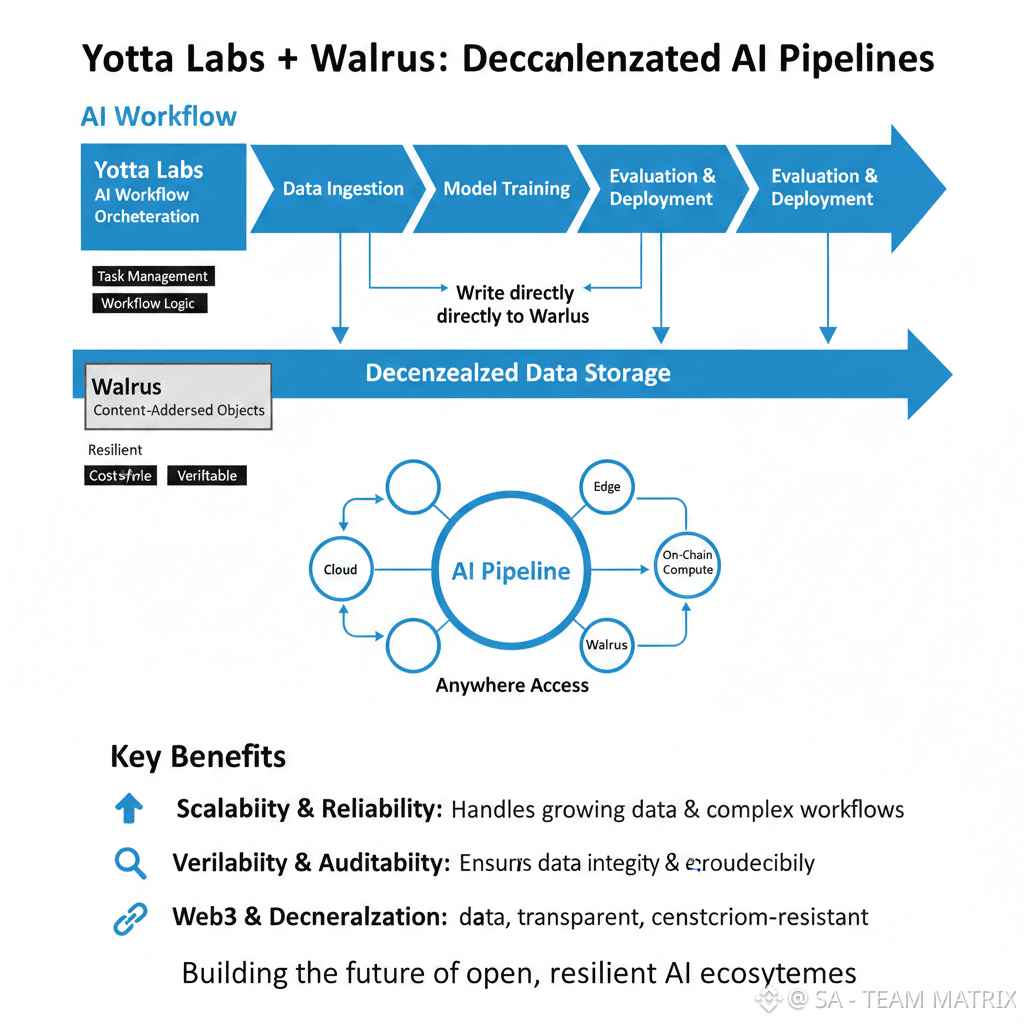
The main idea of this integration is to keep the management of tasks from the storage of data. Yotta Labs takes care of making sure tasks are done in the order and that the workflow makes sense while Walrus is in charge of storing big files in a way that they can be accessed from many places. Things like the data used for training the state of the model at points logs of how the evaluation went and the final results are all written straight to Walrus instead of being sent through a central server. This way no one person is, in control of all the data and the system can handle work without getting slower. Yotta Labs and Walrus work together to make this happen with Yotta Labs managing the tasks and Walrus storing the data.
For Artificial Intelligence teams this architecture is really useful because it allows for a lot of flexibility. The Artificial Intelligence pipelines can work in different places like the cloud, edge and on chain compute without having to move the data into special storage areas that only one company can use. Each part of the workflow uses content addressed objects that are stored on Walrus, which makes sure that everything is correct and can be repeated. The Artificial Intelligence researchers can check that a model was trained on a dataset and that the results are what they should be for a certain process.
This is very important, for teams that work together. For teams that have to follow a lot of rules, where it is necessary to keep track of everything that is done and Artificial Intelligence teams can really benefit from this. Decentralized storage is really good because it is resilient. When you store things in a way you do not have to worry about the system going down like you do with centralized object stores. Even if some of the nodes have problems you can still get to the things you need from other places on the network. This makes it a lot better, for jobs that take a long time to finish and for services that are used by a lot of people.
Decentralized storage also helps with costs because you can predict what you will have to pay. With storage the cost of storing your data is not controlled by one company so you do not have to worry about them changing their prices or limiting how much data you can move. The Yotta Labs and Walrus integration is really good for decentralization. This is because the Yotta Labs and Walrus integration makes sure that the management of intelligence workflows follows the principles of Web3. When we talk about the Yotta Labs and Walrus integration, the people who own the data are the users, the teams or the DAOs, not the platforms.
The Yotta Labs and Walrus integration allows us to manage pipelines in a transparent way. The Yotta Labs and Walrus integration enforces access rules at the protocol level. This is what the Yotta Labs and Walrus integration does over time: it helps to create artificial intelligence networks. In these decentralized intelligence networks the Yotta Labs and Walrus integration makes it possible to share models, datasets and outputs without needing permission and this does not affect performance. The Yotta Labs and Walrus integration is very useful for decentralization and, for the management of intelligence workflows.
As AI continues to demand larger datasets and more complex pipelines centralized infrastructure will struggle to keep up. By combining workflow orchestration with decentralized storage Yotta Labs and Walrus offer a practical path toward scalable verifiable and censorship resistant AI systems. This integration demonstrates how decentralized primitives can solve real operational challenges in modern machine learning while paving the way for open AI ecosystems.

