
Most blockchains are still built for crypto-native behavior: speculation, yield loops, and fast-moving narratives. Vanar takes a noticeably different approach.
Instead of optimizing for short-term attention, it focuses on building @Vanarchain deterministic rails — infrastructure that can quietly support autonomous finance, gaming economies, and consumer-facing applications without exposing users to unnecessary complexity.
What stands out about @Vanarchain is how deliberately it avoids being the “main character.” The chain isn’t shouting about TPS wars or chasing every trend.
Its priorities lean toward reliability, predictable execution, and UX — the things that actually matter when you’re dealing with games, IP, and brands that can’t afford downtime or user confusion.
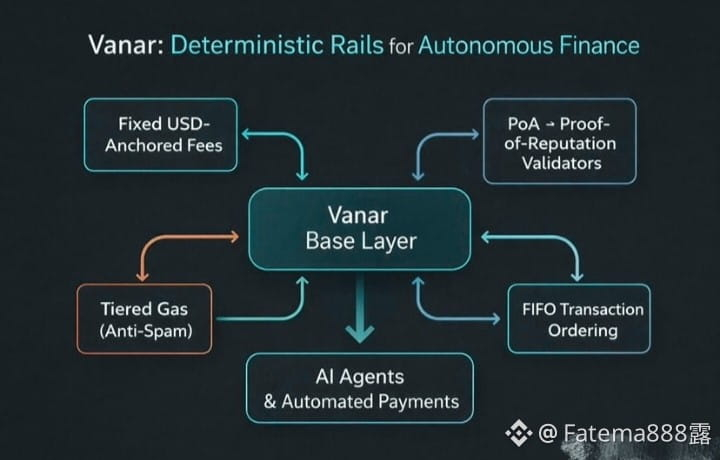
This philosophy shows up across the ecosystem. Projects like Virtua and the VGN network aren’t framed as speculative experiments. They’re designed as platforms where Web3 elements work in the background, letting users engage without needing to understand wallets, gas fees, or on-chain mechanics on day one. That’s what deterministic rails really mean: systems that just work, consistently.
The long-term implication is bigger than it looks. Autonomous finance only scales when infrastructure is stable enough to be invisible.
If users have to “learn crypto” first, adoption stalls. Vanar’s bet is that blockchain succeeds by fading into the backend — powering digital ownership, in-game economies, and brand engagement without friction.
The open question, as always, is execution. Infrastructure alone isn’t enough. Real adoption depends on partners shipping real products.
But if that happens, the role of $VANRY becomes clearer: securing and powering a network designed for predictable, real-world use — not just speculation.
Vanar may not be the loudest chain in the room, but it’s clearly choosing its lane. And if autonomous, consumer-facing finance is the destination, deterministic rails might matter more than hype. #vanar
