
1. Core Project Overview
#UNISWAP is a leading global decentralized exchange (DEX), operating based on the Ethereum automated market maker (AMM) mechanism. Its native token UNI is an ERC-20 type governance token, with a fixed total supply of 1 billion tokens. As of January 2026, the circulating supply of UNI is approximately 750 million tokens (75% of total supply), with a circulating market cap of 4.2 billion to 5.4 billion USD, consistently ranking in the top ten by market cap in the DeFi space.
Uniswap's core positioning is as "Web3 liquidity underlying infrastructure". As of Q1 2025, its total locked value (TVL) reaches 5.12 billion USD, with a trading volume of 84.5 billion USD in the last 30 days, and an annual protocol fee of approximately 26 million USD. It has long maintained over 60% of the global DEX market share, serving as an indispensable trading hub in the Ethereum ecosystem.
2. Token Economic Model
1. Token Distribution Mechanism
The UNI issuance adopted a 'community-oriented' distribution plan without private placement, with specific allocations as follows:
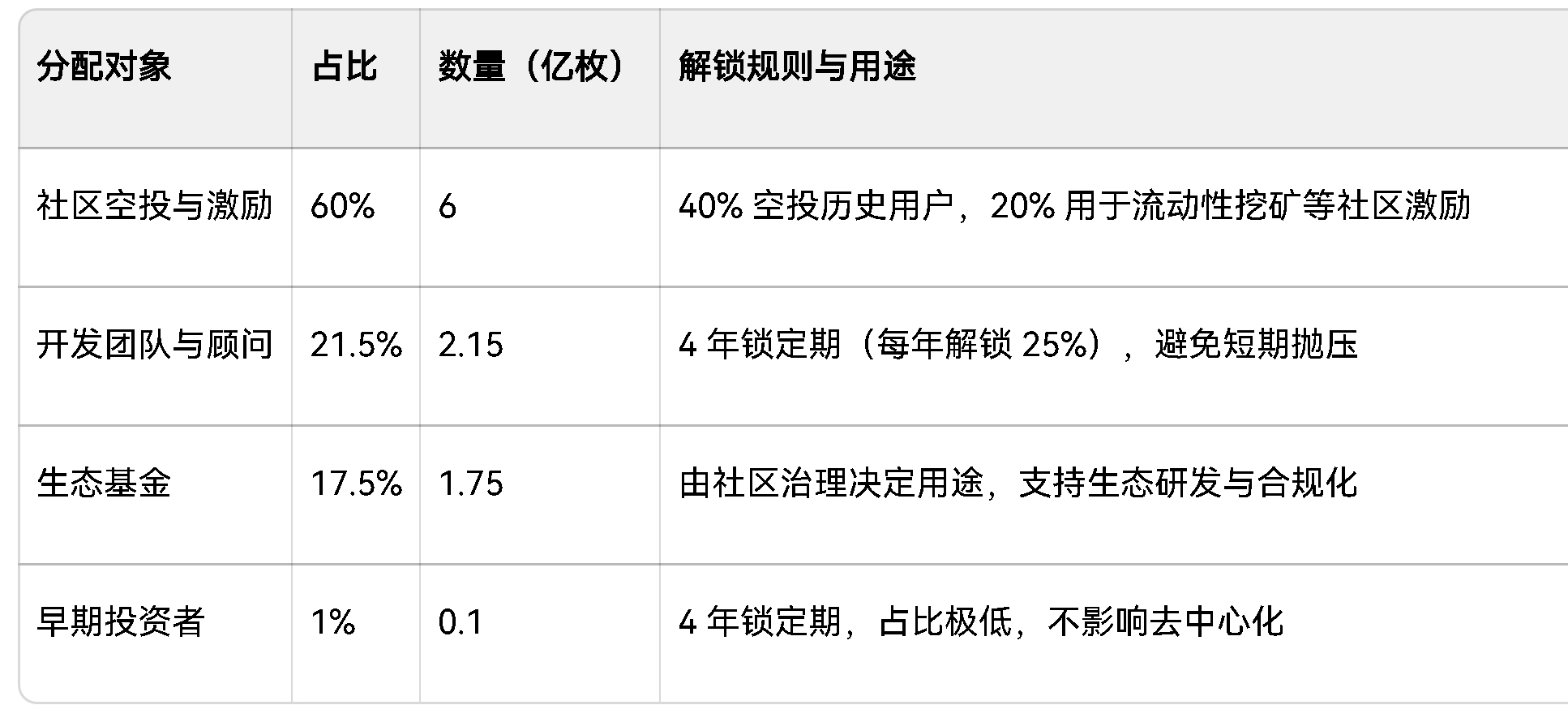
2. Economic Model Iteration (Fee Switch and Destruction Mechanism)
By the end of 2025, Uniswap governance, through the 'UNIfication' proposal, will activate key economic reforms to address the previous issue of 'disconnection between protocol value and token':
- Protocol Fee Capture: A portion of Ethereum mainnet V2/V3 protocol-level fees (originally allocated entirely to LPs) is redirected to the 'TokenJar' treasury, along with Unichain sequencer fees (after deducting costs), with an annual fee scale of approximately 26 million dollars.
- UNI Destruction Mechanism: Treasury funds are only used to destroy UNI through the 'Firepit' smart contract. As of January 2026, the total destruction amount has reached 100.17 million (accounting for 10.1% of the initial total), with an annual destruction rate of approximately 4 to 5 million, transitioning UNI from an 'inflationary governance token' to a 'deflationary value accumulation asset.'
- Retroactive Adjustments: A one-time destruction of 100 million UNI from the treasury to compensate for the rights gap of past token holders who did not participate in fee distribution.
3. Token Functions
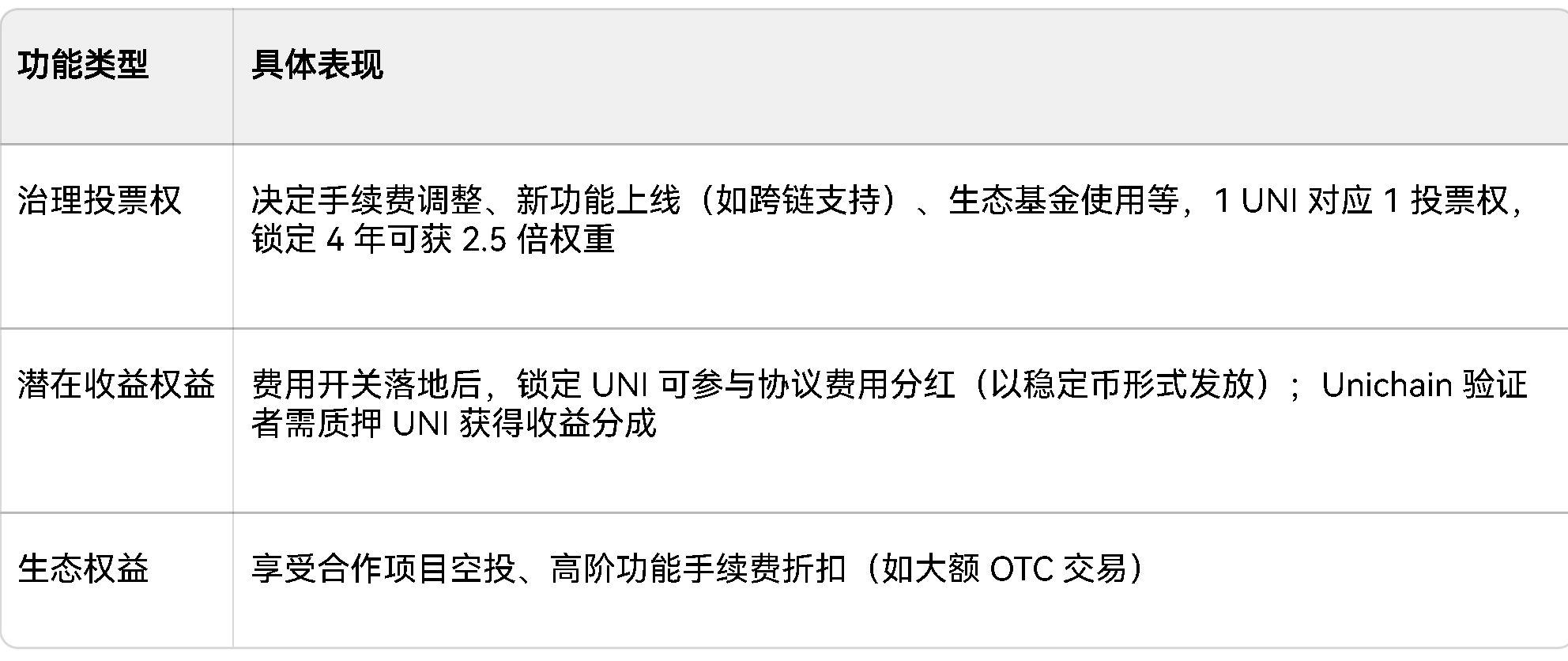
3. Core Technology and Product Iteration
1. Key Version Upgrades: Evolution from V1 to V4
The core goal of Uniswap's version iteration is to enhance capital efficiency, reduce costs, and improve scalability. The key differences between versions are as follows:
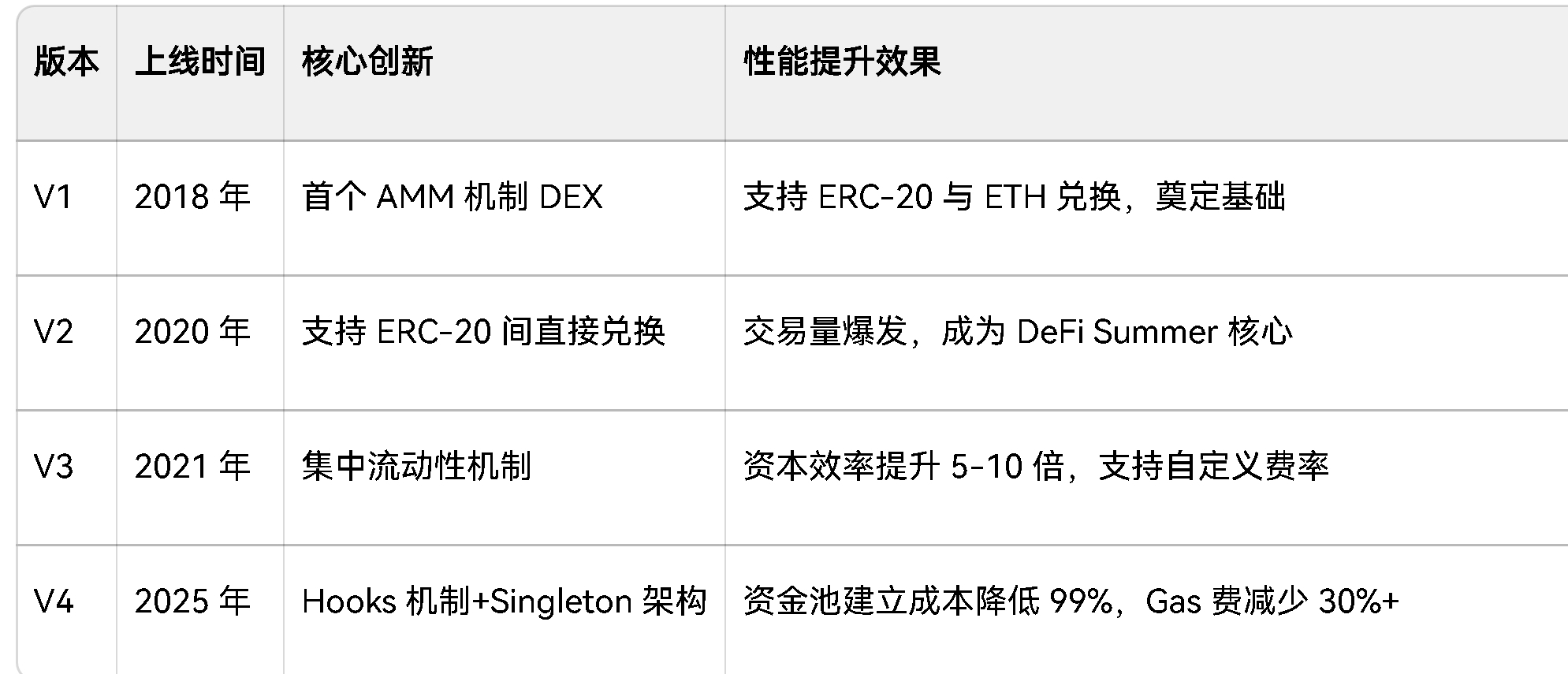
2. V4 Core Innovations: Hooks Mechanism and Singleton Architecture
- Hooks Mechanism: Allows developers to inject custom logic at 14 trigger points during the liquidity pool lifecycle (initialization, trading, adding/removing liquidity, donations), supporting dynamic rates (increasing LP rewards during high volatility), on-chain limit orders, time-weighted average market making (TWAMM), etc., upgrading Uniswap from an 'exchange' to a 'scalable financial framework.'
- Singleton Architecture: Integrates all liquidity pools into a single PoolManager contract, avoiding cross-contract asset transfers during multi-pool trading, reducing multi-hop trading gas fees by over 30%, while using EIP-1153 transient storage to settle the net balance only at the end of transactions, further optimizing costs.
3. Layer 2 Layout: Unichain
In February 2025, Uniswap launched the Layer 2 network Unichain based on Optimism OP Stack, with core values including:
- Cost Advantage: Trading gas fees are only 1/50 to 1/100 of Ethereum's mainnet, supporting high-frequency small transactions.
- Revenue Closure: 65% of net chain revenue (base fees + priority fees + MEV) is allocated to validators according to UNI staking weight, creating a scenario for increased 'staking rewards' for UNI.
- Cross-chain Liquidity: Enabling asset interoperability with Ethereum mainnet, Arbitrum, Optimism, and other networks to solve the issue of fragmented liquidity.
4. Market and Competitive Landscape
1. Core Operational Data (2025-2026)
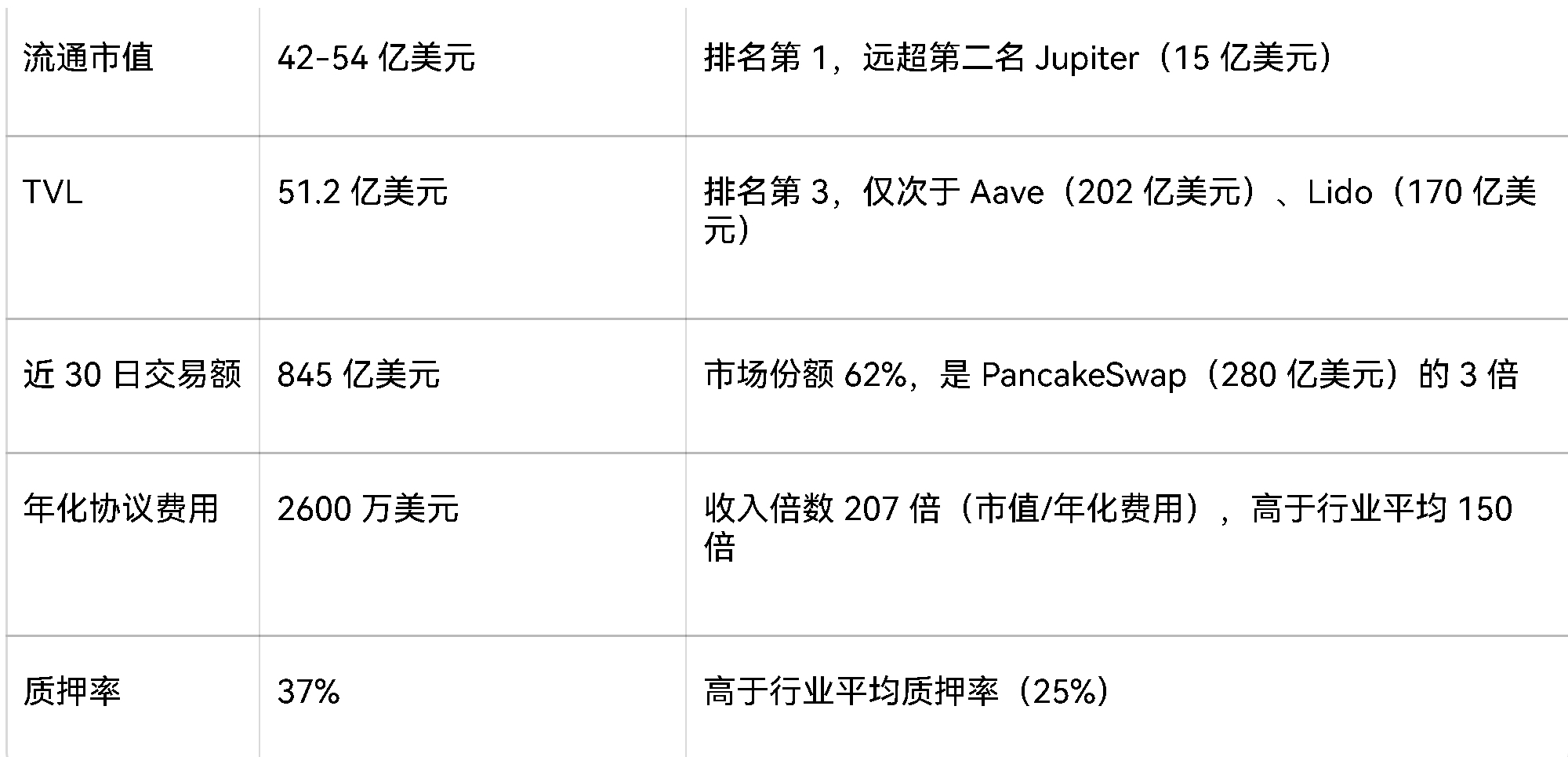
2. Competitive Advantages and Challenges
Competitive Advantages
- Liquidity Moat: Long-term dominance of over 60% of the DEX market share, with deep liquidity attracting more traders and LPs, forming a positive cycle of 'liquidity-users.'
- Technical Barriers: The V4 Hooks mechanism and Unichain create technical barriers, with the ecosystem of third-party developers (over 500 custom Hooks applications) far exceeding competitors.
- Regulatory Compliance Progress: In 2025, the SEC terminated its investigation into Uniswap Labs, becoming the first major DEX to receive 'substantive loosening' of U.S. regulation, laying the foundation for subsequent compliance expansion.
Facing Challenges
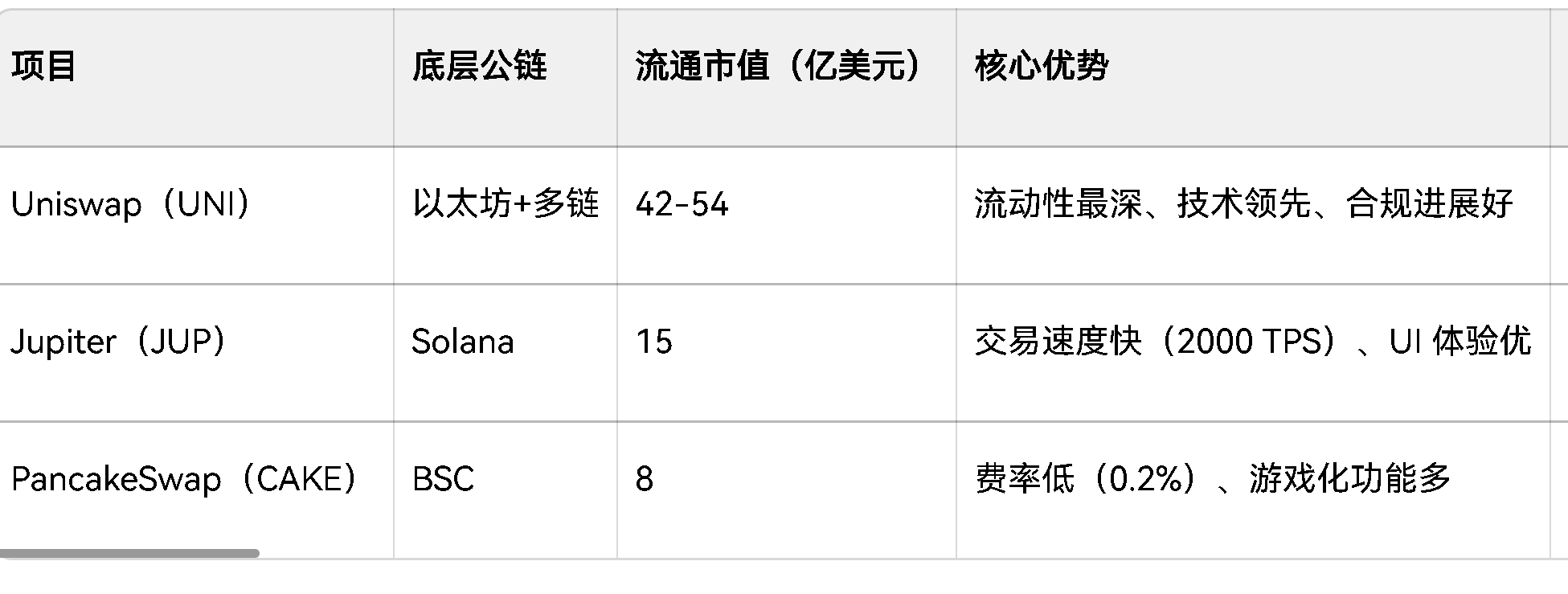
- Multi-chain Competitive Pressure: The Solana ecosystem's Jupiter (with fast transactions) and the BSC ecosystem's PancakeSwap (low fees + gamification) are diverting some users, and multi-chain deployment is causing liquidity dispersal.
- Smart Contract Risks: The V4 Hooks mechanism increases code complexity. Despite being audited through a million-dollar bug bounty program, potential security risks still exist (e.g., malicious Hooks contract attacks).
- Limitations in Token Value Capture: The current annual destruction rate (0.4%) is still relatively low compared to market value. The fee distribution mechanism has not been fully implemented, and the correlation between token price and protocol income needs to be strengthened.
3. Major Competitor Comparisons
5. Risk Analysis
1. Regulatory Risks
- Uncertainty in U.S. Regulatory Policies: Although the SEC will terminate its investigation in 2025, the new government after the 2026 U.S. elections may adjust the crypto regulatory framework. If UNI is redefined as a 'security,' it will affect its trading and circulation.
- Global Compliance Differences: EU MiCA regulations and restrictions on DEX in some Asian countries may limit Uniswap's overseas market expansion.
2. Technical Risks
- V4 Hooks Security Risks: Custom logic may be exploited to initiate attacks. Historically, DeFi protocols have suffered losses due to smart contract vulnerabilities averaging over 50 million dollars per incident.
- Layer 2 Ecosystem Risks: Unichain relies on Optimism OP Stack; if underlying architecture encounters issues, it will affect asset security and trading stability.
3. Market and Operational Risks
- Liquidity Dispersal: Multi-chain deployment (Ethereum, Arbitrum, Base, etc.) leads to a decrease in single-chain TVL. If a better competitor emerges on any chain, it may trigger liquidity migration.
- Governance Efficiency Issues: Uniswap DAO voting participation has been low for a long time (averaging 15%). While the 'Treasury Delegation Program' has raised participation to 80%, it has also sparked controversy over governance power being concentrated in 12 representatives.
\u003cc-58/\u003e
