
People are really buzzing about. Dusk's privacy features, the zero-knowledge proofs, the confidential smart contracts. All technically interesting. But there's something happening that feels more significant for actual adoption, and it's getting almost no attention.
The integration of EURQ as settlement currency.
Not as optional stablecoin support. As primary settlement infrastructure.
That distinction changes what Dusk actually is.
Why Settlement Currency Isn't Just Another Feature🏗️
Most crypto projects treat stablecoins as UX improvement. Easier for users to think in dollars or euros than volatile tokens. Fair enough.
But when I look at how Dusk is positioning EURQ, it reads differently. They're not adding it as convenience. They're building it as foundational settlement layer.
The difference matters because of who this serves.
Regulated securities can't settle in assets that swing 15% in a day. They need recognized monetary equivalents that auditors, tax authorities, and compliance teams accept as legitimate settlement. Fiat-backed digital currency that carries the legal weight of actual money.
If you're tokenizing bonds, equity, or structured products, you can't denominate them in DUSK and expect institutions to participate. The volatility alone kills it. But EURQ? That's something a corporate treasurer can justify to their CFO.
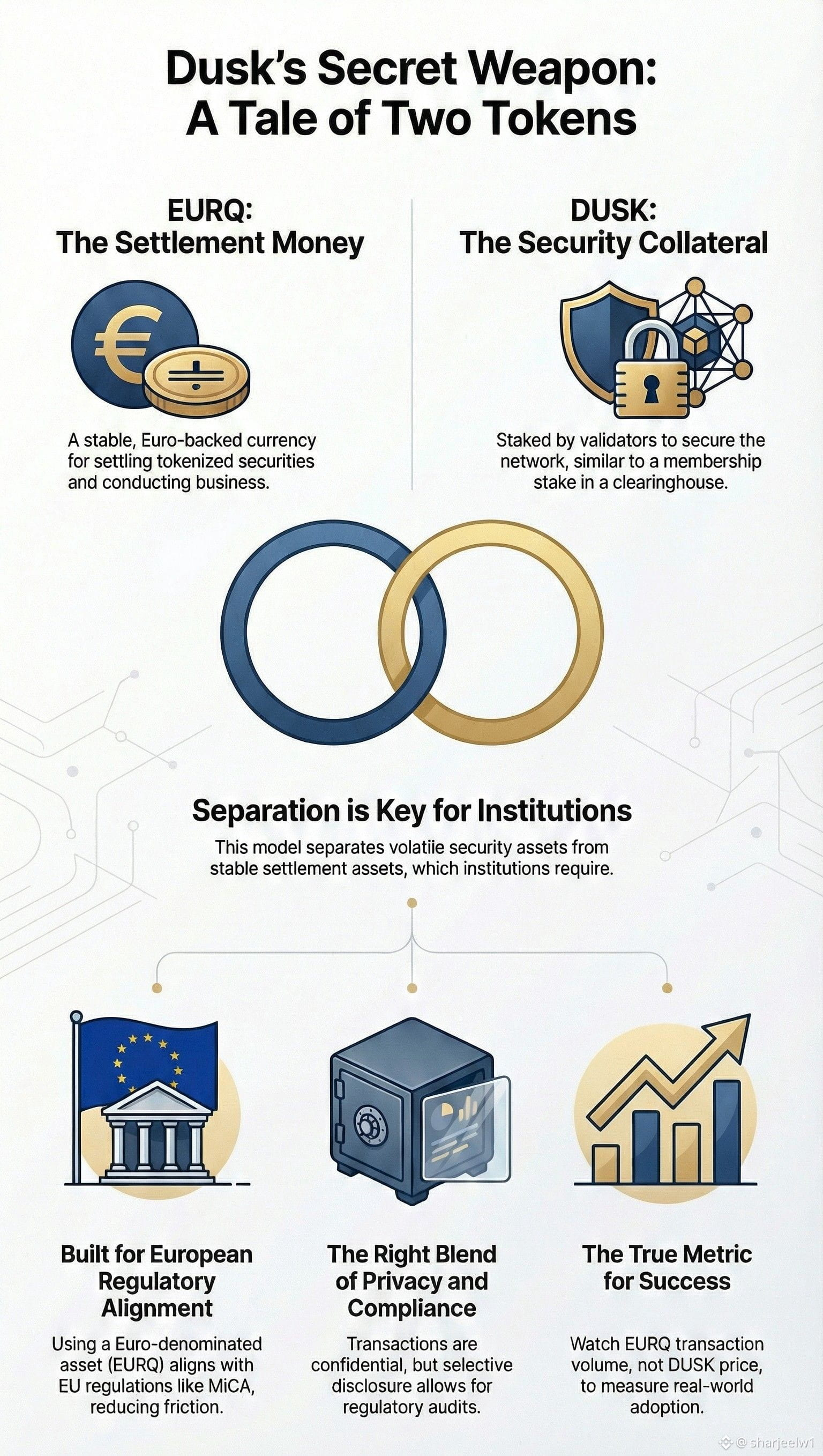
Settlement happens in something stable. Network security happens in DUSK.
Those are different roles serving different functions.
What This Means for the Token 🪙
Here's where it gets interesting for DUSK holders, though not in the way most expect.
If EURQ becomes the primary transactional currency on Dusk—the thing securities settle in, the medium of exchange for actual commercial activity—then DUSK stops being a currency token. It becomes infrastructure collateral.
You stake DUSK to validate. You pay gas in DUSK for transaction inclusion. But you don't conduct business in DUSK.
It's closer to how traditional clearinghouses work. The clearinghouse operates in fiat. But to participate, you post collateral—margin, security deposits, membership stakes. That collateral proves you're serious, aligned with system integrity, committed to not misbehaving.
DUSK as validator collateral. EURQ as settlement money.
That creates a specific value proposition: DUSK value ties to network security demand, not transaction volume in the traditional sense. More validators need more stake. Higher security budgets require deeper collateral.
But if most transactional volume happens in EURQ, then DUSK velocity could stay relatively low even as network usage grows substantially.
For speculators expecting token price to track transaction count directly, that's uncomfortable. For institutions evaluating infrastructure, it's cleaner. Separate the security layer from the settlement layer.
Why European Institutions Might Actually Care 🇪🇺
The focus on EURQ specifically—not USDC, not USDT, but tokenized euros—signals geographic strategy.
Europe is moving faster than most regions on digital asset regulation. MiCA framework, sandbox programs, licensed tokenization venues. Regulatory clarity is higher there than in many other major markets.
Dusk is Dutch. NPEX is licensed in the Netherlands. EURQ is euro-denominated.
This isn't coincidence. It's alignment with where the regulatory environment is most developed for what Dusk wants to enable.
If you're a European asset manager, corporate treasurer, or institutional issuer exploring on-chain settlement, you're already operating under European regulations. Having settlement infrastructure that matches your regulatory jurisdiction—euro-denominated, compliant with European frameworks—reduces friction.
You're not crossing currency risk. Not navigating multi-jurisdictional compliance. Not explaining to auditors why you're settling in USD when your books are in EUR.
EURQ on Dusk creates a natural fit for European institutional adoption. Not because the technology is better, but because the regulatory and operational alignment is tighter.
The Custody and Auditability Angle 🛡️
One aspect that stood out reading about EURQ integration: the auditability model.
Traditional stablecoins have transparency problems. Reserves held off-chain, periodic attestations, trust in issuers. Institutions don't love that model but accept it because alternatives are worse.
EURQ as integrated settlement currency on a privacy-preserving chain creates a different structure. Settlements are confidential by default. But with selective disclosure, authorized auditors can verify specific transactions without seeing everything.
That's closer to how traditional finance actually operates. Your bank doesn't publish your account balance. But if regulators audit the bank, they can verify your account exists, balances correctly, follows rules.
Privacy for participants. Auditability for oversight.
If that model works, it solves a problem institutions have with both transparent blockchains (too much information leakage) and pure privacy coins (not enough compliance pathway).
EURQ gives them settlement in a recognized currency. Dusk gives them confidentiality in execution. Selective disclosure gives regulators what they need without exposing commercial strategy.
Whether that satisfies regulators at scale is still untested. But the structure at least attempts to thread the needle.
What This Doesn't Solve 🤷
EURQ integration doesn't fix adoption timelines. Institutions still move slowly. Regulatory clarity still evolves gradually. Network effects still take years to compound.
And there's a dependency: if EURQ doesn't achieve sufficient liquidity and acceptance, then Dusk's settlement layer remains theoretical. You can't settle securities in a currency nobody recognizes or can't easily convert.
The issuer behind EURQ, their reserves, their regulatory standing—all of that becomes critical infrastructure dependency for Dusk. If that relationship breaks or credibility erodes, the whole settlement model wobbles.
That's risk concentration Dusk doesn't fully control.
The Longer Timeline This Implies ⏳
If Dusk is building around EURQ as settlement infrastructure, they're committing to a multi-year adoption curve.
You don't integrate settlement currency for quick retail wins. You do it because you're betting institutions will eventually move meaningful capital on-chain, and when they do, they'll need:
Regulatory-compliant settlement rails
Confidential execution that protects proprietary information
Recognized monetary instruments (fiat-backed stablecoins)
Selective auditability for oversight
All of which takes time to prove, test, and scale.
For token holders expecting near-term catalysts, this is frustrating. Settlement infrastructure doesn't generate hype. It generates slow, compounding trust.
But if the bet is right—if tokenized securities become standard infrastructure—then having settlement rails ready before demand arrives positions Dusk well.
Building the plumbing before the building goes up.
What Actually Signals Progress 🌱
The metric I'd watch isn't DUSK price action. It's EURQ transaction volume on Dusk mainnet.
If EURQ settles a meaningful number of security transfers, bond coupons, equity dividends—even in pilot programs—that validates the model. It means institutions tested it, compliance approved it, and capital moved through it.
If EURQ integration happens but sees minimal usage, then it's infrastructure without demand. Which is fine for the long term, but signals adoption is still distant.
Settlement volume in EURQ is the ground truth. Everything else is speculation about future potential.
The technology can be perfect. The regulatory alignment can be ideal. But if capital doesn't flow through it, it remains potential rather than reality.
Dusk building for that reality seems clear. Whether the reality arrives is the question.