

The value and relevance of any blockchain’s native token are determined not by speculation alone, but by how deeply it is woven into the daily functioning and long-term vision of the network. XPL is designed with a dynamic utility model that evolves alongside Plasma itself. Rather than remaining a simple gas token, XPL is structured to grow into the central coordinating asset of a full financial ecosystem. This evolution can be understood as a gradual shift from technical necessity to economic signal and finally to sovereign governance power. From its earliest days securing transactions, to becoming a proxy for adoption, and ultimately transforming into the backbone of a decentralized financial protocol, XPL’s demand story is one of progressive expansion in scope and importance.
At launch, XPL serves as the operational engine of the Plasma network. Every blockchain requires a native asset to measure and pay for computation, and for Plasma this role belongs to XPL. While the protocol introduces a paymaster system that enables zero-fee USDT transfers for users, this abstraction does not remove the need for fees at the protocol level. Instead, it shifts them behind the scenes. Complex interactions such as smart contract deployment, decentralized finance activity, asset trading, and advanced application usage still require gas paid in XPL. This creates an immediate and unavoidable baseline demand driven by developers, applications, and power users who interact with Plasma beyond simple transfers. In this early stage, XPL is not optional; it is the fuel that allows the machine to run.
Security further anchors XPL’s foundational role. Plasma’s consensus mechanism depends on validators staking XPL to participate in block production and network verification. This staking requirement links the economic value of XPL directly to the security of the chain. The more valuable the network becomes, the more valuable and widely distributed XPL must be to maintain decentralization and resist attacks. Validators are economically incentivized to act honestly because their staked XPL is at risk if they behave maliciously. This transforms XPL into a security bond for the entire ecosystem. Its value is no longer abstract; it represents real economic weight protecting user funds and transaction integrity.
In addition to validators, payment agents responsible for sponsoring zero-fee transactions must also stake XPL. These agents enable Plasma’s core user experience: frictionless stablecoin transfers. Their requirement to lock XPL introduces another structural demand sink tied directly to transaction volume. As more users send USDT across Plasma, more payment agents are needed, and more XPL must be committed as collateral. This relationship connects everyday network usage to token demand in a measurable way. Even in its earliest phase, XPL’s relevance extends beyond speculation and into operational necessity.
As Plasma grows beyond its launch stage, the nature of XPL demand begins to shift. It becomes not just a functional tool, but a proxy for network adoption and confidence. The emergence of staking rewards transforms XPL into an income-generating asset for participants who believe in the long-term success of the network. Delegators who stake their tokens signal trust in Plasma’s security and future activity. This demand is fundamentally different from transactional demand because it reflects long-term alignment rather than short-term usage. People are no longer holding XPL simply because they need it for gas, but because they expect the ecosystem to grow and want to share in that growth.
At the same time, the node operator economy becomes a visible indicator of Plasma’s health. Payment agents and validators operate in competitive conditions. If running a node is profitable, it suggests that transaction volume is sufficient to sustain infrastructure providers. This profitability attracts more operators, which in turn requires more XPL to be staked. The growth of node participation becomes a mirror of geographical expansion and real-world usage. Instead of relying on marketing metrics, one can observe XPL staking activity to understand whether Plasma is achieving organic adoption.
During this middle phase, XPL’s value increasingly reflects future expectations rather than present necessity alone. Markets begin to price in potential growth of transaction volume, DeFi activity, and cross-chain liquidity flows. The token evolves into a financial signal representing Plasma’s trajectory. It still retains its technical utility, but now carries an additional layer of economic meaning. This is the phase where XPL transitions from being purely infrastructural to being an investment in the network’s success.
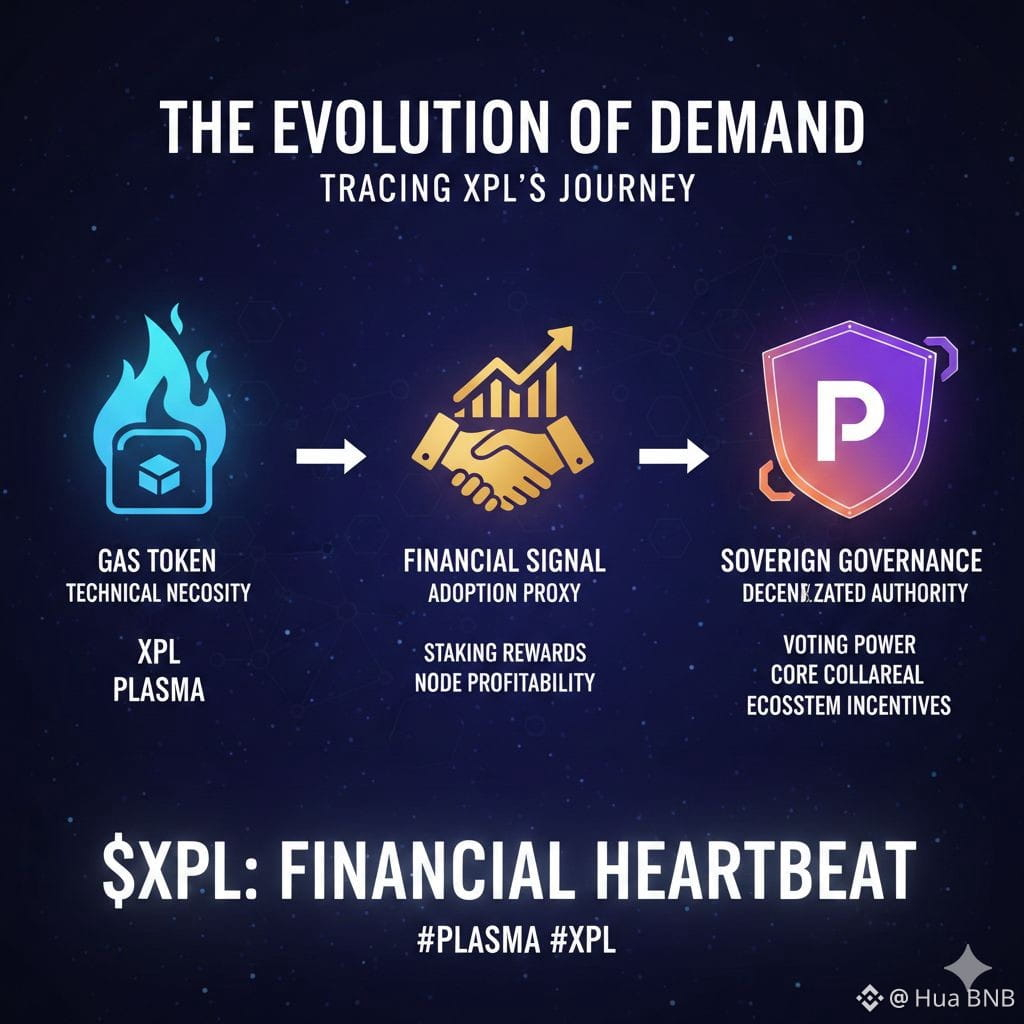
In its mature stage, Plasma aims to function not merely as a settlement layer for stablecoins, but as an open financial protocol. At this point, XPL’s role undergoes its most profound transformation. It becomes the governance and coordination asset of an entire digital economy. Token holders gain the ability to vote on parameters that shape how the network operates financially. These decisions may include risk settings for lending markets, approval of new asset types such as real-world assets, allocation of treasury funds for ecosystem development, and adjustments to incentive structures that guide user behavior. Governance gives XPL holders influence over the rules of a global settlement system, elevating the token from utility instrument to political and economic authority within the protocol.
This stage also introduces XPL as a core collateral asset within Plasma’s own decentralized finance environment. As applications mature, XPL can be used to secure loans, mint synthetic assets, and backstop insurance mechanisms. Its deep integration makes it a natural choice for financial primitives built on Plasma. When a token becomes both the governance key and the preferred collateral, its demand profile expands significantly. It is no longer needed only to operate the network, but also to participate in its financial architecture.
Ecosystem incentivization further strengthens this role. XPL serves as the reward token for liquidity mining programs, security staking for specific applications, and bootstrap mechanisms for new financial products. These incentives align developers, users, and infrastructure providers around a common asset. Instead of fragmenting value across many tokens, Plasma concentrates economic gravity in XPL. This concentration creates a reinforcing loop: more applications increase the usefulness of XPL, which attracts more holders, which strengthens governance and security, which in turn makes the network more attractive for new projects.
In this final phase, demand for XPL is driven primarily by sovereignty rather than consumption. Holding XPL becomes analogous to holding a share in the decision-making power of a financial network. Its value accrues not from paying fees, but from governing rules, directing capital, and benefiting from the total economic activity conducted on Plasma. The token becomes the heartbeat of the ecosystem, coordinating incentives and aligning interests across participants.
What makes this evolution particularly powerful is its continuity. Each phase builds on the previous one rather than replacing it. XPL never loses its role as gas or security collateral; it simply gains additional layers of meaning and utility over time. This layered design allows demand to diversify across multiple drivers: operational necessity, economic participation, and governance authority. Such diversification reduces reliance on a single use case and creates resilience against shifts in market conditions.
Ultimately, XPL’s journey reflects Plasma’s ambition to grow from a technical infrastructure into a financial institution without borders. In the beginning, XPL is the tool that keeps the system running. In the growth phase, it becomes the signal of adoption and confidence. In maturity, it transforms into the key that unlocks influence over a decentralized economy. This path charts a progression from function to finance to sovereignty, positioning XPL not merely as a token, but as the core asset of a new financial marketplace. Its demand is designed to scale with Plasma’s vision, making it not just a participant in the network, but the very expression of its economic life.

