



I’ve been following $XPL prices pretty closely since I first got some during the beta phase last September, and with early February 2026 here, all these new price predictions from sites like CoinCodex, Bitget, and MEXC have me rethinking my small stack. I remember the launch hype—XPL spiked hard after the airdrop, where even $1 contributors got thousands of tokens worth over $10k at one point. I didn’t get in that early, but I swapped some USDT for XPL in October when it dipped below $0.10, thinking the stablecoin focus would pay off long-term. Now, with the market still choppy and fear high, these forecasts are giving me mixed feelings—optimistic upside but realistic short-term pain.
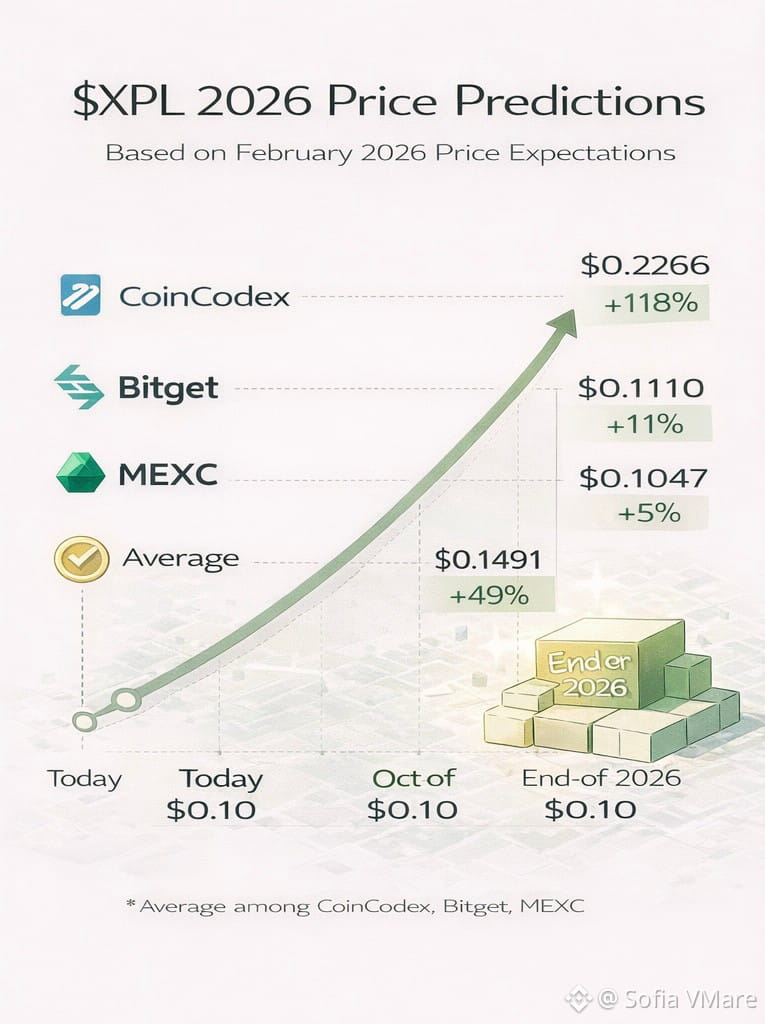
CoinCodex is calling for XPL to hit $0.2266 by year-end 2026, a 118% jump from today’s ~$0.10 levels. They see it climbing to $0.2429 by 2030, and even $0.6943 by 2040. I like their model because it factors in recent integrations like NEAR Intents (Jan 23), which I tested and found super smooth for cross-chain USDT moves. But their short-term view is cautious—dipping to $0.0794 by early February, which matches the post-unlock dip we saw after Jan 25 (88.89M tokens released, ~$11M value). I felt that one—my position dropped 5-7% that week, but I held because the merchant tools (Confirmo, MassPay) seem to be pulling real volume.
Bitget’s predictions are a bit more conservative: $0.1089 by end of February (up 0.42% monthly), reaching $0.1110 for all of 2026, then $0.1165 in 2027 and $0.1349 by 2030. Their tool emphasizes steady growth tied to utility, which resonates with me. I’ve used gasless USDT sends multiple times for small remittances to family, and the sub-second finality makes it feel like normal money. If merchant adoption keeps up ($80M monthly through Confirmo alone), that could support their gradual uptick. But I wonder if they’re underestimating the PoS delegation rollout in Q2—once staking opens, rewards could draw more holders, boosting demand beyond their estimates.
MEXC’s outlook is similar: $0.1051 by March, $0.1108 by July, and $0.1047 end-2026 with 0% growth. Wait, that seems off—their daily predictions show slight ups like $0.1048 by Feb 10, but overall flat. I checked their site after a friend mentioned it, and it feels like they’re basing it on current sentiment (Fear & Greed at extreme fear). Personally, I’ve seen XPL bounce back from dips when news hits—like the NEAR integration pushed a 4% daily gain briefly. If more partners follow (maybe deeper Tether ties or Founders Fund announcements), their flatline could underestimate.
RootData’s unlock calendar has me cautious too—next one Feb 28 (another 88M XPL, ~$9M), then monthly drips. I timed my buy after Jan’s unlock, and it worked okay, but repeated supply pressure could cap gains unless utility absorbs it. On the flip side, Phemex’s old news from July 2025 about the sale being 211% oversubscribed reminds me of the early demand—community FOMO drove that, and if staking yields hit community estimates (8-15%), it could return.
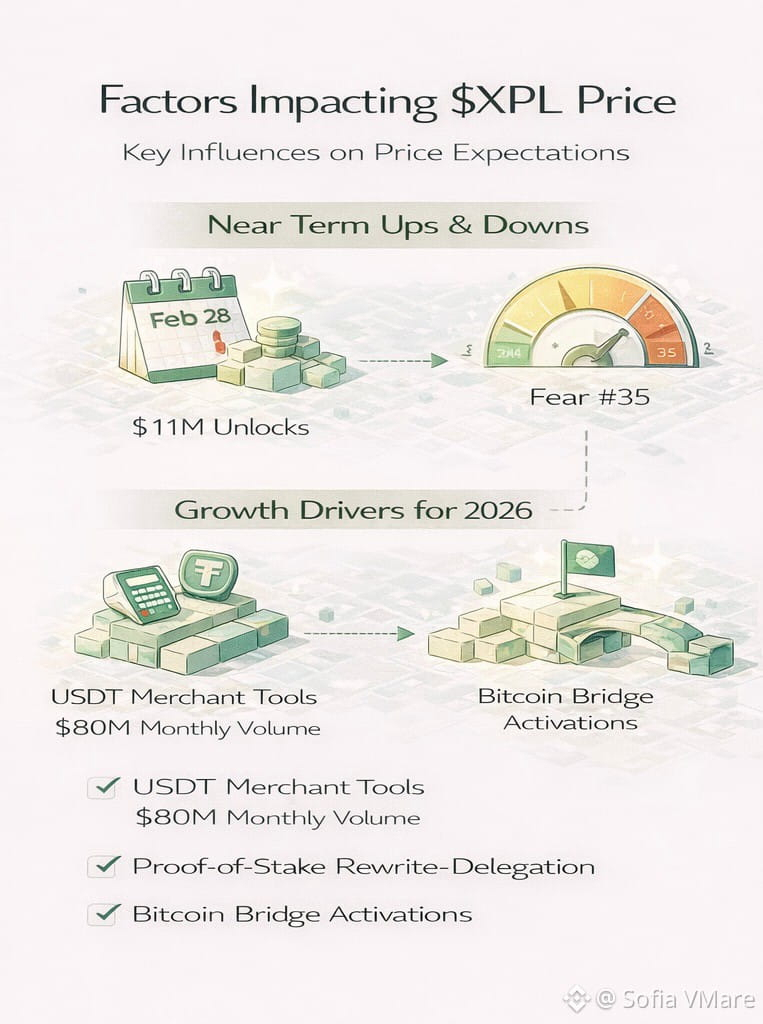
Overall, these predictions average out to modest 10-20% yearly growth, with big jumps long-term (100-500% by 2030-40). That matches what I’ve experienced: XPL isn’t a moonshot meme; it’s a slow builder. My small position is up 15% from entry despite dips, thanks to lending yields (4-6% APY on USDT pools). If the roadmap delivers privacy layers (Plasma One mid-2026) or BTC bridge, upside could exceed forecasts. But short-term, with market fear and unlocks, I’m not adding more yet—holding and earning yield instead.
These tools (CoinCodex, Bitget, MEXC) are helpful for gut checks, but I’ve learned to pair them with actual use: gasless sends, merchant payouts, cross-chain tests. That’s where real value comes from, not just charts.
What predictions are you following for XPL? Do you think they’ll beat or miss?